Moleculaire Biologie en Planten en Micro-organismen
Campbell H11
11.1 Photosynthesis feeds the biosphere
The conversion process that transforms the energy of sunlight into chemical energy stored in sugars
and other organic molecules is called photosynthesis.
- Autotrophs are ‘’self-feeders’’; they sustain themselves without eating anything derived
from other living beings. Autotrophs produce their organic molecules from CO2 and other
inorganic raw materials obtained from the environment.
- Heterotrophs are unable to make their own food; they live on compounds produced by
other organisms. Heterotrophs are the consumer and autotrophs are the producers.
11.2 Photosynthesis converts light energy to the chemical energy or food
Photosynthetic enzymes and other molecules are grouped together as specialized molecular
complexes in a biological membrane, enabling the necessary series of chemical reactions to be
carried out efficiently. The process of photosynthesis most likely originated in a group of bacteria
that had infolded regions of the plasma membrane containing clusters of such molecules. In existing
photosynthetic bacteria, infolded photosynthetic membranes function similarly to the internal
membranes of the chloroplast, the eukaryotic organelle that absorbs energy from sunlight and uses
it to drive the synthesis of organic compounds from CO2
and water.
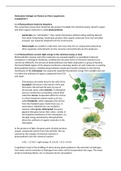
- Chloroplasts are mainly found in the cells of the
mesophyll, the tissue in the interior of the leaf.
CO2 enters the leaf and O2 exits, by way of
microscopic pores called stomata. A chloroplast
has two membranes surrounding a dense fluid
called the stroma. Suspended within the stroma
is a third membrane system made up of sacs
called thylakoids, which segregates the stroma
from the thylakoid space inside these sacs. In
some places, thylakoid sacs are stacked in
columns called grana. Chlorophyll, the green
pigment that gives leaves their colour, resides in
the thylakoid membranes of the chloroplasts. It is
the light energy absorbed by chlorophyll that
drives the synthesis of organic molecules in the
chloroplast.
In the presence of light, the green parts of plants produce
organic compounds and O2 from CO2 and H2O. We can
summarize the complex of chemical reactions in
photosynthesis with this chemical reaction:
- 6 CO2 + 12 H2O + Light energy C6H12O6 + 6 O2 + 6 H2O
A significant result of the shuffling of atoms during photosynthesis is the extraction of hydrogen
from water and its extraction of hydrogen from water and its incorporation into sugar. The waste
product of photosynthesis, O2, is released into the atmosphere.
, Let’s briefly compare photosynthesis with cellular respiration. Both processes involve redox
reactions. During cellular respiration, energy is released from sugar when electrons associated with
hydrogen are transported by carriers to oxygen, forming water as a by-product. The electrons lose
potential energy as they ‘’fall’’ down the electron chain towards the electronegative oxygen, and the
mitochondrion harness that energy to synthesize ATP. Photosynthesis reverses the direction of
electron flow. Water is split, and its electrons are transferred along with hydrogen ions from the
water to carbon dioxide reducing it to sugar. Because the electrons increase in potential energy as
they move from water to sugar, this process requires energy – in other words, it is endergonic. This
energy boost that occurs during photosynthesis is provided by light.
Photosynthesis is not a single process, but two processes, each of which has multiple steps. These
two stages of photosynthesis are known as the light reactions and the Calvin cycle.
- The light reactions are the steps of photosynthesis that convert solar energy to chemical
energy. Water is split, providing a source of electrons and protons and giving off O2 as a by-
product. Light absorbed by chlorophyll drives a transfer of the electrons and hydrogen ions
from water to an acceptor called NADP+, where they are temporarily stored, only differing
from NAD+ by an extra phosphate group). The light reactions use solar energy to reduce
NADP+ to NADPH by adding a pair of electrons along with H+. The light reactions also
generate ATP, using chemiosmosis to power the addition of a phosphate group to ADP, a
process called photophosphorylation. Thus, light energy is initially converted into chemical
energy in the form of two compounds: NADPH and ATP.
- The Calvin cycle begins by incorporating CO2 from the air into organic molecules already
present in the chloroplast. This initial incorporation of carbon into organic compounds is
known as carbon fixation. The Calvin cycle then reduces the fixed carbon to carbohydrate by
the addition of electrons. The reducing
power is provided by NADPH, which
acquired its cargo of electrons in the light
reactions. To convert CO2 to
carbohydrate, the Calvin cycle also
requires chemical energy in the form of
ATP, which is also generated by the light
reactions. Thus, it is the Calvin cycle that
makes sugar, but it can do only so with
the help of NADPH and ATP produced by
the light reactions.
11.3 The light reactions convert solar energy to
the chemical energy of ATP
Campbell H11
11.1 Photosynthesis feeds the biosphere
The conversion process that transforms the energy of sunlight into chemical energy stored in sugars
and other organic molecules is called photosynthesis.
- Autotrophs are ‘’self-feeders’’; they sustain themselves without eating anything derived
from other living beings. Autotrophs produce their organic molecules from CO2 and other
inorganic raw materials obtained from the environment.
- Heterotrophs are unable to make their own food; they live on compounds produced by
other organisms. Heterotrophs are the consumer and autotrophs are the producers.
11.2 Photosynthesis converts light energy to the chemical energy or food
Photosynthetic enzymes and other molecules are grouped together as specialized molecular
complexes in a biological membrane, enabling the necessary series of chemical reactions to be
carried out efficiently. The process of photosynthesis most likely originated in a group of bacteria
that had infolded regions of the plasma membrane containing clusters of such molecules. In existing
photosynthetic bacteria, infolded photosynthetic membranes function similarly to the internal
membranes of the chloroplast, the eukaryotic organelle that absorbs energy from sunlight and uses
it to drive the synthesis of organic compounds from CO2
and water.
- Chloroplasts are mainly found in the cells of the
mesophyll, the tissue in the interior of the leaf.
CO2 enters the leaf and O2 exits, by way of
microscopic pores called stomata. A chloroplast
has two membranes surrounding a dense fluid
called the stroma. Suspended within the stroma
is a third membrane system made up of sacs
called thylakoids, which segregates the stroma
from the thylakoid space inside these sacs. In
some places, thylakoid sacs are stacked in
columns called grana. Chlorophyll, the green
pigment that gives leaves their colour, resides in
the thylakoid membranes of the chloroplasts. It is
the light energy absorbed by chlorophyll that
drives the synthesis of organic molecules in the
chloroplast.
In the presence of light, the green parts of plants produce
organic compounds and O2 from CO2 and H2O. We can
summarize the complex of chemical reactions in
photosynthesis with this chemical reaction:
- 6 CO2 + 12 H2O + Light energy C6H12O6 + 6 O2 + 6 H2O
A significant result of the shuffling of atoms during photosynthesis is the extraction of hydrogen
from water and its extraction of hydrogen from water and its incorporation into sugar. The waste
product of photosynthesis, O2, is released into the atmosphere.
, Let’s briefly compare photosynthesis with cellular respiration. Both processes involve redox
reactions. During cellular respiration, energy is released from sugar when electrons associated with
hydrogen are transported by carriers to oxygen, forming water as a by-product. The electrons lose
potential energy as they ‘’fall’’ down the electron chain towards the electronegative oxygen, and the
mitochondrion harness that energy to synthesize ATP. Photosynthesis reverses the direction of
electron flow. Water is split, and its electrons are transferred along with hydrogen ions from the
water to carbon dioxide reducing it to sugar. Because the electrons increase in potential energy as
they move from water to sugar, this process requires energy – in other words, it is endergonic. This
energy boost that occurs during photosynthesis is provided by light.
Photosynthesis is not a single process, but two processes, each of which has multiple steps. These
two stages of photosynthesis are known as the light reactions and the Calvin cycle.
- The light reactions are the steps of photosynthesis that convert solar energy to chemical
energy. Water is split, providing a source of electrons and protons and giving off O2 as a by-
product. Light absorbed by chlorophyll drives a transfer of the electrons and hydrogen ions
from water to an acceptor called NADP+, where they are temporarily stored, only differing
from NAD+ by an extra phosphate group). The light reactions use solar energy to reduce
NADP+ to NADPH by adding a pair of electrons along with H+. The light reactions also
generate ATP, using chemiosmosis to power the addition of a phosphate group to ADP, a
process called photophosphorylation. Thus, light energy is initially converted into chemical
energy in the form of two compounds: NADPH and ATP.
- The Calvin cycle begins by incorporating CO2 from the air into organic molecules already
present in the chloroplast. This initial incorporation of carbon into organic compounds is
known as carbon fixation. The Calvin cycle then reduces the fixed carbon to carbohydrate by
the addition of electrons. The reducing
power is provided by NADPH, which
acquired its cargo of electrons in the light
reactions. To convert CO2 to
carbohydrate, the Calvin cycle also
requires chemical energy in the form of
ATP, which is also generated by the light
reactions. Thus, it is the Calvin cycle that
makes sugar, but it can do only so with
the help of NADPH and ATP produced by
the light reactions.
11.3 The light reactions convert solar energy to
the chemical energy of ATP