MCB 2289 Microbiology final exam ..New
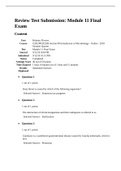
Review Test Submission: Module 11 Final Exam Content User Brittany Flowers Course G282/MCB2289 Section 08 Introduction to Microbiology - Online - 2018 Summer Quarter Test Module 11 Final Exam Started 9/12/18 9:06 PM Submitted 9/12/18 10:15 PM Status Completed Attempt Score 46 out of 50 points Time Elapsed 1 hour, 8 minutes out of 1 hour and 15 minutes Results Displayed Submitted Answers Question 1 1 out of 1 points Strep throat is caused by which of the following organisms? Selected Answer: Streptococcus pyogenes Question 2 1 out of 1 points The destruction of all microorganisms and their endospores is referred to as Selected Answer: Sterilization Question 3 1 out of 1 points Giardiasis is a waterborne gastrointestinal disease caused by Giardia intestinalis, which is a(n) Selected Answer: Protozoan Question 4 1 out of 1 points Beadlike chains of cocci formed after cell division along a single axis are called Selected Answer: Streptococci Question 5 1 out of 1 points A relationship between organisms in which the waste product of one provides nutrients for another is called Selected Answer: Commensalism Question 6 1 out of 1 points Which of the following sites of the human body does not have a normal flora? Selected Answer: Blood Question 7 1 out of 1 points Complex communities of microorganisms on surfaces are called Selected Answer: Biofilms Question 8 1 out of 1 points Toxoplasmosis is caused by the organism Toxoplasma gondii, which is a Selected Answer: Protozoan Question 9 1 out of 1 pointsWhich of the following is the causative agent for fungal meningitis, mostly in immunocompromised patients? Selected Answer: Cryptococcus neoformans Question 10 0 out of 1 points The virulence factors of bacteria include Selected Answer: Toxins, evasion of body defenses, motility, size Question 11 1 out of 1 points Health care-associated infections are also known as Selected Answer: Nosocomial infections Question 12 1 out of 1 points Which of the following is NOT a common characteristic used in the selection of an antimicrobial drug? Selected Answer: Ability to administer intravenously Question 13 1 out of 1 points The latent stage of syphilis, which may last for years, can occur ________. Selected Answer: Between the secondary and tertiary stages Question 14 1 out of 1 points Meningococcal meningitis is caused by Selected Answer: Neisseria meningitidis Question 15 1 out of 1 points The term bacteriostatic means that bacteria Selected Answer: No longer can multiply Question 16 1 out of 1 points The three types of hepatitis virus that can be transmitted through sexual activity are Selected Answer: B, C, and D Question 17 1 out of 1 points The causative agent for Lyme disease is a Selected Answer: Spirochete Question 18 1 out of 1 points Which of the following organelles contain oxidative enzymes capable of oxidizing toxic substances? Selected Answer: Peroxisomes Question 19 1 out of 1 points A complication of influenza that can occur in children and adolescents is a condition known as Selected Answer: Reye Syndrome Question 20 1 out of 1 pointsBotulism is a disease caused by the production of a potent neurotoxin by bacteria of the genus Selected Answer: Clostridium Question 21 1 out of 1 points Which of the following is likely to be the most frequently used portal of entry for pathogens? Selected Answer: Mucosal surfaces Question 22 1 out of 1 points Animals that are capable of transmitting infectious disease are called Selected Answer: Vectors Question 23 1 out of 1 points The toxic condition caused by the multiplication of bacteria in the blood is referred to as Selected Answer: Septicemia Question 24 1 out of 1 points Infections that may result from the use of catheters are classified as Selected Answer: Iatrogenic infections Question 25 1 out of 1 points Rod-shaped bacteria, some of which are endospore forming, are referred to as Selected Answer: Bacilli Question 261 out of 1 points Bacterial endotoxins are Selected Answer: Components of the gram-negative cell wall Question 27 1 out of 1 points The agent causing West Nile encephalitis belongs to which of the following? Selected Answer: Arboviruses Question 28 1 out of 1 points Which of the following infectious diseases is considered to be a reemerging disease? Selected Answer: drug-resistant tuberculosis Question 29 1 out of 1 points Which of the following cannot be and should not be treated with antibiotics? Selected Answer: Common cold Question 30 1 out of 1 points Whooping cough is caused by Selected Answer: Bordetella pertussis Question 31 1 out of 1 points CDC stands for Selected Answer: Centers for Disease Control and Prevention Question 32 1 out of 1 points All of the following are general metabolic or structural targets for antimicrobial drugs except Selected Answer: Carbohydrate synthesis inhibition Question 33 0 out of 1 points Which of the following viruses is the most widespread in the human population? Selected Answer: HIV Question 34 1 out of 1 points Legionella, Thiobacillus and Burkholderia are examples of Selected Answer: Gram-negative aerobic rods Question 35 1 out of 1 points The degree or extent of disease-evoking power that a microorganism has is referred to as Selected Answer: Virulence Question 36 1 out of 1 points The fungi most commonly associated with reproductive system infections are Selected Answer: Candida albicans, Tinea-related species, Epidermophyton floccosum Question 37 1 out of 1 pointsThe only currently known STI that is transmitted by a protozoan is Selected Answer: Trichomoniasis Question 38 1 out of 1 points Staphylococci and streptococci are best classified in the group of Selected Answer: Gram-positive cocci Question 39 0 out of 1 points Which of the following is not considered to be a vehicle transmission? Selected Answer: Airborne Question 40 1 out of 1 points An inanimate object or substance capable of transporting pathogens from one medium or individual to another is referred to as a Selected Answer: Fomite Question 41 1 out of 1 points Which of the following organisms is the causative agent for gonorrhea? Selected Answer: Neisseria Question 42 1 out of 1 points The most common cause of infectious diarrhea in infants and children is Selected Answer: Rotaviruses Question 43 0 out of 1 points Malaria is caused by a Selected Answer: Helminth Question 44 1 out of 1 points The group of organisms that includes yeasts and molds are known as _______ Selected Answer: Fungi Question 45 1 out of 1 points Vaginal infections that are resulting from an overgrowth of normal flora are called Selected Answer: Endogenous infections Question 46 1 out of 1 points Which of the following stains is generally used for the diagnosis of tuberculosis (TB)? Selected Answer: Acid fast stain Question 47 1 out of 1 points Diagnosis of a UTI is a two-stage process that involves: Selected Answer: collecting a urine sample and testing for antibiotic susceptibility of the organism Question 48 1 out of 1 pointsAll of the following are nitrogen-fixing bacteria except Selected Answer: Staphylococcus Question 49 1 out of 1 points Tuberculosis is caused by an organism of the genus Selected Answer: Mycobacterium Question 50 1 out of 1 points All of the following areas of the human body contain normal flora except Selected Answer: Peritoneum Wednesday, September 12, 2018 10:15:13 PM CDT
Written for
- Institution
-
Rasmussen College
Document information
- Uploaded on
- June 2, 2021
- Number of pages
- 10
- Written in
- 2020/2021
- Type
- Exam (elaborations)
- Contains
- Questions & answers
Subjects
-
review test submission module 11 final exam content user brittany flowers course g282mcb2289 section 08 introduction to microbiology online 2018 summer quarter test module 11 final exam started

Also available in package deal