You will receive a 8 pages fully detailed with images responding to the following questions: P1:Describe the structure (including atomic structure) associated with a given metal, polymer, ceramic, composite and smart material. Part of Assignment 1 - Structure and Classification of Engineering Materials BTEC Level 3 Extended Diploma in Engineering: Unit 10 – Properties and Applications of Engineering Systems Know the structure of and classify engineering materials Atomic structure: element; atom eg nucleus, electron; compound; molecule; mixture; bonding mechanisms eg covalent, ionic, metallic Structure of metals: lattice structure; grain structure; crystals; crystal growth; alloying eg interstitial, substitutional; phase equilibrium diagrams eg eutectic, solid solution, combination; intermetallic compounds Structure of polymeric materials: monomer; polymer; polymer chains eg linear, branched, cross-linked; crystallinity; glass transition temperature Structure of ceramics: amorphous; crystalline; bonded Structure of composites: particulate; fibrous; laminated Structure of smart materials: crystalline; amorphous; metallic; P2: Classify given engineering materials as either metals or non-metals according to their properties. Part of Assignment 1 - Structure and Classification of Engineering Materials BTEC Level 3 Extended Classification of metals: ferrous eg plain carbon steel, cast iron (grey, white, malleable, wrought iron), stainless and heat-resisting steels (austenitic, martensitic, ferritic); non-ferrous eg aluminium, copper, gold, lead, silver, titanium, zinc; non-ferrous alloys eg aluminium-copper heat treatable – wrought and cast, non-heat-treatable – wrought and cast, copper-zinc (brass), copper-tin (bronze), nickel-titanium alloy. M1: Explain how the properties and structure of different given engineering materials affect their behaviour in given engineering applications. Part of Assignment 2 - Processing Engineering Materials BTEC Level 3 Extended Diploma in Engineering: Unit 10 – Properties and Applications of Engineering Systems Know the structure of and classify engineering Effects of processing metals: recrystallisation temperature; grain structure eg hot working, cold working, grain growth; alloying elements in steel eg manganese, phosphorous, silicon, sulphur, chromium, nickel Effects of processing thermoplastic polymers: polymer processing temperature; process parameters eg mould temperature, injection pressure, injection speed, mould clamping force, mould open and closed time Effects of processing thermoplastic polymers: polymer processing temperature; process parameters eg mould temperature, injection pressure, injection speed, mould clamping force, mould open and closed time Effects of processing thermosetting polymers: process parameters eg moulding pressure and time, mould temperature, curing Effects of processing ceramics: eg water content of clay, sintering pressing force, firing temperature Effects of processing composites: fibres eg alignment to the direction of stress, ply direction; de-lamination; matrix/reinforcement ratio on tensile strength; particle reinforcement on cermets Effects of post-production use: smart materials eg impact (piezoelectric), electric field (electro-rheostatic), magnetic field (magneto-rheostatic), temperature (shape memory alloys), colour change (temperature or viscosity) Be able to use information sources to select materials for engineering uses Information sources: relevant standard specifications eg British Standards (BS), European Standards (EN), International Standards (ISO); material manufacturers’ and stockholders’ information eg data sheets, catalogues, websites, CD ROMs Design criteria: properties eg mechanical, physical, thermal, electrical and magnetic; surface finish; durability eg corrosion resistance, solvent resistance, impact resistance, wear resistance Cost criteria: initial cost eg raw material, processing, environmental impact, energy requirements; processing eg forming, machining, casting, joining (thermal, adhesive, mechanical); quantity; mode of delivery eg bulk, just-in-time (JIT); recycling Availability criteria: standard forms eg sheet and plate, bar-stock, pipe and tube, sectional, extrusions, ingots, castings, forgings, pressings, granular, powder, liquid Know about the modes of failure of engineering materials Principles of ductile and brittle fracture: effects of gradual and impact loading eg tensile, compressive, shear; effects of grain size; transition temperature; appearance of fracture surfaces Principles of fatigue: cyclic loading; effects of stress concentrations eg internal, external; effects of surface finish; appearance of fracture surfaces Principles of creep: primary; secondary; tertiary; effects of temperature; strain versus time curve; creep limit; effect of grain size; effect of variations in the applied stress Tests: destructive eg tensile, hardness, impact, ductility, fatigue, creep; non-destructive eg dye penetrant, ultrasonic, radiographic (x-ray, gamma ray), magnetic powder, visual Degradation processes: on metals eg oxidation, erosion, stress corrosion; on polymers eg solvent attack, radiation and ageing; on ceramics eg thermal shock, sustained high temperature what is the estimated percentage of people in the uk who are affected by manual handling injuries? health and safety regulations in engineering workshop list of health and safety legislation health and safety at work act health and safety at work act employees responsibilities health and safety at work regulations 1999 management of health and safety at work regulations 1999 risk assessment list of health and safety legislation workplace health safety and welfare regulations 1992 benefits of the management of health and safety at work regulations 1999 HSE roles and responsibilities of employees and employers what are my responsibilities as an employee? health and safety at work act 1974 employees responsibilities section 7 engineering and environmental health and safety btec level 3 national engineering teaching resource pack pdf btec level 3 engineering unit 1 assignment 2 pearson btec level 3 unit 1 health and safety assignment 2 Controlling Hazards & Risks in the workplace
Content preview
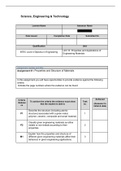
Science, Engineering & Technology
Learner Name Assessor Name
Mathew Pioli
Date Issued Completion Date Submitted On
Qualification Unit
Unit 10: Properties and Applications of
BTEC Level 3 Diploma in Engineering
Engineering Materials
Assignment number and title:
Assignment 01: Properties and Structure of Materials
In this assignment you will have opportunities to provide evidence against the following
criteria.
Indicate the page numbers where the evidence can be found
Criteria Achieved
To achieve the criteria the evidence must show Task
Referen (Assessor to
that the student is able to no.
ce initial & date)
Describe the structure (including atomic
P1 structure) associated with a given metal, 1
polymer, ceramic, composite and smart material.
Classify given engineering materials as either
P2 metals or non-metals according to their 2
properties.
Explain how the properties and structure of
M1 different given engineering materials affect their 3
behaviour in given engineering applications.
, Learner declaration
I certify that the work submitted for this assignment is my own and research sources are
fully acknowledged
Learner Signature Date
Scenario