FUNDAMENTALS
OF PHYSIOLOGY
AND ANATOMY
4BBY1060
Physiology & Anatomy
of the Gastro-Intestinal
Tract
LECTURE 27:
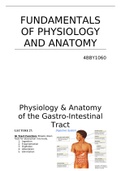
GI Tract Function: Breaks down
food for absorption into body.
1. Ingestion
2. Fragmentation
3. Digestion
4. Absorption
5. Elimination
,Hollow muscular tube with regional anatomical functional differences:
Mucosa
- Protective in Oral cavity, pharynx, esophagus, anal canal
- Secretory in stomach
- Absorptive in small intestine
- Absorptive and protective in Large intestine
Submucosa
- Consist of loose connective tissue with:
a. Blood vessels
b. Nerves which form the plexus of the submucosa
c. Leukocytes
d. Variable amounts of lipid
e. Glands (Esophagus/duodenum)
Muscularis propria (externa)
- Two thick inner layers of smooth muscle (except stomach) responsible for
peristalsis (mixing and moving contents along GI tract)
a. Inner circular & Outer longitudinal
- Between inner and outer layers is a plexus of nerves (Auerbach’s plexus or
myenteric plexus, provides motor innervation to muscularis externa and
has both parasympathetic and sympathetic input
Adventitia (Serosa in more mobile parts)
- Thin layer of connective tissue continuous with surrounding organs
- Bounded by simple, squamous epithelium termed mesothelium in
peritoneal cavity
Stratified epithelium
- Physical protection in oral cavity, pharynx, esophagus, anal canal, uterine
cervix, , anal canal, uterine cervix and vagina
- Sites subject to mechanical abrasion but kept moist by glandular
secretions (Cells remain nucleated)
Oesophageal function: Conduction of bolus/liquids
- Stratified squamous epithelium (E) for
protection
- Muscularis Mucosae (MM)
- Submucosal seromucous glands (G) for
lubrication
- Inner circular muscle (CM) of muscularis
externa
- Outer longitudinal layer (LM) of muscularis
external
- Muscularis externa has skeletal muscle (Sk) at top as initiation of
swallowing is voluntary, then transitions and is replaced entirely by
smooth muscle (Sm)
Stomach: Chemical breakdown of materials via acid and enzymes (HCl and
pepsin) to break hard food into a soft fluid (chyme)
- Has Gastric Rugae
o Produced by folding of internal surface of stomach
- Allow stomach to expand to accommodate food by unfolding rugae, which
reforms as stomach empties
Stomach organization
, - Secretory Mucosa (M) with gastric pits (faveoli) and gastric glands
- Muscularis mucosae (MM)
- Submucosa (S) with no glands
- Muscularis externa (propria) with 3 layers
for strong churning action for mechanical
breakdown and mixing to make chyme,
also respond to hormone Gastrin
o Oblique (O) layer
o Circular (C) layer
o Longitudinal (L) layer
Regions of stomach
- Cardia Mucosa: where the bolus of food
first arrives, with space Glands and mainly involved in mucus secreting.
- Fundus/Body mucosa: Glands are densly packed, producing mucus and
gastric juice (acid + enzymes)
- Pyloric Mucosa: Deep gastric pits (P) branching, coiled glands mucus
secreting. Endocrine cells secrete Gastrin
Mucosa in stomach line with simple columnar
epithelium
Simple columnar epithelium invaginates to form
gastric pits connected to 1-7 simple tubular
gastric glands.
Surface mucous cells: secrete mucus and
bicarbonate to protect cells from acidic and
enzymatic properties of gastric juices and
ingested food (pale staining)
Mucous Neck Cells: line upper parts of gastric glands and secrete mucous
Stem cells: In neck region, divide every 3 days (approx.) to replace all other cell
types
Endocrine Cells: G cells secrete peptide hormone gastrin. Others secrete
hormones including serotonin and somatostatin
Parietal Cells of stomach
- Throughout gastric gland but most numerous in isthmus
- Secrete HCl vía canaliculi in response to gastrin
- Secrete intrinsic factor for vitamin B12 absorption
- Large rounded eosinophilic cells with many mitochondria and centrally
located nucleus. (pale pink fried egg appearance)
Chief cells of stomach
- Main cell in lower regions of gastric glands
- Release zymogen granules containing digestive enzymes (lipase) and
proteases (pepsinogen) in response to gastrin
- Acid environment activates pepsinogen to pepsin
OF PHYSIOLOGY
AND ANATOMY
4BBY1060
Physiology & Anatomy
of the Gastro-Intestinal
Tract
LECTURE 27:
GI Tract Function: Breaks down
food for absorption into body.
1. Ingestion
2. Fragmentation
3. Digestion
4. Absorption
5. Elimination
,Hollow muscular tube with regional anatomical functional differences:
Mucosa
- Protective in Oral cavity, pharynx, esophagus, anal canal
- Secretory in stomach
- Absorptive in small intestine
- Absorptive and protective in Large intestine
Submucosa
- Consist of loose connective tissue with:
a. Blood vessels
b. Nerves which form the plexus of the submucosa
c. Leukocytes
d. Variable amounts of lipid
e. Glands (Esophagus/duodenum)
Muscularis propria (externa)
- Two thick inner layers of smooth muscle (except stomach) responsible for
peristalsis (mixing and moving contents along GI tract)
a. Inner circular & Outer longitudinal
- Between inner and outer layers is a plexus of nerves (Auerbach’s plexus or
myenteric plexus, provides motor innervation to muscularis externa and
has both parasympathetic and sympathetic input
Adventitia (Serosa in more mobile parts)
- Thin layer of connective tissue continuous with surrounding organs
- Bounded by simple, squamous epithelium termed mesothelium in
peritoneal cavity
Stratified epithelium
- Physical protection in oral cavity, pharynx, esophagus, anal canal, uterine
cervix, , anal canal, uterine cervix and vagina
- Sites subject to mechanical abrasion but kept moist by glandular
secretions (Cells remain nucleated)
Oesophageal function: Conduction of bolus/liquids
- Stratified squamous epithelium (E) for
protection
- Muscularis Mucosae (MM)
- Submucosal seromucous glands (G) for
lubrication
- Inner circular muscle (CM) of muscularis
externa
- Outer longitudinal layer (LM) of muscularis
external
- Muscularis externa has skeletal muscle (Sk) at top as initiation of
swallowing is voluntary, then transitions and is replaced entirely by
smooth muscle (Sm)
Stomach: Chemical breakdown of materials via acid and enzymes (HCl and
pepsin) to break hard food into a soft fluid (chyme)
- Has Gastric Rugae
o Produced by folding of internal surface of stomach
- Allow stomach to expand to accommodate food by unfolding rugae, which
reforms as stomach empties
Stomach organization
, - Secretory Mucosa (M) with gastric pits (faveoli) and gastric glands
- Muscularis mucosae (MM)
- Submucosa (S) with no glands
- Muscularis externa (propria) with 3 layers
for strong churning action for mechanical
breakdown and mixing to make chyme,
also respond to hormone Gastrin
o Oblique (O) layer
o Circular (C) layer
o Longitudinal (L) layer
Regions of stomach
- Cardia Mucosa: where the bolus of food
first arrives, with space Glands and mainly involved in mucus secreting.
- Fundus/Body mucosa: Glands are densly packed, producing mucus and
gastric juice (acid + enzymes)
- Pyloric Mucosa: Deep gastric pits (P) branching, coiled glands mucus
secreting. Endocrine cells secrete Gastrin
Mucosa in stomach line with simple columnar
epithelium
Simple columnar epithelium invaginates to form
gastric pits connected to 1-7 simple tubular
gastric glands.
Surface mucous cells: secrete mucus and
bicarbonate to protect cells from acidic and
enzymatic properties of gastric juices and
ingested food (pale staining)
Mucous Neck Cells: line upper parts of gastric glands and secrete mucous
Stem cells: In neck region, divide every 3 days (approx.) to replace all other cell
types
Endocrine Cells: G cells secrete peptide hormone gastrin. Others secrete
hormones including serotonin and somatostatin
Parietal Cells of stomach
- Throughout gastric gland but most numerous in isthmus
- Secrete HCl vía canaliculi in response to gastrin
- Secrete intrinsic factor for vitamin B12 absorption
- Large rounded eosinophilic cells with many mitochondria and centrally
located nucleus. (pale pink fried egg appearance)
Chief cells of stomach
- Main cell in lower regions of gastric glands
- Release zymogen granules containing digestive enzymes (lipase) and
proteases (pepsinogen) in response to gastrin
- Acid environment activates pepsinogen to pepsin