Social Influence and Social Change
Key terms
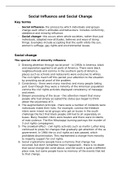
- Social influence- the process by which individuals and groups
change each other’s attitudes and behaviours. Includes conformity,
obedience and minority influence.
- Social change- this occurs when whole societies, rather than just
individuals, adopted new attitudes, believes and ways of doing
things. Examples include accepting that the earth orbits the sun,
women's suffrage, gay rights and environmental issues.
Social change
The special role of minority influence
1- Drawing attention through social proof - in 1950s in America, black
and separation applied to all parts of America. There were black
neighbourhoods and comma in the southern parts of America,
places such as schools and restaurants were exclusive to whites.
The civil rights march off this period your attention to the situation
by providing social proof of the problem.
2- Consistency - there were many marches and many people taking
part. Even though they were a minority of the American population
comma the civil rights activists displayed consistency of message
and intent.
3- Deeper processing of the issue - this attention meant that many
people who had simply accepted the status quo began to think
about the unjustness of it.
4- The augmentation principle - there were a number of incidents were
individuals risked their lives. For example, comma the freedom
riders were mixed racial groups who got on buses in the south
challenge the fact that black people still had to sit separately on
buses. Many freedom riders were beaten and there were incidents
of mob violence. The film Mississippi burning portrays the murder of
3 civil rights campaigners.
5- The snowball effect - civil rights activists such as martin Luther king
continued to press for changes that gradually got attention of the us
government. In 1964 the us civil rights act was passed, which
prohibited discrimination. This represented a change from minority
to majority support for civil rights.
6- Social cryptomeria (people have a memory that change has
occurred, but don't remember how it happened) - there is no doubt
that social change did come about, and the south is quite a different
place now, but some people have no memory of the events that led
to that change.
Key terms
- Social influence- the process by which individuals and groups
change each other’s attitudes and behaviours. Includes conformity,
obedience and minority influence.
- Social change- this occurs when whole societies, rather than just
individuals, adopted new attitudes, believes and ways of doing
things. Examples include accepting that the earth orbits the sun,
women's suffrage, gay rights and environmental issues.
Social change
The special role of minority influence
1- Drawing attention through social proof - in 1950s in America, black
and separation applied to all parts of America. There were black
neighbourhoods and comma in the southern parts of America,
places such as schools and restaurants were exclusive to whites.
The civil rights march off this period your attention to the situation
by providing social proof of the problem.
2- Consistency - there were many marches and many people taking
part. Even though they were a minority of the American population
comma the civil rights activists displayed consistency of message
and intent.
3- Deeper processing of the issue - this attention meant that many
people who had simply accepted the status quo began to think
about the unjustness of it.
4- The augmentation principle - there were a number of incidents were
individuals risked their lives. For example, comma the freedom
riders were mixed racial groups who got on buses in the south
challenge the fact that black people still had to sit separately on
buses. Many freedom riders were beaten and there were incidents
of mob violence. The film Mississippi burning portrays the murder of
3 civil rights campaigners.
5- The snowball effect - civil rights activists such as martin Luther king
continued to press for changes that gradually got attention of the us
government. In 1964 the us civil rights act was passed, which
prohibited discrimination. This represented a change from minority
to majority support for civil rights.
6- Social cryptomeria (people have a memory that change has
occurred, but don't remember how it happened) - there is no doubt
that social change did come about, and the south is quite a different
place now, but some people have no memory of the events that led
to that change.