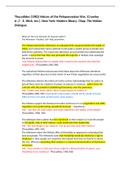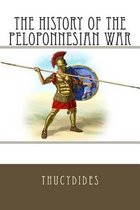
Thucydides (1982) History of the Peloponnesian War. (Crawley
tr.,T . E. Wick, rev.). New York: Modern library. Chap. The Melian
Dialogue.
- What are the core elements of classical realism?
The Athenians = Realists. Self- help, pessimism,
The Melians denied the Athenian’s to articulate their argument before the public of
Melos and instead they had to attempt to persuade a smaller group of people who
held all the authority. The reason the Athenians are prevented from addressing the
public is out of fear that they may persuade the majority of Melians that outweigh
the minority in power.
“the Melians desired them to explain their errand to the minority who held the
magistracies” (Thucydides,1982:180)
The authorized Melians had preconceived ideas about the Athenians intentions
regardless of their plea due to their intent of war if their negotiation be unsuccessful.
The Athenians dismiss the notion of Justice as they acknowledge that for justice to
prevail there must be a balance of power to execute it. However, Justice does not
coincide with the powerful establishing themselves over the powerless.
Ath- “Justice only enters where there is equal power to enforce it”
(Thucydides,1982 :181) Machiavelli’s idea leaders should not be wholly virtuous.
Different form of reality performed by state leaders.
The Melians support the dismissal of Justice and focus’s in on pragmatism and utility
regardless of an action being considered immoral. – Expediency
Mel- “you thus set aside justice and make expediency the subject of the debate”
(Thucydides, 1982: 181)
The Athenians then outline that the real threat to their empire is in fact the people
or the public, who in their masses, could overthrow their leadership.
Ath- “the real danger is our subjects…rise up and overcome their masters”
(Thucydides,1982 :181)
The Athenians reject the Melians offer of friendship as opposed to colonizing their
land and people. The Athenians state that friendship would be viewed as a sign of
weakness to their people as it would be interrupted that they are fearful to attack
this city. Whereas expanding their empire is a outward demonstration of dominance
and power.
Ath- “Your enmity is in the eyes of our subjects a demonstration of power, your
friendship of our weakness” (Thucydides, 1982:182)
tr.,T . E. Wick, rev.). New York: Modern library. Chap. The Melian
Dialogue.
- What are the core elements of classical realism?
The Athenians = Realists. Self- help, pessimism,
The Melians denied the Athenian’s to articulate their argument before the public of
Melos and instead they had to attempt to persuade a smaller group of people who
held all the authority. The reason the Athenians are prevented from addressing the
public is out of fear that they may persuade the majority of Melians that outweigh
the minority in power.
“the Melians desired them to explain their errand to the minority who held the
magistracies” (Thucydides,1982:180)
The authorized Melians had preconceived ideas about the Athenians intentions
regardless of their plea due to their intent of war if their negotiation be unsuccessful.
The Athenians dismiss the notion of Justice as they acknowledge that for justice to
prevail there must be a balance of power to execute it. However, Justice does not
coincide with the powerful establishing themselves over the powerless.
Ath- “Justice only enters where there is equal power to enforce it”
(Thucydides,1982 :181) Machiavelli’s idea leaders should not be wholly virtuous.
Different form of reality performed by state leaders.
The Melians support the dismissal of Justice and focus’s in on pragmatism and utility
regardless of an action being considered immoral. – Expediency
Mel- “you thus set aside justice and make expediency the subject of the debate”
(Thucydides, 1982: 181)
The Athenians then outline that the real threat to their empire is in fact the people
or the public, who in their masses, could overthrow their leadership.
Ath- “the real danger is our subjects…rise up and overcome their masters”
(Thucydides,1982 :181)
The Athenians reject the Melians offer of friendship as opposed to colonizing their
land and people. The Athenians state that friendship would be viewed as a sign of
weakness to their people as it would be interrupted that they are fearful to attack
this city. Whereas expanding their empire is a outward demonstration of dominance
and power.
Ath- “Your enmity is in the eyes of our subjects a demonstration of power, your
friendship of our weakness” (Thucydides, 1982:182)