Aliya Hussain
Unit 8: Physiology of Human Body Systems- Musculoskeletal
disorders
Context
Page number Context
2 Structure of the musculoskeletal system -P1
3 Skeletal functions- P1
3-4 The axial and appendicular skeleton-P1
4-5 Bone types -P1
5 Bone composition
5-9 Joints-P1
9-11 Structure of the major muscle groups-P1
11-13 Cartilage-P1
13-14 Tendons and ligaments-P1
15-16 difference between skeletal and smooth
muscle-P1
16 Muscle contraction steps-P1
17-18 Slow and fast twitch muscle-P1
18 Muscle fibres and sliding theory-P1
19 types of movement-P1
20-24 Disorders of the musculoskeletal system-P2
25 Comparing how the three disorders affect
different aspects of the musculoskeletal
system- M1
25-26 Normal movements compromised in each
of the three conditions-M1.
27-31 D1
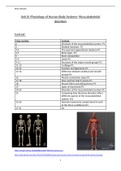
https://images-wixmp-ed30a86b8c4ca887773594c2.wixmp.com/
https://img2.cgtrader.com/items/184129/d9748ed8aa/human-male-muscular-system-3d-model-max-obj-3ds-fbx-c4d-lwo-lw-lws.jpg
1
,Aliya Hussain
The musculoskeletal system
Applied science study book 1
Structure of the musculoskeletal system
The human musculoskeletal system consists of all the bones, cartilage,
tendons, and ligaments in the body. Altogether, the skeleton makes up about
20 percent of a person’s body weight. An adult’s skeleton contains 206 bones.
Children’s skeletons contain more bones because some of them, including
those of the skull, fuse together as they grow up. There are also some
differences in the male and female skeleton. The male skeleton is usually
longer and has a high bone mass. The female skeleton, on the other hand, has
a broader pelvis to accommodate for pregnancy and childbirth. There are more
than 600 muscles in the human body. They vary greatly in shape in size, with
the smallest one being the stapedius muscle in the inner ear, and the largest
one being the quadriceps femoris muscle in the thigh.
2
,Aliya Hussain
Skeletal functions
Support- The functions of the skeleton and the bones is to provide rigidity,
which gives the body shape and supports the weight of the muscles and
organs. Without this structure, the body would collapse in on itself. For
example, the spine helps us to stay up straight.
Protection- One of the main functions of skeletal system involves protection to
the delicate internal organs of the body. The brain is protected by the skull, the
nerves are protected by the spinal column, the rib cage provides protection to
the heart and lungs.
Attachment for skeletal muscles- The bones of the skeleton provide surfaces
for the attachment of muscles. Therefore, bones are often irregular shaped
and have bony points and grooves to provide attachment points.
Storing minerals- The bones themselves are made of minerals and act as a
mineral store for calcium and phosphorous, which can be given up if the body
requires the minerals for other functions.
Producing blood cells- Certain bones in the skeleton contain red bone marrow
and the bone marrow produces red blood cells, white blood cells and platelets.
Examples of bones that contain marrow are the pelvis, sternum, vertebrae and
clavicle.
Maintaining mineral homeostasis- Maintaining mineral homeostasis is a very
important function of the skeleton, because just the right levels of calcium and
other minerals are needed in the blood for normal functioning of the body.
When mineral levels in the blood are too high, bones absorb some of the
minerals and store them as mineral salts, which is why bones are so hard.
The axial and appendicular skeleton
Axial skeleton- The axial skeleton forms the central axis of the body and it
consists of 80 bones that include the skull, vertebral column and thoracic cage.
The bones of the skull are divided into cranial bones and facial bones; their
main role consists of supporting the structures of the face and protecting the
3
, Aliya Hussain
brain. The vertebral column protects the spinal cord, supports the head and
acts as an attachment point for the ribs and muscles of the back and neck. The
thoracic cage protects the organs of the thoracic cavity, provides supports for
the shoulder girdles and upper limbs and functions muscles of the back, chest,
neck and shoulders.
Appendicular skeleton- The appendicular skeleton is made up by the bones
attached or appended to the axial skeleton. The appendicular skeleton is
composed of the bones of the upper limbs (which function to grasp and
manipulate objects), and the lower limbs (which permit locomotion). It also
includes the pectoral girdle and the pelvic girdle, which attach the upper and
lower limbs to the body.
Bone types
https://www.registerednursern.com/types-of-bones-anatomy/
-
-
- Flat bones protect Internal Organs and are hard and spongy.
4
Unit 8: Physiology of Human Body Systems- Musculoskeletal
disorders
Context
Page number Context
2 Structure of the musculoskeletal system -P1
3 Skeletal functions- P1
3-4 The axial and appendicular skeleton-P1
4-5 Bone types -P1
5 Bone composition
5-9 Joints-P1
9-11 Structure of the major muscle groups-P1
11-13 Cartilage-P1
13-14 Tendons and ligaments-P1
15-16 difference between skeletal and smooth
muscle-P1
16 Muscle contraction steps-P1
17-18 Slow and fast twitch muscle-P1
18 Muscle fibres and sliding theory-P1
19 types of movement-P1
20-24 Disorders of the musculoskeletal system-P2
25 Comparing how the three disorders affect
different aspects of the musculoskeletal
system- M1
25-26 Normal movements compromised in each
of the three conditions-M1.
27-31 D1
https://images-wixmp-ed30a86b8c4ca887773594c2.wixmp.com/
https://img2.cgtrader.com/items/184129/d9748ed8aa/human-male-muscular-system-3d-model-max-obj-3ds-fbx-c4d-lwo-lw-lws.jpg
1
,Aliya Hussain
The musculoskeletal system
Applied science study book 1
Structure of the musculoskeletal system
The human musculoskeletal system consists of all the bones, cartilage,
tendons, and ligaments in the body. Altogether, the skeleton makes up about
20 percent of a person’s body weight. An adult’s skeleton contains 206 bones.
Children’s skeletons contain more bones because some of them, including
those of the skull, fuse together as they grow up. There are also some
differences in the male and female skeleton. The male skeleton is usually
longer and has a high bone mass. The female skeleton, on the other hand, has
a broader pelvis to accommodate for pregnancy and childbirth. There are more
than 600 muscles in the human body. They vary greatly in shape in size, with
the smallest one being the stapedius muscle in the inner ear, and the largest
one being the quadriceps femoris muscle in the thigh.
2
,Aliya Hussain
Skeletal functions
Support- The functions of the skeleton and the bones is to provide rigidity,
which gives the body shape and supports the weight of the muscles and
organs. Without this structure, the body would collapse in on itself. For
example, the spine helps us to stay up straight.
Protection- One of the main functions of skeletal system involves protection to
the delicate internal organs of the body. The brain is protected by the skull, the
nerves are protected by the spinal column, the rib cage provides protection to
the heart and lungs.
Attachment for skeletal muscles- The bones of the skeleton provide surfaces
for the attachment of muscles. Therefore, bones are often irregular shaped
and have bony points and grooves to provide attachment points.
Storing minerals- The bones themselves are made of minerals and act as a
mineral store for calcium and phosphorous, which can be given up if the body
requires the minerals for other functions.
Producing blood cells- Certain bones in the skeleton contain red bone marrow
and the bone marrow produces red blood cells, white blood cells and platelets.
Examples of bones that contain marrow are the pelvis, sternum, vertebrae and
clavicle.
Maintaining mineral homeostasis- Maintaining mineral homeostasis is a very
important function of the skeleton, because just the right levels of calcium and
other minerals are needed in the blood for normal functioning of the body.
When mineral levels in the blood are too high, bones absorb some of the
minerals and store them as mineral salts, which is why bones are so hard.
The axial and appendicular skeleton
Axial skeleton- The axial skeleton forms the central axis of the body and it
consists of 80 bones that include the skull, vertebral column and thoracic cage.
The bones of the skull are divided into cranial bones and facial bones; their
main role consists of supporting the structures of the face and protecting the
3
, Aliya Hussain
brain. The vertebral column protects the spinal cord, supports the head and
acts as an attachment point for the ribs and muscles of the back and neck. The
thoracic cage protects the organs of the thoracic cavity, provides supports for
the shoulder girdles and upper limbs and functions muscles of the back, chest,
neck and shoulders.
Appendicular skeleton- The appendicular skeleton is made up by the bones
attached or appended to the axial skeleton. The appendicular skeleton is
composed of the bones of the upper limbs (which function to grasp and
manipulate objects), and the lower limbs (which permit locomotion). It also
includes the pectoral girdle and the pelvic girdle, which attach the upper and
lower limbs to the body.
Bone types
https://www.registerednursern.com/types-of-bones-anatomy/
-
-
- Flat bones protect Internal Organs and are hard and spongy.
4