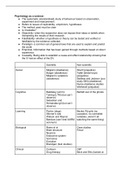
Psychology as a science-
● The systematic (standardised) study of behaviour based on observation,
experiment and measurement.
● Refers to issues of replicability, empiricism, hypotheses
● The method used must be clear
● Is it testable?
● Objectivity- when the researcher does not impose their ideas or beliefs when
interpreting the results of their research.
● Falsifiability- whether a hypothesis or theory can be tested and verified or
falsifiable by the evidence collected.
● Paradigm- a common set of general laws that are used to explain and predict
the world
● Empirical- Information that has been gained through methods based on direct
experience
● Causality- Being able to establish a cause and effect relationship showing that
the IV had an effect of the DV.
Scientific Non-scientific
Social Milgram (obedience) Sherif (prejudice)
Burger (obedience) Tajfel (bristol boys)
Milgram’s variations (prejudice)
(obedience) Sedikes and Jackson (zoo
study SIN) (obedience)
Nurse obedience studies
Wetherall (prejudice)
Cognitive Baddeley (wmm) Bartlett war of the ghosts
Tulving (LTM) (but can’t
observe)
Sebastien and
Hernandez-gil (but can’t
observe)
Learning Pavlov (dogs) Becker Fiji girls (no
Skinner’s rats causation, no controlled
Watson and Raynor variables, weren’t all
Bandura (can’t test AARM watching the same thing)
acronym)
Biological Raine et al Case studies
Brain structure Freud
Neurons
Endocrine system-
hormones
Evolution
Brendgen (twin studies)
Clinical Carlsson CBT
Drug therapy Beck and Ellis (looked at
, Williams the effectiveness of CBT)
Biological explanation of Social causation of
schizophrenia schizophrenia
Rosenhan (but wasn’t Culture bound syndromes
clear what they were 4 d’s
testing) Diagnosis
Valentine Laverne
Criminal Bio explanations of crime- Case studies
personality, xyy, brain Labelling and self fulfilling
injury, amygdala prophecy
Social learning theory
Valentine and Mesout
Eye witness testimony
Jury decision decision
To what extent is psychology scientific-
AO1-
● What makes something scientific - controlling variables - the scientific method
● Causality (IV and DV)
● Key terms
● Methods used in psychology.
AO3-
● Does psychology need to be scientific - Loftus and Palmer used scientific
method - easily replicated, has great implication for society as it can apply to
eye witness testimony. However it has low ecological validity and it’s not
looking at real life behaviour - suggesting that a scientific method is not
always needed when studying human behaviour seen with Sherif
● Non-scientific- field experiment, low control of extraneous variables however
still had great implications for society as it provides explanations on how to
reduce prejudice.
● For psychology to be a science it needs to be objective - Raine et al was
objective.
● Social psychology is not always objective- Sherif is not, Milgram was
● Cognitive is both.
Social control-
● Refers to people being regulated by systems in a society.
● A number of different ways in which psychologists use their knowledge to
control peoples behaviour
● Some are un-controversial as certain behaviours need controlling some raise
issues of personal freedom
Types of Power:
● EXPERT power = given to someone who is an expert in their field e.g.
psychologist
● REWARD power = when someone has the power to reward client e.g., token
economist
● LEGITIMATE power = an agent in a society where you expect people to
behave appropriately e.g. psychiatrist
● The systematic (standardised) study of behaviour based on observation,
experiment and measurement.
● Refers to issues of replicability, empiricism, hypotheses
● The method used must be clear
● Is it testable?
● Objectivity- when the researcher does not impose their ideas or beliefs when
interpreting the results of their research.
● Falsifiability- whether a hypothesis or theory can be tested and verified or
falsifiable by the evidence collected.
● Paradigm- a common set of general laws that are used to explain and predict
the world
● Empirical- Information that has been gained through methods based on direct
experience
● Causality- Being able to establish a cause and effect relationship showing that
the IV had an effect of the DV.
Scientific Non-scientific
Social Milgram (obedience) Sherif (prejudice)
Burger (obedience) Tajfel (bristol boys)
Milgram’s variations (prejudice)
(obedience) Sedikes and Jackson (zoo
study SIN) (obedience)
Nurse obedience studies
Wetherall (prejudice)
Cognitive Baddeley (wmm) Bartlett war of the ghosts
Tulving (LTM) (but can’t
observe)
Sebastien and
Hernandez-gil (but can’t
observe)
Learning Pavlov (dogs) Becker Fiji girls (no
Skinner’s rats causation, no controlled
Watson and Raynor variables, weren’t all
Bandura (can’t test AARM watching the same thing)
acronym)
Biological Raine et al Case studies
Brain structure Freud
Neurons
Endocrine system-
hormones
Evolution
Brendgen (twin studies)
Clinical Carlsson CBT
Drug therapy Beck and Ellis (looked at
, Williams the effectiveness of CBT)
Biological explanation of Social causation of
schizophrenia schizophrenia
Rosenhan (but wasn’t Culture bound syndromes
clear what they were 4 d’s
testing) Diagnosis
Valentine Laverne
Criminal Bio explanations of crime- Case studies
personality, xyy, brain Labelling and self fulfilling
injury, amygdala prophecy
Social learning theory
Valentine and Mesout
Eye witness testimony
Jury decision decision
To what extent is psychology scientific-
AO1-
● What makes something scientific - controlling variables - the scientific method
● Causality (IV and DV)
● Key terms
● Methods used in psychology.
AO3-
● Does psychology need to be scientific - Loftus and Palmer used scientific
method - easily replicated, has great implication for society as it can apply to
eye witness testimony. However it has low ecological validity and it’s not
looking at real life behaviour - suggesting that a scientific method is not
always needed when studying human behaviour seen with Sherif
● Non-scientific- field experiment, low control of extraneous variables however
still had great implications for society as it provides explanations on how to
reduce prejudice.
● For psychology to be a science it needs to be objective - Raine et al was
objective.
● Social psychology is not always objective- Sherif is not, Milgram was
● Cognitive is both.
Social control-
● Refers to people being regulated by systems in a society.
● A number of different ways in which psychologists use their knowledge to
control peoples behaviour
● Some are un-controversial as certain behaviours need controlling some raise
issues of personal freedom
Types of Power:
● EXPERT power = given to someone who is an expert in their field e.g.
psychologist
● REWARD power = when someone has the power to reward client e.g., token
economist
● LEGITIMATE power = an agent in a society where you expect people to
behave appropriately e.g. psychiatrist