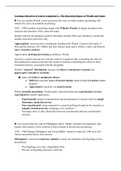
Learning objectives of course component 2: The theoretical legacy of Wundt and James
You can explain Wundt’s work and assess the ways in which modern psychology still
reflects his views on scientific psychology.
1850 – 1900 scientific psychology began with Wilhelm Wundt: he began research on the
structure and operation of the conscious mind.
Wundt criticizes the language model of Wernicke and the 2500 years old theory which both
assume associative processes only.
Apperception: non-associative mechanism introduced by Wundt. Central to the study of
Watt and the theories of G. Müller and Selz (former time) and E. Miller, Cohen, and Roelofs
(now: executive control).
Apperception prolongs processing according to Wundt.
Executive control concerns not only the control of cognition (like controlling the retrieval
from declarative memory) but also the control of emotion (controlling the retrieval from
emotional memory, associated with the amygdala).
Wundt’s “natural” distribution: mixture of reflexive (automatic) reactions and
apperceptive (attentive) reactions.
Link with Fodor’s modularity theory:
o Reflexive reactions happen from perception (input module) to action (output
module).
o Apperceptive reactions via central system
Within scientific psychology, Wundt made a distinction between experimental and non-
experimental scientific approaches.
- Experimental: based on introspection and measurement of reaction time for simple
elementary mental processes.
- Non-experimental: using comparative research and logical analysis for research on
complex mental processes. (language, law, myth etc.)
- Nowadays there is still a distinction between experimental and non-experimental
research.
You can describe the work of Ebbinghaus and G. Müller, and later developments, and
explain what aspects of this work have been retained in present-day psychology.
1850 – 1900 Herman Ebbinghaus and Georg Müller: wanted to make the 2500 years old
classic association theory more precise
Ebbinghaus: constructed nonsense syllables to study the formation and forgetting of new
associations.
- The forgetting curve has a logarithmic form
- The rate of forgetting decreases with time
You can explain Wundt’s work and assess the ways in which modern psychology still
reflects his views on scientific psychology.
1850 – 1900 scientific psychology began with Wilhelm Wundt: he began research on the
structure and operation of the conscious mind.
Wundt criticizes the language model of Wernicke and the 2500 years old theory which both
assume associative processes only.
Apperception: non-associative mechanism introduced by Wundt. Central to the study of
Watt and the theories of G. Müller and Selz (former time) and E. Miller, Cohen, and Roelofs
(now: executive control).
Apperception prolongs processing according to Wundt.
Executive control concerns not only the control of cognition (like controlling the retrieval
from declarative memory) but also the control of emotion (controlling the retrieval from
emotional memory, associated with the amygdala).
Wundt’s “natural” distribution: mixture of reflexive (automatic) reactions and
apperceptive (attentive) reactions.
Link with Fodor’s modularity theory:
o Reflexive reactions happen from perception (input module) to action (output
module).
o Apperceptive reactions via central system
Within scientific psychology, Wundt made a distinction between experimental and non-
experimental scientific approaches.
- Experimental: based on introspection and measurement of reaction time for simple
elementary mental processes.
- Non-experimental: using comparative research and logical analysis for research on
complex mental processes. (language, law, myth etc.)
- Nowadays there is still a distinction between experimental and non-experimental
research.
You can describe the work of Ebbinghaus and G. Müller, and later developments, and
explain what aspects of this work have been retained in present-day psychology.
1850 – 1900 Herman Ebbinghaus and Georg Müller: wanted to make the 2500 years old
classic association theory more precise
Ebbinghaus: constructed nonsense syllables to study the formation and forgetting of new
associations.
- The forgetting curve has a logarithmic form
- The rate of forgetting decreases with time