
Module 1
←
The South African Legal System
←
o Law is a social science.
o South African Law is not codified: recorded in one comprehensive piece of legislation.
← Origin:
o Indigenous legal systems applied at the southernmost tip of Africa before 1652.
o Jan van Riebeeck arrives in Cape Town in 1652 and the adoption of Roman-Dutch law as a legalsystem
to the Cape.
← Sources of South African law
o Some are authoritative: courts are bound by authoritative sources
o Others have merely persuasive authority: serves to convince a court to apply or interpret a rule in a
particular way.
Corpus Iuris Civilis: codification of Roman law that is a primary authoritative source on which South African
courts draw when reverting to Roman Law to solve a legal problem.
←
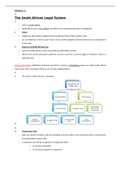
← The order in which SA law is consulted:
←
←
← Customary law
o Does not consist of written rules but develops from the habits of the community and is carried down
from generation to generation
o A customary rule will be recognized as a legal rule when:
o It must be reasonable
o It must have existed for a long time
, o It must be generally recognized and observed by the community
o It must be certain and clear
←
← The Courts in the Republic
Persuasive
Power:
High
High courts
courts in
in other
other
areas
areas of
of jurisdiction
jurisdiction
← SA Courts is devided in: Superior Courts – 1. Constitutional Court
2. Supreme Court of Appeal
3. High Court – Full Bench
- Two Judge Bench
- Single Judge
Lower Courts - 4. Magistrate Court
5. Small Claims Court
←
← The Doctrine of Stare Decisis
o The judgments of the superior courts are one of the most important sources of the law.
o The function of a judge is to state, interpret and apply the existing law but not to make a new law.
o Nevertheless, the effect of a judicial decision which gives new interpretation to a statutory provision
or which abstracts, extends or adapts a common law principle, is in many cases to create law.
o Law so created is termed ‘judge-made law’. Because a later court does not depart lightly from the
decisions of an earlier court, this judge-made law becomes established legal rule.
o The court or judge does not purposefully set out to create a law.
,Application of the Doctrine
← Stare Decisis: The decision stands.
o Obviously, when a court gives a decision, the parties to the dispute will be bound by the decision.
o The doctrine of Stare Decisis would mean that a later court would be bound by the earlier decision
regardless of whether or not the earlier decision could be regarded as correct.
o South African courts follow a middle course. A court is bound by its own decisions unless and until
they are overruled by a superior court.
The doctrine of stare Decisis and the hierarchy of courts
o Every court is bound by the decisions of the superior court within its area of jurisdiction. Thus a High
Court regardless of the amount of judges is bound by the decisions of the Supreme Court of Appeal; a
bench of 2 judges is bound by a decision of the full bench and a single judge by the decisions either of
the two just mentioned.
o Every court is bound by the decision of a court of concurrent status within its own area of jurisdiction.
Thus the Supreme Court of Appeal is bound by its previous judgments (even a bench of 5 judges by a
bench of 3). A full bench of a High Court is similarly bound by an earlier full bench decision, a 2 bench
by a 2 bench and a single judge by an earlier decision by a single judge.
o One High Court is not bound to follow the decisions of another High Court since they belong to
different jurisdictions. The High Court from another jurisdiction will, however, serve as a persuasive
authority.
o Magistrate’s courts are bound by the judgments of the Supreme Court of Appeal and the High Courts.
If the judgments of the High Courts are conflicting, a magistrate should follow the decision of the High
Court in whose jurisdiction it falls.
Ratio Decidendi: The reason for the decision – which is binding and which is the subject of the doctrine of stare
Decisis.
The ratio decidendi is binding on subsequent courts. Any statement, which falls outside the ratio decidendi, is
known as the: Obiter Dictum or incidental remark.
Legislation: 1. The making of the law by a competent authority.
2. It’s the most important source of the law.
The Constitution: 1. Most important source of law in SA
2. The Bill of rights is the cornerstone of democracy in SA
o Bill of rights deal with first generation rights & second generation rights
First Generation: Human dignity
, Life
Various freedom of persons
Religion
Movement of trade
Second Generation: Right to housing
Health Care
Food & Water
Social Security
Education
The High Court can hear any matter within their area or Jurisdiction.
The only court that can hear : 1. Divorce proceedings
2. State of persons mental capacity
3. Sequestration & Liquidation
4. Validity of a will
Officers of Supreme Court
o A Registrar is appointed in each of the Superior Courts
o The Registrar with his assistance is responsible for the smooth running of the court.
o Duties: 1. Issue of process (Summons & Warrants)
2. Enrolments of Cases
3. Issuing of orders of Court
4. Maintenance of Court
Duties of Sheriff: 1. To serve warrants & Summons
←
The South African Legal System
←
o Law is a social science.
o South African Law is not codified: recorded in one comprehensive piece of legislation.
← Origin:
o Indigenous legal systems applied at the southernmost tip of Africa before 1652.
o Jan van Riebeeck arrives in Cape Town in 1652 and the adoption of Roman-Dutch law as a legalsystem
to the Cape.
← Sources of South African law
o Some are authoritative: courts are bound by authoritative sources
o Others have merely persuasive authority: serves to convince a court to apply or interpret a rule in a
particular way.
Corpus Iuris Civilis: codification of Roman law that is a primary authoritative source on which South African
courts draw when reverting to Roman Law to solve a legal problem.
←
← The order in which SA law is consulted:
←
←
← Customary law
o Does not consist of written rules but develops from the habits of the community and is carried down
from generation to generation
o A customary rule will be recognized as a legal rule when:
o It must be reasonable
o It must have existed for a long time
, o It must be generally recognized and observed by the community
o It must be certain and clear
←
← The Courts in the Republic
Persuasive
Power:
High
High courts
courts in
in other
other
areas
areas of
of jurisdiction
jurisdiction
← SA Courts is devided in: Superior Courts – 1. Constitutional Court
2. Supreme Court of Appeal
3. High Court – Full Bench
- Two Judge Bench
- Single Judge
Lower Courts - 4. Magistrate Court
5. Small Claims Court
←
← The Doctrine of Stare Decisis
o The judgments of the superior courts are one of the most important sources of the law.
o The function of a judge is to state, interpret and apply the existing law but not to make a new law.
o Nevertheless, the effect of a judicial decision which gives new interpretation to a statutory provision
or which abstracts, extends or adapts a common law principle, is in many cases to create law.
o Law so created is termed ‘judge-made law’. Because a later court does not depart lightly from the
decisions of an earlier court, this judge-made law becomes established legal rule.
o The court or judge does not purposefully set out to create a law.
,Application of the Doctrine
← Stare Decisis: The decision stands.
o Obviously, when a court gives a decision, the parties to the dispute will be bound by the decision.
o The doctrine of Stare Decisis would mean that a later court would be bound by the earlier decision
regardless of whether or not the earlier decision could be regarded as correct.
o South African courts follow a middle course. A court is bound by its own decisions unless and until
they are overruled by a superior court.
The doctrine of stare Decisis and the hierarchy of courts
o Every court is bound by the decisions of the superior court within its area of jurisdiction. Thus a High
Court regardless of the amount of judges is bound by the decisions of the Supreme Court of Appeal; a
bench of 2 judges is bound by a decision of the full bench and a single judge by the decisions either of
the two just mentioned.
o Every court is bound by the decision of a court of concurrent status within its own area of jurisdiction.
Thus the Supreme Court of Appeal is bound by its previous judgments (even a bench of 5 judges by a
bench of 3). A full bench of a High Court is similarly bound by an earlier full bench decision, a 2 bench
by a 2 bench and a single judge by an earlier decision by a single judge.
o One High Court is not bound to follow the decisions of another High Court since they belong to
different jurisdictions. The High Court from another jurisdiction will, however, serve as a persuasive
authority.
o Magistrate’s courts are bound by the judgments of the Supreme Court of Appeal and the High Courts.
If the judgments of the High Courts are conflicting, a magistrate should follow the decision of the High
Court in whose jurisdiction it falls.
Ratio Decidendi: The reason for the decision – which is binding and which is the subject of the doctrine of stare
Decisis.
The ratio decidendi is binding on subsequent courts. Any statement, which falls outside the ratio decidendi, is
known as the: Obiter Dictum or incidental remark.
Legislation: 1. The making of the law by a competent authority.
2. It’s the most important source of the law.
The Constitution: 1. Most important source of law in SA
2. The Bill of rights is the cornerstone of democracy in SA
o Bill of rights deal with first generation rights & second generation rights
First Generation: Human dignity
, Life
Various freedom of persons
Religion
Movement of trade
Second Generation: Right to housing
Health Care
Food & Water
Social Security
Education
The High Court can hear any matter within their area or Jurisdiction.
The only court that can hear : 1. Divorce proceedings
2. State of persons mental capacity
3. Sequestration & Liquidation
4. Validity of a will
Officers of Supreme Court
o A Registrar is appointed in each of the Superior Courts
o The Registrar with his assistance is responsible for the smooth running of the court.
o Duties: 1. Issue of process (Summons & Warrants)
2. Enrolments of Cases
3. Issuing of orders of Court
4. Maintenance of Court
Duties of Sheriff: 1. To serve warrants & Summons



