PPG7: Agenda setting
A very important stage of policy-making is agenda setting, which basically comes down to
which problems and possible solutions get noticed by political elites and which do not.
Problem definition is a crucial aspect of agenda setting that we will explore more in depth.
We will see that problem definition is a struggle for authoritative meaning in which
numbers and reasoning about causes play a substantial role.
Literature:
● Knill & Tosun: Chapter 5 (Problem definition and agenda setting), pp. 97-120.
● Stone: Chapters 8 (Numbers) and 9 (Causes), pp. 183-228.
I. What is agenda setting?
Knill and Tosun and Birkland define agenda setting in different ways both looking for
definitions. For Knill & Tosun ‘put simply, this stage is about getting an issue on the
agenda’. However for Birkland (not in readings) agenda setting is ‘(…) the process by
which problems and alternative solutions gain or lose public and elite attention’.
But, what is an agenda? For Birkland (not in readings): ‘An agenda is a collection of
problems, understandings of causes, symbols, solutions, and other elements of public
problems that come to the attention of members of the public and their government
officials’. Here, problems are the core element and governmental and non-governmental
actors participate in the process.
There are 4 types of agenda:
1. Agenda universe: All matters possibly up for discussion.
2. Systemic agenda: Problems worthy of public attention.
3. Institutional agenda: Problems up for spending time and resources.
4. Decision agenda: Problems that will be acted upon.
,Getting on the right agenda: It is important to know that moving up the
agenda is a competition between the potential public interests. The higher
you get, the more competition between interest groups, NGOs, SMOs…
there is. There is a core executive system: small time window; a Federal
system such as U.S.: opens more opportunities.
II. The how and why of agenda-setting
- Outside initiative model: Bottom up: NGOs, SMOs.
- Mobilization model: Top down: politicians move topic between agenda’s (ex: Aids).
- Inside access model: Top down: focus on stakeholders (ex: accountability
hospitals).
Three dimensions of power:
Dahl: A has power over B to the extent that she or he can have B do
something that B would not otherwise do.
Barach & Baratz: A creates or reinforces social and political values and
institutional practices that limit the scope for B to raise issues
that would be detrimental to A's preferences.
Lukes: A also has power over B by influencing, shaping and
determining his or her desires through control over
information, mass media, and socialization processes.
The why of agenda-setting, Knill & Tosun have three perspectives about this:
1. Power distribution perspective: First dimension: pressure on government
through lobbying, protest and media attention. Second dimension: how topics
are kept off the agenda.
2. Institution based perspective: Punctuated equilibrium (= is a conceptual
framework for understanding the process of change in complex social systems.
The approach studies the evolution of policy change,[1] including the evolution of
conflicts.[2] The theory posits that most social systems exist in an extended
period of stasis, which may be punctuated by sudden shifts leading to radical
change).
, 3. Contingency perspective: Garbage can model (=is an irrational model of
decision-making, which assumes that problems, solutions and participants are
disconnected and exist as separate organizational streams. Choice opportunities
are initiated by the organization, but none or few problems may be solved in the
process and then only by chance).
III. Problem definitions and different actors
Constructivism and problems:
+ Policy making as deeply political
+ Not one truth, fact or proof
+ Multiple visions of reality
+ Language and symbolic meaning are ambiguous = multiple interpretations
+ Politics & policy: strategic context of problems and solutions
Problem definition:
● Cognitive dimension
Problem definition is the same as formulating the problem and finding a preferred
solution; leap from is to ought. Naming or giving a problem a name is also important,
and they need to give a proposition of facts (=causal, predictive, historical, severity,
incidence, novelty, proximity claims…). Also, in order to define the problem numerical
estimates like incidence, growth or range are mandatory.
● Moral dimension
Shaming. This dimension enables status quo or desired change, it also gives some
propositions of value: what is good, bad, moral, immoral… and load justifications for
solution with support for action. (Link with Stone ch.9 on causes).
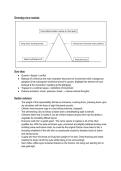
The case of Groningen:
, => Summing up
- Four types of agenda’s: universe, systemic, institutional, decision
- Competition to get on these agenda’s
- How: outside initiative, mobilization, inside access
- Three perspectives on why: power distribution, institution-based, contingency
- Problem definitions: cognitive and moral dimension.
A very important stage of policy-making is agenda setting, which basically comes down to
which problems and possible solutions get noticed by political elites and which do not.
Problem definition is a crucial aspect of agenda setting that we will explore more in depth.
We will see that problem definition is a struggle for authoritative meaning in which
numbers and reasoning about causes play a substantial role.
Literature:
● Knill & Tosun: Chapter 5 (Problem definition and agenda setting), pp. 97-120.
● Stone: Chapters 8 (Numbers) and 9 (Causes), pp. 183-228.
I. What is agenda setting?
Knill and Tosun and Birkland define agenda setting in different ways both looking for
definitions. For Knill & Tosun ‘put simply, this stage is about getting an issue on the
agenda’. However for Birkland (not in readings) agenda setting is ‘(…) the process by
which problems and alternative solutions gain or lose public and elite attention’.
But, what is an agenda? For Birkland (not in readings): ‘An agenda is a collection of
problems, understandings of causes, symbols, solutions, and other elements of public
problems that come to the attention of members of the public and their government
officials’. Here, problems are the core element and governmental and non-governmental
actors participate in the process.
There are 4 types of agenda:
1. Agenda universe: All matters possibly up for discussion.
2. Systemic agenda: Problems worthy of public attention.
3. Institutional agenda: Problems up for spending time and resources.
4. Decision agenda: Problems that will be acted upon.
,Getting on the right agenda: It is important to know that moving up the
agenda is a competition between the potential public interests. The higher
you get, the more competition between interest groups, NGOs, SMOs…
there is. There is a core executive system: small time window; a Federal
system such as U.S.: opens more opportunities.
II. The how and why of agenda-setting
- Outside initiative model: Bottom up: NGOs, SMOs.
- Mobilization model: Top down: politicians move topic between agenda’s (ex: Aids).
- Inside access model: Top down: focus on stakeholders (ex: accountability
hospitals).
Three dimensions of power:
Dahl: A has power over B to the extent that she or he can have B do
something that B would not otherwise do.
Barach & Baratz: A creates or reinforces social and political values and
institutional practices that limit the scope for B to raise issues
that would be detrimental to A's preferences.
Lukes: A also has power over B by influencing, shaping and
determining his or her desires through control over
information, mass media, and socialization processes.
The why of agenda-setting, Knill & Tosun have three perspectives about this:
1. Power distribution perspective: First dimension: pressure on government
through lobbying, protest and media attention. Second dimension: how topics
are kept off the agenda.
2. Institution based perspective: Punctuated equilibrium (= is a conceptual
framework for understanding the process of change in complex social systems.
The approach studies the evolution of policy change,[1] including the evolution of
conflicts.[2] The theory posits that most social systems exist in an extended
period of stasis, which may be punctuated by sudden shifts leading to radical
change).
, 3. Contingency perspective: Garbage can model (=is an irrational model of
decision-making, which assumes that problems, solutions and participants are
disconnected and exist as separate organizational streams. Choice opportunities
are initiated by the organization, but none or few problems may be solved in the
process and then only by chance).
III. Problem definitions and different actors
Constructivism and problems:
+ Policy making as deeply political
+ Not one truth, fact or proof
+ Multiple visions of reality
+ Language and symbolic meaning are ambiguous = multiple interpretations
+ Politics & policy: strategic context of problems and solutions
Problem definition:
● Cognitive dimension
Problem definition is the same as formulating the problem and finding a preferred
solution; leap from is to ought. Naming or giving a problem a name is also important,
and they need to give a proposition of facts (=causal, predictive, historical, severity,
incidence, novelty, proximity claims…). Also, in order to define the problem numerical
estimates like incidence, growth or range are mandatory.
● Moral dimension
Shaming. This dimension enables status quo or desired change, it also gives some
propositions of value: what is good, bad, moral, immoral… and load justifications for
solution with support for action. (Link with Stone ch.9 on causes).
The case of Groningen:
, => Summing up
- Four types of agenda’s: universe, systemic, institutional, decision
- Competition to get on these agenda’s
- How: outside initiative, mobilization, inside access
- Three perspectives on why: power distribution, institution-based, contingency
- Problem definitions: cognitive and moral dimension.