🧶
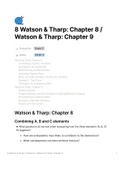
8 Watson & Tharp: Chapter 8 /
Watson & Tharp: Chapter 9
Evaluation Exam 2
WEEK WEEK 9
Watson & Tharp: Chapter 8
Combining A, B and C elements
Six Features of a Good Plan
Brainstorming an Effective Plan
Improving Ongoing Plans
When you make mistakes, Control your Attention
Develop If...Then Plans
Techniques for Evaluating a Plan
Watson & Tharp: Chapter 9
Problem Solving
Trouble shooting: Common Problems in Self-Modification Projects
The Abstinence Violation Effect
Recognize High-Risk Situations
Prepare self-instructions
Watson & Tharp: Chapter 8
Combining A, B and C elements
What questions do we ask when evaluating how the three elements A, B, C
fit together?
How are antecedents most likely to contribute to the desired bxs?
What consequences can best reinforce that bxs?
8 Watson & Tharp: Chapter 8 / Watson & Tharp: Chapter 9 1
, What is the two-stage process?
Avoid high risk situations.
Build new bxs.
Six Features of a Good Plan
What are the fix features of a good plan?
Develop measurable goals and subgoals.
Develop effective rules.
Practice.
Provide immediate and consistent feedback on your bx.
Compare feedback on your bx to goals and subgoals.
Adjust the plan to new conditions.
Brainstorming an Effective Plan
What do we do when brainstorming an effective plan?
Try to quantify of ideas.
Don't criticize or evaluate your ideas.
Try to think of unusual ideas.
Try to combine ideas to create new ones.
Improving Ongoing Plans
What do we do when improving ongoing plans?
Learn from mistakes.
Skill of dealing with mistakes.
Changing targets and effects on record keeping.
When you make mistakes, Control your Attention
8 Watson & Tharp: Chapter 8 / Watson & Tharp: Chapter 9 2
8 Watson & Tharp: Chapter 8 /
Watson & Tharp: Chapter 9
Evaluation Exam 2
WEEK WEEK 9
Watson & Tharp: Chapter 8
Combining A, B and C elements
Six Features of a Good Plan
Brainstorming an Effective Plan
Improving Ongoing Plans
When you make mistakes, Control your Attention
Develop If...Then Plans
Techniques for Evaluating a Plan
Watson & Tharp: Chapter 9
Problem Solving
Trouble shooting: Common Problems in Self-Modification Projects
The Abstinence Violation Effect
Recognize High-Risk Situations
Prepare self-instructions
Watson & Tharp: Chapter 8
Combining A, B and C elements
What questions do we ask when evaluating how the three elements A, B, C
fit together?
How are antecedents most likely to contribute to the desired bxs?
What consequences can best reinforce that bxs?
8 Watson & Tharp: Chapter 8 / Watson & Tharp: Chapter 9 1
, What is the two-stage process?
Avoid high risk situations.
Build new bxs.
Six Features of a Good Plan
What are the fix features of a good plan?
Develop measurable goals and subgoals.
Develop effective rules.
Practice.
Provide immediate and consistent feedback on your bx.
Compare feedback on your bx to goals and subgoals.
Adjust the plan to new conditions.
Brainstorming an Effective Plan
What do we do when brainstorming an effective plan?
Try to quantify of ideas.
Don't criticize or evaluate your ideas.
Try to think of unusual ideas.
Try to combine ideas to create new ones.
Improving Ongoing Plans
What do we do when improving ongoing plans?
Learn from mistakes.
Skill of dealing with mistakes.
Changing targets and effects on record keeping.
When you make mistakes, Control your Attention
8 Watson & Tharp: Chapter 8 / Watson & Tharp: Chapter 9 2