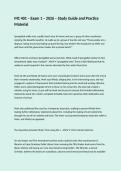
MC 401 – Exam 1 – 2026 – Study Guide and Practice
Material
SpongeBob walks onto a public beach near his home and sees a group of other vacationers
enjoying the beautiful weather. He walks up to a group of tourists and says "These people are a
disgrace, laying around and taking up space like big, lazy whales! We should pick up shells and
pelt them until the government makes this a private beach!"
Officer Patrick overhears SpongeBob and arrests him. What result if SpongeBob claims his First
Amendment rights were violated? - ANS✔✔ SpongeBob wins! There is little likelihood that his
audience would respond in the manner advocated by him under these facts.
Mork de Ork and Mindy No Name were once romantically involved. Some years after the end of
their romantic relationship, Mork sued Mindy, alleging that, in the intervening years, she had
engaged in a pattern of harassment that included hacking into his email and sending offensive
letters and a naked photograph of him to those on his contact list. She also had created a
website, using his name, to pre-sell her book and to post an excerpt that included defamatory
statements about him. Mork's complaint included claims for injunctive relief, defamation and
invasion of privacy.
Mork also petitioned the court for a temporary injunction, seeking to prevent Mindy from
making further defamatory statements about him, including the making of such statements
through the use of her website and book. The lower court granted temporary injunctive relief to
Mork, and Mindy has appealed.
The injunction prevents Mindy "from using the n - ANS✔✔ Prior restraint doctrine
An avid reader and First Amendment activist seeks a judicial order that would prevent a
librarian at Cape Girardeau Public Library from removing the Fifty Shades book series from the
library shelves and having an I Love Jesus book burning bonfire. The librarian, a devout
Christian, believes the books are scandalous, obscene and immoral and should not be available
, to anyone to read. The reader's request for the judicial order would be what source of law? -
ANS✔✔ NOT statutory law
A city ordinance prohibited homeowners from displaying any signs on property except
residence identification, for sale signs and signs warning of safety hazards. Blue Ivy placed a 24-
by-36-inch sign calling for peace in the Middle East on her front lawn. The original sign
disappeared and a subsequent sign was knocked down. She reported these incidents to the
police, who advised her that such signs were prohibited in the city. She replaced the lawn signs
with a new one in her window and sued the city on grounds the ordinance violated her right to
free speech.
If the city argues the ordinance is a valid time, place, and manner restriction, what is Ivy's best
argument? - ANS✔✔ The ordinance was a complete ban on expression using signs.
Suppose that a Missouri statute provides for the abatement of any "malicious, scandalous or
defamatory newspaper, magazine or other periodical" as a public nuisance. A St. Louis
newspaper publishes a series of articles about gambling, bootlegging and racketeering in the
city, and alleges that governmental officials are in cahoots with the Canadian mob. A county
attorney seeks to have the newspaper labeled a nuisance and barred from publishing under the
statute. A trial court hears evidence regarding the truthfulness of the prior articles, and issues
an injunction against further publication. Under the First Amendment, is the injunction valid? -
ANS✔✔ No because injunctions against speech are presumptively invalid because they preclude
or delay publication, sometimes for long periods, thereby keeping information from the public.
In the state of Buckingham, the law authorizes public schools to regulate the after-hours use of
school property and facilities. The Backwater R-2 School District, acting under state law, allowed
social, civic, and recreational uses of its schools, but prohibited the use of its property by any
political group. The school district refused repeated requests by Young Democrats to use the
school's facilities for an after-hours political rally.
The organization brought suit against the school district, claiming the school district violated the
First Amendment's right to free speech when it denied the group the use of school premises.
Material
SpongeBob walks onto a public beach near his home and sees a group of other vacationers
enjoying the beautiful weather. He walks up to a group of tourists and says "These people are a
disgrace, laying around and taking up space like big, lazy whales! We should pick up shells and
pelt them until the government makes this a private beach!"
Officer Patrick overhears SpongeBob and arrests him. What result if SpongeBob claims his First
Amendment rights were violated? - ANS✔✔ SpongeBob wins! There is little likelihood that his
audience would respond in the manner advocated by him under these facts.
Mork de Ork and Mindy No Name were once romantically involved. Some years after the end of
their romantic relationship, Mork sued Mindy, alleging that, in the intervening years, she had
engaged in a pattern of harassment that included hacking into his email and sending offensive
letters and a naked photograph of him to those on his contact list. She also had created a
website, using his name, to pre-sell her book and to post an excerpt that included defamatory
statements about him. Mork's complaint included claims for injunctive relief, defamation and
invasion of privacy.
Mork also petitioned the court for a temporary injunction, seeking to prevent Mindy from
making further defamatory statements about him, including the making of such statements
through the use of her website and book. The lower court granted temporary injunctive relief to
Mork, and Mindy has appealed.
The injunction prevents Mindy "from using the n - ANS✔✔ Prior restraint doctrine
An avid reader and First Amendment activist seeks a judicial order that would prevent a
librarian at Cape Girardeau Public Library from removing the Fifty Shades book series from the
library shelves and having an I Love Jesus book burning bonfire. The librarian, a devout
Christian, believes the books are scandalous, obscene and immoral and should not be available
, to anyone to read. The reader's request for the judicial order would be what source of law? -
ANS✔✔ NOT statutory law
A city ordinance prohibited homeowners from displaying any signs on property except
residence identification, for sale signs and signs warning of safety hazards. Blue Ivy placed a 24-
by-36-inch sign calling for peace in the Middle East on her front lawn. The original sign
disappeared and a subsequent sign was knocked down. She reported these incidents to the
police, who advised her that such signs were prohibited in the city. She replaced the lawn signs
with a new one in her window and sued the city on grounds the ordinance violated her right to
free speech.
If the city argues the ordinance is a valid time, place, and manner restriction, what is Ivy's best
argument? - ANS✔✔ The ordinance was a complete ban on expression using signs.
Suppose that a Missouri statute provides for the abatement of any "malicious, scandalous or
defamatory newspaper, magazine or other periodical" as a public nuisance. A St. Louis
newspaper publishes a series of articles about gambling, bootlegging and racketeering in the
city, and alleges that governmental officials are in cahoots with the Canadian mob. A county
attorney seeks to have the newspaper labeled a nuisance and barred from publishing under the
statute. A trial court hears evidence regarding the truthfulness of the prior articles, and issues
an injunction against further publication. Under the First Amendment, is the injunction valid? -
ANS✔✔ No because injunctions against speech are presumptively invalid because they preclude
or delay publication, sometimes for long periods, thereby keeping information from the public.
In the state of Buckingham, the law authorizes public schools to regulate the after-hours use of
school property and facilities. The Backwater R-2 School District, acting under state law, allowed
social, civic, and recreational uses of its schools, but prohibited the use of its property by any
political group. The school district refused repeated requests by Young Democrats to use the
school's facilities for an after-hours political rally.
The organization brought suit against the school district, claiming the school district violated the
First Amendment's right to free speech when it denied the group the use of school premises.