PROBLEM 8. COGNITIVE AGEING 1
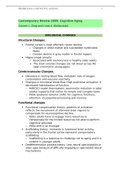
Contemporary Review 2009: Cognitive Aging
(Lauren L. Drag and Linas A. Bieliauskas)
BIOLOGICAL CHANGES
Structural Changes
Frontal cortex is most affected / faster decline
o Changes in white matter and susceptible myelinated
fibers
o Greater decline in gray matter in frontal regions
Hippocampal atrophy
o Associated with memory loss in healthy older adults
The brain volume changes are not linear across life
span (minimal in young ages)
Cerebrovascular Changes
Decrease in resting blood flow, metabolic rate of oxygen
consumption and vascular reactivity
Changes in functional blood flow: High prefrontal activation
decreased lateralization of function
o HAROLD model (Hemispheric asymmetry reduction in older
adults) supports that notion for simple and complex tasks
o PASA (posterior-anterior shift): for cognitive functions,
attention, visuospatial processing and memory
Functional changes
Functional compensation theory: patterns of activation
reflects the recruitment of alternate brain regions to
compensate for neurocognitive decline.
o Older adults have to engage more resources to
compensate for the limited resources not able to perform
cognitive activities
o PASA shift is an example
Scaffolding theory: increases in functional brain activity,
particularly in the frontal cortex represent compensatory
scaffolding
o Scaffolding is a response to challenge not to aging and it is
evident in younger adults
Dedifferentiation process theory: Less neural specialization in
older ages because of difficulty engaging in specialized neural
mechanisms.
, PROBLEM 8. COGNITIVE AGEING 2
o Another theory proposed that dedifferentiation is a results
of disruptions in dopamine system affecting the
prefrontal cortex
o Results in disruptions of top-dow/goal-driven processes
older networks less discriminant and more likely to respond
to similar stimuli
Interrelated cognitive activities because of lack of neural
specialization
MODERATING VARIABLES IN COGNITIVE AGING
Variables: intelligence, education and sensory abilities, extraneous
influences (inter-individual variability increases with age)
Greater heterogeneity for low scorers
Education
Positive relationship between education and cognitive
performance
o Influence on: recall ability and minimal effects on
recognition performance greater influence on strategic
memory demands
Years of education-lower rates of cognitive decline (more
cognitive reserve)
o Cognitive reserve: passive-capacity of neurons or active-
engage alternative networks
Protective factor against cognitive aging (AD cognitive
symptoms same, the high educated were more
progressed in the course of the disorder)
Individuals with higher reserve start with higher
resources and take longer to reach the threshold for the
disorder appearance
Positive influence throughout the life span
Biological influences
Sensory function is a component of cognitive function
sensory inefficiency leads to engagement of more resources
for “simpler” tasks which in turn leads to less resources for
complex cognitive tasks
Intra-individual variability
Time-of day effect: decline of cognitive performance in the
afternoon
Coffee can minimize this decline and improve cognitive
performance in the afternoon
THEORIES OF AGING
Contemporary Review 2009: Cognitive Aging
(Lauren L. Drag and Linas A. Bieliauskas)
BIOLOGICAL CHANGES
Structural Changes
Frontal cortex is most affected / faster decline
o Changes in white matter and susceptible myelinated
fibers
o Greater decline in gray matter in frontal regions
Hippocampal atrophy
o Associated with memory loss in healthy older adults
The brain volume changes are not linear across life
span (minimal in young ages)
Cerebrovascular Changes
Decrease in resting blood flow, metabolic rate of oxygen
consumption and vascular reactivity
Changes in functional blood flow: High prefrontal activation
decreased lateralization of function
o HAROLD model (Hemispheric asymmetry reduction in older
adults) supports that notion for simple and complex tasks
o PASA (posterior-anterior shift): for cognitive functions,
attention, visuospatial processing and memory
Functional changes
Functional compensation theory: patterns of activation
reflects the recruitment of alternate brain regions to
compensate for neurocognitive decline.
o Older adults have to engage more resources to
compensate for the limited resources not able to perform
cognitive activities
o PASA shift is an example
Scaffolding theory: increases in functional brain activity,
particularly in the frontal cortex represent compensatory
scaffolding
o Scaffolding is a response to challenge not to aging and it is
evident in younger adults
Dedifferentiation process theory: Less neural specialization in
older ages because of difficulty engaging in specialized neural
mechanisms.
, PROBLEM 8. COGNITIVE AGEING 2
o Another theory proposed that dedifferentiation is a results
of disruptions in dopamine system affecting the
prefrontal cortex
o Results in disruptions of top-dow/goal-driven processes
older networks less discriminant and more likely to respond
to similar stimuli
Interrelated cognitive activities because of lack of neural
specialization
MODERATING VARIABLES IN COGNITIVE AGING
Variables: intelligence, education and sensory abilities, extraneous
influences (inter-individual variability increases with age)
Greater heterogeneity for low scorers
Education
Positive relationship between education and cognitive
performance
o Influence on: recall ability and minimal effects on
recognition performance greater influence on strategic
memory demands
Years of education-lower rates of cognitive decline (more
cognitive reserve)
o Cognitive reserve: passive-capacity of neurons or active-
engage alternative networks
Protective factor against cognitive aging (AD cognitive
symptoms same, the high educated were more
progressed in the course of the disorder)
Individuals with higher reserve start with higher
resources and take longer to reach the threshold for the
disorder appearance
Positive influence throughout the life span
Biological influences
Sensory function is a component of cognitive function
sensory inefficiency leads to engagement of more resources
for “simpler” tasks which in turn leads to less resources for
complex cognitive tasks
Intra-individual variability
Time-of day effect: decline of cognitive performance in the
afternoon
Coffee can minimize this decline and improve cognitive
performance in the afternoon
THEORIES OF AGING