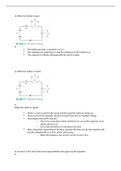
Q: When the switch is open
A:
The battery provides a constant e.m.f V0
The capacitor has capacitance C and the resistance of the resistor is R
The capacitor is initially uncharged and the switch is open
Q: When the switch is closed
A:
When the switch is closed
There is a max current in the circuit and the capacitor starts to charge up
The p.d across the capacitor starts to increase from zero as it gathers charge
According to Kirchhoff's 2nd law:
o The p.d VR across the resistor and the p.d VC across the capacitor must
always add up to V0
o So VR must decrease as VC increases with time
After a long time, depending on the time constant CR of the circuit, the capacitor will
be fully charged with a p.d of V 0 and VR will be zero
o When this happens, the current I in the circuit is zero
Q: Current I in the circuit decreases exponentially and is given by the equation:
A:
A:
The battery provides a constant e.m.f V0
The capacitor has capacitance C and the resistance of the resistor is R
The capacitor is initially uncharged and the switch is open
Q: When the switch is closed
A:
When the switch is closed
There is a max current in the circuit and the capacitor starts to charge up
The p.d across the capacitor starts to increase from zero as it gathers charge
According to Kirchhoff's 2nd law:
o The p.d VR across the resistor and the p.d VC across the capacitor must
always add up to V0
o So VR must decrease as VC increases with time
After a long time, depending on the time constant CR of the circuit, the capacitor will
be fully charged with a p.d of V 0 and VR will be zero
o When this happens, the current I in the circuit is zero
Q: Current I in the circuit decreases exponentially and is given by the equation:
A: