
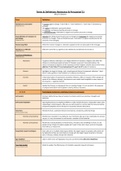
Terms & Definitions Resistance & Persuasion’21
© by R. Broeren
Term Definition
Resistance to persuasion A reaction against change: “I don’t like it”, “I don’t believe it”, “I won’t do it” (resistance as
(Knowles & Linn) attitude)
The ability to withstand a persuasive attack
An outcome: not being moved by pressures to change
A motivational state: motivation to oppose and counter pressures to change
Dual definition of resistance in Outcome (not being moved to pressures to change) and motivation (to oppose and counter
psychology pressures to change). These are linked because a motivation to oppose would promote the
(Knowles & Linn) outcome of not changing
Boomerang effect When the receiver changes in a direction opposite to the one advocated in the message
Resistance as Attitude Affective (i dont like it), cognitive (i dont believe it) and behvioral (i wont do it)
(Knowles & Linn)
Four faces of Resistance:
(Knowles & Linn)
- Reactance recognizes influence attempts as an integral element of resistance. Happens only when the
influence is directly perceived and when it threatens a person’s choice alternatives. the
amount of reactance depends on the importance of the freedoms and the nature of the threat.
affective (“I don’t like it!”) and motivational (“I won’t do it!”) sides of resistance.
- Distrust Spotlights the target of change, and it reveals general distrust of proposals. affective (“I don’t
like it!”) and cognitive (“I don’t believe it!”) reactions to influence.
- Scrutiny Critical observation of examination created by influence, offers or requests. When people are
aware of the influence attempt, they become more careful and thoughtful to every aspect of
the situation. > cognitive element
- Inertia Quality that focuses on staying put than on resisting change. It's not reactant to the proposer
or proposal and doesn't led to greater scrutiny, distrust, reactance.
Les 2,3,4 Psychological mechanisms underlying resistance to persuasion
Self-control the basic ability that we have as humans to actively control our emotions, thoughts and
behaviors.
Self-control depletion (ego depletion/resource depletion) Ability to make mindful decisions is being taken away when
responding to initial requests. After you use self-control for a certain task the resources will be
temporarily depleted and we fall back on automatic behavior (heuristics)
Heuristics: Mental shortcuts, automatic behavior (consistency, reciprocity, authority, liking)
(Fennis, Janssen & Vohs)
- Heuristic of consistency We like to be consistent in our behavior. e.g: If someone asks you if you read books etc and you
say yes, it is very inconsistent to not become a member of the bookclub
- Heuristic of reciprocity We all have a strong tendency to return favors, we want to do something in return. ex: ask
people to buy 5 boxes of cookies, people don't want it then ask to buy 1 and a lot of people
then will buy 1 instead of 5.
Sequential request techniques Start with one or multiple initial request before the target request so peoples self-control will
be depleted and they are more likely to comply with the target request (e.g foot in the door,
door in the face, lowball, disrupt then reframe)
Ego depletion state in which one's self regulatory resources are diminished (self-control depletion)
(Wheeler, Brinol & Hermann)
Two stage model: Model to explain the effectiveness of charitable sequential request techniques
(Fennis, Janssen & Vohs)
© by R. Broeren
Term Definition
Resistance to persuasion A reaction against change: “I don’t like it”, “I don’t believe it”, “I won’t do it” (resistance as
(Knowles & Linn) attitude)
The ability to withstand a persuasive attack
An outcome: not being moved by pressures to change
A motivational state: motivation to oppose and counter pressures to change
Dual definition of resistance in Outcome (not being moved to pressures to change) and motivation (to oppose and counter
psychology pressures to change). These are linked because a motivation to oppose would promote the
(Knowles & Linn) outcome of not changing
Boomerang effect When the receiver changes in a direction opposite to the one advocated in the message
Resistance as Attitude Affective (i dont like it), cognitive (i dont believe it) and behvioral (i wont do it)
(Knowles & Linn)
Four faces of Resistance:
(Knowles & Linn)
- Reactance recognizes influence attempts as an integral element of resistance. Happens only when the
influence is directly perceived and when it threatens a person’s choice alternatives. the
amount of reactance depends on the importance of the freedoms and the nature of the threat.
affective (“I don’t like it!”) and motivational (“I won’t do it!”) sides of resistance.
- Distrust Spotlights the target of change, and it reveals general distrust of proposals. affective (“I don’t
like it!”) and cognitive (“I don’t believe it!”) reactions to influence.
- Scrutiny Critical observation of examination created by influence, offers or requests. When people are
aware of the influence attempt, they become more careful and thoughtful to every aspect of
the situation. > cognitive element
- Inertia Quality that focuses on staying put than on resisting change. It's not reactant to the proposer
or proposal and doesn't led to greater scrutiny, distrust, reactance.
Les 2,3,4 Psychological mechanisms underlying resistance to persuasion
Self-control the basic ability that we have as humans to actively control our emotions, thoughts and
behaviors.
Self-control depletion (ego depletion/resource depletion) Ability to make mindful decisions is being taken away when
responding to initial requests. After you use self-control for a certain task the resources will be
temporarily depleted and we fall back on automatic behavior (heuristics)
Heuristics: Mental shortcuts, automatic behavior (consistency, reciprocity, authority, liking)
(Fennis, Janssen & Vohs)
- Heuristic of consistency We like to be consistent in our behavior. e.g: If someone asks you if you read books etc and you
say yes, it is very inconsistent to not become a member of the bookclub
- Heuristic of reciprocity We all have a strong tendency to return favors, we want to do something in return. ex: ask
people to buy 5 boxes of cookies, people don't want it then ask to buy 1 and a lot of people
then will buy 1 instead of 5.
Sequential request techniques Start with one or multiple initial request before the target request so peoples self-control will
be depleted and they are more likely to comply with the target request (e.g foot in the door,
door in the face, lowball, disrupt then reframe)
Ego depletion state in which one's self regulatory resources are diminished (self-control depletion)
(Wheeler, Brinol & Hermann)
Two stage model: Model to explain the effectiveness of charitable sequential request techniques
(Fennis, Janssen & Vohs)


