Alcohols and carboxylic acids - Chemistry
Alcohols
The alcohols form a homologous series. Like all homologous series, the alcohols:
- have the same general formula.
- differ by CH2 in molecular formulae from neighbouring compounds.
- show a gradual variation in physical properties, such as their boiling points.
- have similar chemical properties.
Functional group
The functional group in the alcohols is the hydroxyl group, –OH. It is responsible for the
typical reactions of alcohols. Take care not to confuse the –OH group with the hydroxide
ion, OH-.
General formula
The general formula for the alcohols is CnH2n+1OH (where n is the number of carbon atoms
in the molecule).
Worked example-
Decanol is an alcohol. Its molecules contain ten carbon atoms. Predict the formula of
decanol and explain your answer.
The formula is C10H21OH. This is because n = 10. So, 2n+1 = (2 × 10) + 1 = 20 + 1 = 21.
Structures
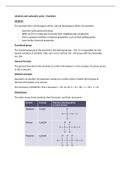
The table shows three alcohols, their formulae, and their structures –
, Reactions of alcohols -
The alcohols undergo complete combustion to form carbon dioxide and water. For
example, ethanol is used as a fuel:
Ethanol + oxygen → carbon dioxide + water
C2H5OH + 3O2 → 2CO2 + 3H2O
However, the alcohols can also be chemically oxidised, without combustion in oxygen, to
produce carboxylic acids. For example, ethanol can be oxidised to ethanoic acid using an
oxidising agent.
It is easier to understand what happens if ethanol is shown as CH3CH2OH in the balanced
equation:
Ethanol + oxidising agent → ethanoic acid + water
CH3CH2OH + 2[O] → CH3COOH + H2O
Each of the two oxygen atoms provided by the oxidising agent are shown as [O]. Notice that
the left-hand side of the ethanol molecule is unchanged. The reaction involves the carbon
attached to the –OH functional group on the right-hand side. The number of carbon atoms
in the carboxylic acid is the same as the number of carbon atoms in the alcohol.
Ethanol -
Ethanol is the alcohol found in beer, wine and other alcoholic drinks. It is also used as a fuel
for vehicles, either on its own or mixed with petrol. Ethanol can be produced by
fermentation and concentrated using fractional distillation.
Fermentation -
Fermentation is an anaerobic process (it happens in the absence of oxygen):
Glucose → ethanol + carbon dioxide
Yeast, a type of single-celled fungus, provides the enzymes needed for fermentation. If the
yeast cells become too cold, fermentation happens very slowly, or may not happen at all. If
the yeast cells become too hot, their enzymes become denatured and fermentation stops.
The typical conditions needed for fermentation include:
- sugars dissolved in water, and mixed with yeast
- an air lock to allow carbon dioxide out, while stopping air getting in
- warm temperature, 25-35°C
The yeast dies when the ethanol concentration reaches about 15%. Fermentation is a slow
reaction and takes several days or weeks to finish. If air is present, the oxygen causes the
ethanol to oxidise to ethanoic acid, so the drink tastes of vinegar.
Alcohols
The alcohols form a homologous series. Like all homologous series, the alcohols:
- have the same general formula.
- differ by CH2 in molecular formulae from neighbouring compounds.
- show a gradual variation in physical properties, such as their boiling points.
- have similar chemical properties.
Functional group
The functional group in the alcohols is the hydroxyl group, –OH. It is responsible for the
typical reactions of alcohols. Take care not to confuse the –OH group with the hydroxide
ion, OH-.
General formula
The general formula for the alcohols is CnH2n+1OH (where n is the number of carbon atoms
in the molecule).
Worked example-
Decanol is an alcohol. Its molecules contain ten carbon atoms. Predict the formula of
decanol and explain your answer.
The formula is C10H21OH. This is because n = 10. So, 2n+1 = (2 × 10) + 1 = 20 + 1 = 21.
Structures
The table shows three alcohols, their formulae, and their structures –
, Reactions of alcohols -
The alcohols undergo complete combustion to form carbon dioxide and water. For
example, ethanol is used as a fuel:
Ethanol + oxygen → carbon dioxide + water
C2H5OH + 3O2 → 2CO2 + 3H2O
However, the alcohols can also be chemically oxidised, without combustion in oxygen, to
produce carboxylic acids. For example, ethanol can be oxidised to ethanoic acid using an
oxidising agent.
It is easier to understand what happens if ethanol is shown as CH3CH2OH in the balanced
equation:
Ethanol + oxidising agent → ethanoic acid + water
CH3CH2OH + 2[O] → CH3COOH + H2O
Each of the two oxygen atoms provided by the oxidising agent are shown as [O]. Notice that
the left-hand side of the ethanol molecule is unchanged. The reaction involves the carbon
attached to the –OH functional group on the right-hand side. The number of carbon atoms
in the carboxylic acid is the same as the number of carbon atoms in the alcohol.
Ethanol -
Ethanol is the alcohol found in beer, wine and other alcoholic drinks. It is also used as a fuel
for vehicles, either on its own or mixed with petrol. Ethanol can be produced by
fermentation and concentrated using fractional distillation.
Fermentation -
Fermentation is an anaerobic process (it happens in the absence of oxygen):
Glucose → ethanol + carbon dioxide
Yeast, a type of single-celled fungus, provides the enzymes needed for fermentation. If the
yeast cells become too cold, fermentation happens very slowly, or may not happen at all. If
the yeast cells become too hot, their enzymes become denatured and fermentation stops.
The typical conditions needed for fermentation include:
- sugars dissolved in water, and mixed with yeast
- an air lock to allow carbon dioxide out, while stopping air getting in
- warm temperature, 25-35°C
The yeast dies when the ethanol concentration reaches about 15%. Fermentation is a slow
reaction and takes several days or weeks to finish. If air is present, the oxygen causes the
ethanol to oxidise to ethanoic acid, so the drink tastes of vinegar.