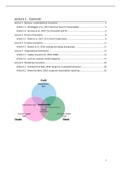
Lecture 1 - Contents
Lecture 2 - Business, sustainability & innovation .................................................................................... 3
Article 2.1 - Schaltegger et al., 2017: Business Cases for Sustainability.............................................. 3
Article 2.2 - de Jesus et al., 2017: Eco-innovation and CE ................................................................... 6
Lecture 3 - Process innovations............................................................................................................... 8
Article 3.1 - Reike et al., 2017: CE 3.0 and R imperatives.................................................................... 8
Lecture 4 - Product innovations ............................................................................................................ 11
Article 4.1 - Bocken et al., 2016: slowing narrowing closing loops ................................................... 11
Lecture 5 - Organisational innovations ................................................................................................. 13
Article 5.1 - Lüdeke-Freund et al., 2018: CEBM ................................................................................ 13
Article 5.2 - Lectures: business model categories ............................................................................. 17
Lecture 6 - Marketing innovations ........................................................................................................ 18
Article 6.1 - Chamberlin & Boks, 2018: design for sustainable behaviour ........................................ 18
Article 6.2 - Stewart & Niero, 2018: corporate sustainability reporting ........................................... 19
1
,Circular economy: a regenerative system in which resource input and waste, emission, and energy
leakage are minimized by slowing, closing, and narrowing material and energy loops.
Measured on three levels:
− Micro: the CE focuses on individual actors (particularly companies)
− Meso: focus on actor interaction, especially on inter-firm networks and green supply chain
management
− Macro: national or global scale with emphasis on legislation
Principles of CE:
− Design out waste and pollution
− Keep products and materials in use
− Regenerate natural systems
CE and Doughnut economy
− Similarities
o Both focus on nutrients/resources. Specifically, waste of nutrients/resources
− Differences
o Doughnut economy is also focused on social aspects, while the CE is mainly focused
on resources.
o Circular economy only improves some of the boundaries of the Doughnut economy
o Doughnut economy is more of a framework while the CE is more of a tool to
implement it
− How do they fit together?
o CE is a possible micro solution for the inequalities described by the Doughnut
economy
2
, Lecture 2 - Business, sustainability & innovation
Article 2.1 - Schaltegger et al., 2017: Business Cases for Sustainability
Stakeholders: any group or individual that can either impact the company or that the company can
impact. Types of stakeholders:
− Primary stakeholders: direct control of essential means of support required by the
organisation. E.g. Consumers
− Secondary stakeholders: do not directly provide any essential means of support for the
organization but still have influence through the primary stakeholders. E.g. Researcher at a
university as the researcher is not directly related to a company but the research can become
important for the company through the primary stakeholder.
− interested parties: interest in organizational activities, output, or outcome, but no ability to
act if their needs are not met. E.g. Future generations.
3
Lecture 2 - Business, sustainability & innovation .................................................................................... 3
Article 2.1 - Schaltegger et al., 2017: Business Cases for Sustainability.............................................. 3
Article 2.2 - de Jesus et al., 2017: Eco-innovation and CE ................................................................... 6
Lecture 3 - Process innovations............................................................................................................... 8
Article 3.1 - Reike et al., 2017: CE 3.0 and R imperatives.................................................................... 8
Lecture 4 - Product innovations ............................................................................................................ 11
Article 4.1 - Bocken et al., 2016: slowing narrowing closing loops ................................................... 11
Lecture 5 - Organisational innovations ................................................................................................. 13
Article 5.1 - Lüdeke-Freund et al., 2018: CEBM ................................................................................ 13
Article 5.2 - Lectures: business model categories ............................................................................. 17
Lecture 6 - Marketing innovations ........................................................................................................ 18
Article 6.1 - Chamberlin & Boks, 2018: design for sustainable behaviour ........................................ 18
Article 6.2 - Stewart & Niero, 2018: corporate sustainability reporting ........................................... 19
1
,Circular economy: a regenerative system in which resource input and waste, emission, and energy
leakage are minimized by slowing, closing, and narrowing material and energy loops.
Measured on three levels:
− Micro: the CE focuses on individual actors (particularly companies)
− Meso: focus on actor interaction, especially on inter-firm networks and green supply chain
management
− Macro: national or global scale with emphasis on legislation
Principles of CE:
− Design out waste and pollution
− Keep products and materials in use
− Regenerate natural systems
CE and Doughnut economy
− Similarities
o Both focus on nutrients/resources. Specifically, waste of nutrients/resources
− Differences
o Doughnut economy is also focused on social aspects, while the CE is mainly focused
on resources.
o Circular economy only improves some of the boundaries of the Doughnut economy
o Doughnut economy is more of a framework while the CE is more of a tool to
implement it
− How do they fit together?
o CE is a possible micro solution for the inequalities described by the Doughnut
economy
2
, Lecture 2 - Business, sustainability & innovation
Article 2.1 - Schaltegger et al., 2017: Business Cases for Sustainability
Stakeholders: any group or individual that can either impact the company or that the company can
impact. Types of stakeholders:
− Primary stakeholders: direct control of essential means of support required by the
organisation. E.g. Consumers
− Secondary stakeholders: do not directly provide any essential means of support for the
organization but still have influence through the primary stakeholders. E.g. Researcher at a
university as the researcher is not directly related to a company but the research can become
important for the company through the primary stakeholder.
− interested parties: interest in organizational activities, output, or outcome, but no ability to
act if their needs are not met. E.g. Future generations.
3