Psych 255 quiz 4 exam questions and answers
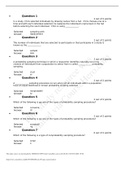
Question 1 2 out of 2 points In a study, Chris selected individuals by drawing names from a hat. Chris chooses one at a time and with each individual selected, he replaces the individual’s name back in the hat before selecting the next individual. Chris is using . Question 2 2 out of 2 points The number of individuals that are selected to participate or that participate in a study is known as the . Question 3 2 out of 2 points A probability sampling technique in which a researcher identifies naturally occurring clusters of individuals from a population to select from is called probability sampling. Question 4 2 out of 2 points A sampling procedure occurs when not all individuals within a population have an equal likelihood or known probability of being selected. Question 5 2 out of 2 points Which of the following is not one of the types of probability sampling procedures? Question 6 2 out of 2 points Which of the following is not one of the types of probability sampling procedures? Question 7 Which of the following is a type of nonprobability sampling procedure? 0 out of 2 points Question 8 2 out of 2 points In a sampling procedure, each individual in a population has a known probability (or chance) of being selected for a study. Question 9 2 out of 2 points When two population overlap minimally on a dependent variable, they are said to have a(n) effect size. Question 10 2 out of 2 points The two main sampling techniques that researchers use are sampling and sampling. Question 11 2 out of 2 points After analyzing her data, Faith has found that her power level for her analyses is .80. Faith’s power is considered to be . Question 12 0 out of 2 points While selecting participants for her study, Jamie draws names from a hat to place participants in groups. Once the participant’s name has been selected, she does not put it back in the hat. Jamie is using . Question 13 2 out of 2 points A nonprobability sampling procedure where a sample is acquired by a referral process among similar individuals is called a sampling procedure. Question 14 2 out of 2 points In a probability sampling procedure, all individuals in a population have an equal probability of being selected. Question 15 2 out of 2 points Stefani has identified several subgroups of individuals from the population she is studying. Stefani plans on randomly sampling participants from each of these subgroups. Stefani is using probability sampling. Question 16 2 out of 2 points Which of the following is an accurate statement regarding the differences between extraneous and nuisance variables? Question 17 2 out of 2 points You have just learned of survey results conducted by your university on the drinking behaviors of the college campus. Wondering about the results, you ask yourself the following questions: how were participants selected, were participants selected depending on if they lived on or off campus, were all the participants in a sorority or fraternity, were non–traditional age students included in the survey, and were men and women equally sampled? These types of questions indicate that you are concerned about what threat to internal validity? Question 18 2 out of 2 points Psychological studies involve the use of many variables. Which of the following variables could bias research findings? Question 19 0 out of 2 points When a change in the dependent variable could be due to participants’ familiarity with the test, is a threat to internal validity. Question 20 2 out of 2 points Reflect on the Are You Equipped Now? section at the end of chapter 9. What if some of the participants dropped out of the experiment before the end because it was not working to alleviate pain? This question is associated with which of the following threats to internal validity? Question 21 2 out of 2 points variables are variables that influence all participants and cause the experimental results to be less clear. Question 22 2 out of 2 points If you and a friend watched an episode of Family Guy separately and counted the number of violent acts, you are likely to get different counts. Which threat to internal validity explains these results? Question 23 2 out of 2 points Which of the following threats to internal validity would be of concern if an outbreak of salmonella in peanut butter occurred while a study was being conducted on perceptions of peanut butter? Question 24 2 out of 2 points When a change in the dependent variable could be due to the participant’s expectation that change will occur, is a threat to internal validity. Question 25 2 out of 2 points Reflect on the Are You Equipped Now? section at the end of chapter 9. If the decrease in pain reported by participants was due to internal changes that occurred within the participant over a three-month time period, which of the following was a threat to internal validity? Question 26 2 out of 2 points Have you ever played a video game breaking the all-time high score only to find that you were never able to duplicate that performance? This is an example of , which is a threat to internal validity. Question 27 2 out of 2 points Which of the following statements accurately describes the use of double-blind studies? Question 28 2 out of 2 points Which of the following statements regarding threats to internal validity is correct? Question 29 2 out of 2 points When a change in the dependent variable could be due to participants in one group talking to participants in another group, is a threat to internal validity. Chapter 9 begins with an example regarding the TV show American Idol. The format of the show allows viewers to watch performances and, after hearing reviews of the judges, call in to vote for their favorite performer. The judges providing feedback before viewers vote could be a problem because .
Written for
- Institution
-
Grand Canyon University
- Course
-
PSYCH 255 (PSYCH255)
Document information
- Uploaded on
- April 9, 2021
- Number of pages
- 5
- Written in
- 2020/2021
- Type
- Exam (elaborations)
- Contains
- Questions & answers
Subjects
- psych 255
- in a study
-
chris selected individuals by drawing names from a hat chris chooses one at a time and with each individual selected
-
he replaces the individual’s name back in the hat before se

Also available in package deal