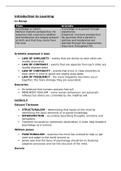
Introduction to Learning
L1 Recap
Plato Aristotle
Knowledge is inborn. Knowledge is acquired through
Nativist (nature) perspective. He experience.
assumes that a person’s abilities Empiricist (nurture) perspective.
and tendencies are largely present He assumes that a person’s
at birth and that they come from abilities and tendencies are
the soul. learned through the experiences
they have throughout life.
Aristotle proposed 4 laws
LAW OF SIMILARITY – events that are similar to each other are
readily associated.
LAW OF CONTRAST – events that are opposite from each other are
readily disassociated.
LAW OF CONTIGUITY – events that occur in close proximity to
each other in time or space are readily associated.
LAW OF FREQUENCY – the more frequently two items occur
together, the more strongly they are associated.
Descartes
He believed that humans possess free will.
MIND-BODY DUALISM – some human behaviours are automatic
reflexes but others are controlled by the mid/free will.
Lecture 2
Edward Titchener
STRUCTURALISM – determining that layout of the mind by
identifying the basic elements of acquired knowledge.
INTROSPECTION – accurately describing thoughts, emotions and
sensations.
Titchener focussed on systematic observation in order help establish
psychology as a science.
William James
FUNCTIONALISM – assumes the mind has evolved to help us get
used and adapt to the world around us.
James saw that the focus of psychology should be on studying
adaptive processes and not the structure of the mind.
Darwin
L1 Recap
Plato Aristotle
Knowledge is inborn. Knowledge is acquired through
Nativist (nature) perspective. He experience.
assumes that a person’s abilities Empiricist (nurture) perspective.
and tendencies are largely present He assumes that a person’s
at birth and that they come from abilities and tendencies are
the soul. learned through the experiences
they have throughout life.
Aristotle proposed 4 laws
LAW OF SIMILARITY – events that are similar to each other are
readily associated.
LAW OF CONTRAST – events that are opposite from each other are
readily disassociated.
LAW OF CONTIGUITY – events that occur in close proximity to
each other in time or space are readily associated.
LAW OF FREQUENCY – the more frequently two items occur
together, the more strongly they are associated.
Descartes
He believed that humans possess free will.
MIND-BODY DUALISM – some human behaviours are automatic
reflexes but others are controlled by the mid/free will.
Lecture 2
Edward Titchener
STRUCTURALISM – determining that layout of the mind by
identifying the basic elements of acquired knowledge.
INTROSPECTION – accurately describing thoughts, emotions and
sensations.
Titchener focussed on systematic observation in order help establish
psychology as a science.
William James
FUNCTIONALISM – assumes the mind has evolved to help us get
used and adapt to the world around us.
James saw that the focus of psychology should be on studying
adaptive processes and not the structure of the mind.
Darwin