Module: Sociology and Everyday Life
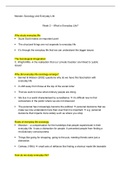
Week 2 – What is Everyday Life?
Why study everyday life
Suzie Scott makes an important point
The structural things are not separate to everyday life
It’s through the everyday life that we can understand the bigger issues
The Sociological Imagination
C. Wright-Mills the realisation that our ‘private troubles’ are linked to ‘public
issues’
Why did everyday life sociology emerge?
Bennet & Watson (2002) questions why do we have this fascination with
everyday life
A shift away from those at the top of the social order
That we want to know what ordinary people are doing
We live in a world characterised by surveillance it’s difficult now to find
somewhere in the public where we are not observed
The personal has increasingly become the political personal decisions that we
make we now understand more than ever that it is important e.g. personal
decisions that impacts more widely such as where you shop
Roots of everyday life sociology
Marxism – a compensation for the hardships that people experienced in their
everyday life. It was a distraction for people. It prevented people from finding a
revolutionary consciousness.
Things like going for shopping, going to the pub, meeting friends were just a
distraction.
Certeau (1984) small acts of defiance like finding a shortcut made life bearable
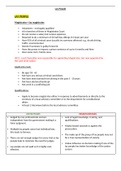
How do we study everyday life?
, To apply the methods that are appropriate to everyday sociology
To apply an ethnographic approach observing and talking to people and
understanding from their perspectives
We have to make the familiar strange – to ask the dumb and really obvious
questions e.g. why do we have cake on someone’s birthday?
Put aside the idea of what is normal
Searching for rules
What are the rules that define how people behave?
Example: not drinking alcohol in public places
Ritualistic – how do we behave during meal time?
The tension between structure and agency
Rule breaking
For functionalists, rule breaking is positive.
What this means for your work?
Shopping – there are many forms of shopping
Try not to be judgemental
The university ‘space’ – Understanding the university as a site of everyday life
Thinking about the library, what kind of activities take place there?
Studying and reading
Eat and drinking
Meeting place
A focal point for the university
Classes going on in there
How would you describe the location? For example, is it noisy or quiet? Is it
industrious or relaxed?
Top floor is really quiet
Ground floor is much more relaxed
In sociology we often describe how locations or activities are bounded from others.
How is the location divided/separated from other locations or activities? For example,
Week 2 – What is Everyday Life?
Why study everyday life
Suzie Scott makes an important point
The structural things are not separate to everyday life
It’s through the everyday life that we can understand the bigger issues
The Sociological Imagination
C. Wright-Mills the realisation that our ‘private troubles’ are linked to ‘public
issues’
Why did everyday life sociology emerge?
Bennet & Watson (2002) questions why do we have this fascination with
everyday life
A shift away from those at the top of the social order
That we want to know what ordinary people are doing
We live in a world characterised by surveillance it’s difficult now to find
somewhere in the public where we are not observed
The personal has increasingly become the political personal decisions that we
make we now understand more than ever that it is important e.g. personal
decisions that impacts more widely such as where you shop
Roots of everyday life sociology
Marxism – a compensation for the hardships that people experienced in their
everyday life. It was a distraction for people. It prevented people from finding a
revolutionary consciousness.
Things like going for shopping, going to the pub, meeting friends were just a
distraction.
Certeau (1984) small acts of defiance like finding a shortcut made life bearable
How do we study everyday life?
, To apply the methods that are appropriate to everyday sociology
To apply an ethnographic approach observing and talking to people and
understanding from their perspectives
We have to make the familiar strange – to ask the dumb and really obvious
questions e.g. why do we have cake on someone’s birthday?
Put aside the idea of what is normal
Searching for rules
What are the rules that define how people behave?
Example: not drinking alcohol in public places
Ritualistic – how do we behave during meal time?
The tension between structure and agency
Rule breaking
For functionalists, rule breaking is positive.
What this means for your work?
Shopping – there are many forms of shopping
Try not to be judgemental
The university ‘space’ – Understanding the university as a site of everyday life
Thinking about the library, what kind of activities take place there?
Studying and reading
Eat and drinking
Meeting place
A focal point for the university
Classes going on in there
How would you describe the location? For example, is it noisy or quiet? Is it
industrious or relaxed?
Top floor is really quiet
Ground floor is much more relaxed
In sociology we often describe how locations or activities are bounded from others.
How is the location divided/separated from other locations or activities? For example,