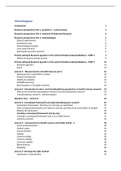
Inhoudsopgave
Introduction 2
Research perspectives Part 1: positivism – constructivism 3
Research perspectives Part 2: Inductive & Deductive Research 4
Research perspectives Part 3: methodologies 5
(Quasi) experimental 5
Analytical survey 6
Phenomological studies 6
Case study research 6
(participatory) action research 6
Priority setting & Research agenda’s in the world of Evidence Based Medicine – PART 1 7
Wheel of research priority setting 8
Priority setting & Research agenda’s in the world of Evidence Based Medicine – PART 2 12
Research agenda’s 14
Q&A 15
Lecture 3 – Measurements in Health Sciences part 1 16
Measurement in quantitative studies 16
General introduction 16
Validity & reliability 16
COSMIN taxonomy 17
Real outcome vs Surrogate outcome 18
Lecture 4 - Introduction to inter- and transdisciplinary perspective on health sciences research 19
Why do we need more participation research and interdisciplinary research 19
Transdisciplinary research – Barbara Regeer 21
Question hour – Lecture 4 22
Lecture 5 - Conceptual frameworks and operationalizing your research 25
Conceptual Frameworks, that they are and why we need them 25
How conceptual frameworks are implicit in articles, but have to be used explicit in designs 27
Making the framework 30
Creating a conceptual framework step by step: 30
Creating a conceptual framework step 1,2,3,4 Q&A lecture 31
sentizing concepts 34
Lecture 6 – measurement in Health sciences and Public health - 2 34
Levels of measurement 34
Ordinal scales: 34
Interval & Ratio 35
Validity 36
Content validity 36
Criterion validity 38
Construct validity 39
Reponsiveness 39
Reliability 40
Lecture 7: Choosing the right method 41
Qualitative vs Quantitative 42
, Common designs mixed methods design 44
An approach to select the right method 45
Q&A 46
Lecture 8 – Risk factors versus prediction of risk - nog afmaken! 47
Powerpoint observational study designs – risk factors vs prediction rules 47
Sources of bias – selection bias powerpoint slides 50
Selection bias – confounding 50
Number needed to treat (NNT) 51
Evidence Based Medicine (EBM) → mp4 video 53
Risk 53
Sources of bias → mp4 video 54
Lecture 9 – intervention design and evaluation in Health Sciences/Inter-trans transdisciplinary
research: engagement for understanding 54
Monitoring vs evaluation 56
Timeline method 58
Case story method 58
Lecture 10 – Evaluations of interventions – Experimental research: (non) regular parallel design of
RCT and alternatives 59
Selection bias: 61
Performance bias 61
Exclusion bias (attrition bias) 62
Potential sources of bias in trials 62
Criteria for internal validity 62
Criteria for external validity 62
Criteria for precision/accuracy 62
Allocation of study population 63
Lecture 11- Qualitative Data analyses 64
Part 1: elements of qualitative analysis 64
Part 2 – learn how to analyze qualitative data 65
Part 3: Quality of qualitative analysis 73
Lecture 12 – Systematic Reviews – part 1 75
What is the Cochrane Collaboration 75
Introduction to Systematic reviews 75
Steps to follow in a systematic review 77
Lecture 13- Systematic Reviews – part 2 82
Dichotomous 85
continuous outcomes 86
Ordinal outcomes 86
Heterogeneity 86
Interpretation 88
Forest Plot article – Interpreting and understanding meta-analysis graphs 90
Introduction
01-09-2020
1 werkgroep missen, 2e mag je ook missen alleen wel met vervangende opdracht
2
,all students should attend 3 workshops. The workshop research integrity is mandatory.
International public health → two workshops on interview techniques.
Exam → 60% open end questions, paar gesloten vragen geen woordenboek
Assignment → 40%
Book: doing research in the real world Gray D.E. 4th edition
Epidemiology Bouter et al. assume that you know all the chapters except chapter 10
Research perspectives Part 1: positivism – constructivism
- Scientia = (the pursuit of) knowledge about the world
- Research/science = production and organization of knowledge (to address (real
world) problems/issues
- Methodology is the body of knowledge that justifies methods chosen
The purpose of health science/research is finding an objective, generalizable, truth
- Different perspectives on knowledge production
- As a young health researcher you need to be flexible to understand and further
delineate research questions and use an appropriate methodology to address the
question
- Research from a positivist (objectivism) perspectives aims to find generalizable
truths, this is the dominant perspective within clinical research and epidemiology.
- Whereas interpretivist (constructivism) approaches to research acknowledge that
any truth is socially constructed and this socially constructed truth is largely based on
the interpretations of the researcher and his/her participants. This perspective is
more common in the social sciences.
When we want to research the society around us, are we then finding the truth or do we
construct a reality that is plausible than us. And if we construct a reality than maybe
somebody (another researcher) else may construct a slightly different reality.
- The object we study. We study them through the eyes of other subject/persons.
- Time: we can measure how long something taken ex. How long is the waiting list for
a procedure. Does it matter how people experience that time? How do you want to
study it.
Most researchers doing health sciences come from a positivism background where they are
really looking at a causality. Doing a lot of quantative research. But when you are doing
qualitative research you have to interpret the findings.
If 2 persons have the same score on a depression list, does this really mean that they’re both
equally depressed and does this say something about how we experience this. We can make
very good scales. But we have to think about if we’re constructing something or if we finding
a generalizable truth.
3
, Positivistic approaches: look at the world not by their own value frames, observe facts,
value free, largely measure and predict, it is generalizable.
Constructivism: people who look at the world through their own eyes, their own
perspectives. That gives direction to their views. They construct reality, their observations
are value bound. Time and context bound hypothesis.
Research perspectives Part 2: Inductive & Deductive Research
Statement: All Health Sciences students are smart.
4
Introduction 2
Research perspectives Part 1: positivism – constructivism 3
Research perspectives Part 2: Inductive & Deductive Research 4
Research perspectives Part 3: methodologies 5
(Quasi) experimental 5
Analytical survey 6
Phenomological studies 6
Case study research 6
(participatory) action research 6
Priority setting & Research agenda’s in the world of Evidence Based Medicine – PART 1 7
Wheel of research priority setting 8
Priority setting & Research agenda’s in the world of Evidence Based Medicine – PART 2 12
Research agenda’s 14
Q&A 15
Lecture 3 – Measurements in Health Sciences part 1 16
Measurement in quantitative studies 16
General introduction 16
Validity & reliability 16
COSMIN taxonomy 17
Real outcome vs Surrogate outcome 18
Lecture 4 - Introduction to inter- and transdisciplinary perspective on health sciences research 19
Why do we need more participation research and interdisciplinary research 19
Transdisciplinary research – Barbara Regeer 21
Question hour – Lecture 4 22
Lecture 5 - Conceptual frameworks and operationalizing your research 25
Conceptual Frameworks, that they are and why we need them 25
How conceptual frameworks are implicit in articles, but have to be used explicit in designs 27
Making the framework 30
Creating a conceptual framework step by step: 30
Creating a conceptual framework step 1,2,3,4 Q&A lecture 31
sentizing concepts 34
Lecture 6 – measurement in Health sciences and Public health - 2 34
Levels of measurement 34
Ordinal scales: 34
Interval & Ratio 35
Validity 36
Content validity 36
Criterion validity 38
Construct validity 39
Reponsiveness 39
Reliability 40
Lecture 7: Choosing the right method 41
Qualitative vs Quantitative 42
, Common designs mixed methods design 44
An approach to select the right method 45
Q&A 46
Lecture 8 – Risk factors versus prediction of risk - nog afmaken! 47
Powerpoint observational study designs – risk factors vs prediction rules 47
Sources of bias – selection bias powerpoint slides 50
Selection bias – confounding 50
Number needed to treat (NNT) 51
Evidence Based Medicine (EBM) → mp4 video 53
Risk 53
Sources of bias → mp4 video 54
Lecture 9 – intervention design and evaluation in Health Sciences/Inter-trans transdisciplinary
research: engagement for understanding 54
Monitoring vs evaluation 56
Timeline method 58
Case story method 58
Lecture 10 – Evaluations of interventions – Experimental research: (non) regular parallel design of
RCT and alternatives 59
Selection bias: 61
Performance bias 61
Exclusion bias (attrition bias) 62
Potential sources of bias in trials 62
Criteria for internal validity 62
Criteria for external validity 62
Criteria for precision/accuracy 62
Allocation of study population 63
Lecture 11- Qualitative Data analyses 64
Part 1: elements of qualitative analysis 64
Part 2 – learn how to analyze qualitative data 65
Part 3: Quality of qualitative analysis 73
Lecture 12 – Systematic Reviews – part 1 75
What is the Cochrane Collaboration 75
Introduction to Systematic reviews 75
Steps to follow in a systematic review 77
Lecture 13- Systematic Reviews – part 2 82
Dichotomous 85
continuous outcomes 86
Ordinal outcomes 86
Heterogeneity 86
Interpretation 88
Forest Plot article – Interpreting and understanding meta-analysis graphs 90
Introduction
01-09-2020
1 werkgroep missen, 2e mag je ook missen alleen wel met vervangende opdracht
2
,all students should attend 3 workshops. The workshop research integrity is mandatory.
International public health → two workshops on interview techniques.
Exam → 60% open end questions, paar gesloten vragen geen woordenboek
Assignment → 40%
Book: doing research in the real world Gray D.E. 4th edition
Epidemiology Bouter et al. assume that you know all the chapters except chapter 10
Research perspectives Part 1: positivism – constructivism
- Scientia = (the pursuit of) knowledge about the world
- Research/science = production and organization of knowledge (to address (real
world) problems/issues
- Methodology is the body of knowledge that justifies methods chosen
The purpose of health science/research is finding an objective, generalizable, truth
- Different perspectives on knowledge production
- As a young health researcher you need to be flexible to understand and further
delineate research questions and use an appropriate methodology to address the
question
- Research from a positivist (objectivism) perspectives aims to find generalizable
truths, this is the dominant perspective within clinical research and epidemiology.
- Whereas interpretivist (constructivism) approaches to research acknowledge that
any truth is socially constructed and this socially constructed truth is largely based on
the interpretations of the researcher and his/her participants. This perspective is
more common in the social sciences.
When we want to research the society around us, are we then finding the truth or do we
construct a reality that is plausible than us. And if we construct a reality than maybe
somebody (another researcher) else may construct a slightly different reality.
- The object we study. We study them through the eyes of other subject/persons.
- Time: we can measure how long something taken ex. How long is the waiting list for
a procedure. Does it matter how people experience that time? How do you want to
study it.
Most researchers doing health sciences come from a positivism background where they are
really looking at a causality. Doing a lot of quantative research. But when you are doing
qualitative research you have to interpret the findings.
If 2 persons have the same score on a depression list, does this really mean that they’re both
equally depressed and does this say something about how we experience this. We can make
very good scales. But we have to think about if we’re constructing something or if we finding
a generalizable truth.
3
, Positivistic approaches: look at the world not by their own value frames, observe facts,
value free, largely measure and predict, it is generalizable.
Constructivism: people who look at the world through their own eyes, their own
perspectives. That gives direction to their views. They construct reality, their observations
are value bound. Time and context bound hypothesis.
Research perspectives Part 2: Inductive & Deductive Research
Statement: All Health Sciences students are smart.
4