NSG6001 MIDTERM (Graded A+) LATEST UPDATE
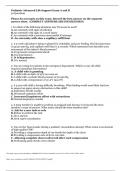
7. Question : Of the answers below, which would be included in defining a positive Exercise Echocardiogram? Student Answer: Death two days after test Regional hypokensis of ventricular muscles walls Induced decrease in regional wall motion (Induced decrease in regional wall motion would be included in defining a positive exercise echocardiogram. Wall thickening would not traditionally occur in a positive test and hyperkinesis, not hypokinesis, generally occurs in a positive test.) Increase in wall thickening Points Received: 0 of 5 Comments: Question 19. Question : Improvements in the delivery and management of healthcare are necessary if we are to improve the overall health of this nation’s population. Which of the following are identified in your readings as strategic in the movement to improve the healthcare system? Student Answer: Population management and healthcare practice (Population management and healthcare practice are strategic in the movement to improve the nation’s healthcare system. ) Socialized medicine and governmental controls Monetary savings and limited disruption in healthcare delivery President and Congress Points Received: 0 of 5 Comments: Question 20. Question : Specifically, when is an ETT considered to be negative? Student Answer: Patient has ST-segmental changes with down sloping of greater than 1 mm at 50% of age-predicted maximum heart rate Patient exercises to 20% maximum age-predicted heart rate without induced ischemia Patient exercises to 85% of age predicted maximum heart rate without evidence of induced ischemia (An ETT is considered to be negative when the patient exercises to 85% of age predicted maximum heart rate without evidence of induced ischemia. ) Patient exercises until tired without evidence of induced ischemia Points Received: 0 of 5 Comments: Question 23. Question : Your patient has a maximum age-predicted heart rate of 180. During the exercise, he reaches a heart rate of 140 and then states he can no longer exercise. You see no evidence of ischemia on the ECG. This would be diagnostic for what condition? Student Answer: Diagnostic of laziness Has no diagnostic value to rule out CAD (This scenario has no diagnostic value to rule out CAD.) Diagnostic for impending Myocardial Infarction Predictive of no CAD Points Received: 0 of 5 Comments: Question 27. Question : Your preceptor decides to add Doppler Flow studies to the echocardiogram exercise test for a patient with a recent history of a holistic murmur best auscultated at the left steral boarder. The patient has no history of cardiac surgeries. He asks you what might be the main advantages of adding Doppler Flow for this particular patient. You know from your readings that there are several reasons to add Doppler Flow and below are listed more than one correct reason. Your best response for this specific case, however, would be that Doppler Flow studies would be of what additive value during the echocardiogram study? Student Answer: Detect and evaluate blood shunting from a septal defect (Your best response for this specific case, however, would be that Doppler Flow studies would detect and evaluate blood shunting from a septal defect.) Gives better screen shots of wall abnormalities Provides assessment of prosthetic valve function No advantage is seen for this patient Points Received: 0 of 5 Comments: Question 30. Question : The sensitivity of a routine ETT is effort dependent. What physiological changes occur during effort in the routine ETT? Student Answer: Rapid heart rates and coronary artery narrowing Decreased heart rate and increased systolic blood pressure Decrease in coronary blood flow Increased coronary flow and increased systolic blood pressure (The physiological changes that occur during effort in the routine ETT are increased coronary flow and increased systolic blood pressure.) Points Received: 0 of 5 Comments: Question 32. Question : Medicare hospital insurance (Part A) is funded through what system? Student Answer: Federal income taxes Interest from investments Federal payroll taxes (Medicare Part A is funded through federal payroll taxes. ) State income taxes Points Received: 0 of 5 Comments: Question 34. Question : After completion of the exercise stress test, you would measure the ST-segment depression after the J point of the QRS. The J point is located where in relation to the QRS? Student Answer: Immediately after the P wave After the H point Junction between P and R Junction between QRS and ST segment (The J point is located at the junction between QRS and ST-segment.) Points Received: 0 of 5 Comments: Question 35. Question : Why would inability to exercise reduce the specificity of the routine ETT? Student Answer: Will not produce any changes in ECG Causes ST-segment changes and P-wave abnormalities Produces persistent ST-segmental changes and T-wave abnormalities (The inability to exercise reduces the specificity of the routine ETT because it produces persistent ST-segmental changes and T-wave abnormalities. ) Produces QRS changes that cannot be interpreted Points Received: 0 of 5 Comments: Question 36. Question : For women with known CAD and diabetes, which is most appropriate to assess CAD risk? Student Answer: ETT Coronary bypass surgery ETT with imaging (ETT with imaging is most appropriate to assess CAD risk.) Coronary catheterization Points Received: 0 of 5 Comments: Question 37. Question : Medicare covers inpatient hospital services under which part of the Medicare insurance? Student Answer: Part A (Medicare covers inpatient hospital services under Part A. ) Part B Part D Part C Points Received: 0 of 5 Comments: Question 40. Question : We all know that collaboration is integral to becoming a successful nurse practitioner. Among collaborations, however, only one can be considered as the most important. While each example below is important, which is the most important collaboration? The one that occurs: Student Answer: Between the patient and the nurse practitioner (The collaboration that is most important is the one that occurs between the patient and the nurse practitioner. ) Between the nurse practitioner and their physician mentor Between the patient and their family Between two healthcare providers about a single patient
Written for
Document information
- Uploaded on
- March 30, 2021
- Number of pages
- 7
- Written in
- 2020/2021
- Type
- Exam (elaborations)
- Contains
- Questions & answers
Subjects
-
7 question of the answers below
-
which would be included in defining a positive exercise echocardiogram student answer death two days after test regional hypokensis of ventricular mu