Chapter 1 – Introduction
Organizations – social entities which are goal directed, designed as systems of activities that are consciously structured,
coordinated and which are connected to the external environment
Challenges they face: Benefits of organizations:
- Globalization - bring together resources to achieve desired goals and
- Speed of responsiveness (respond quickly and outcomes
decisively to environmental changes, organizational - produce goods and services efficiently
crises and shifting customer expectations) - facilitate innovation
- Ethics and societal responsibility (concerns about - use modern manufacturing and information
ecological sustainability, not just about corporate technologies
survival – are expected to take a lead on addressing - adapt to and influence a changing environment
these issues) - create value for owners, customers and employees
- Virtual/digital workplace - accommodate ongoing challenges of diversity ethics,
- diversity motivation and coordination of employees
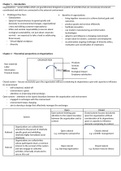
Chapter 2 – Theoretical perspectives on Organizations
ORGANIZATION
Products
Raw materials
Services
Labor
Waste
Information STRUCTURE PROCESS
ORGANIZATION
Ecological impact
Financial means
Employee satisfaction
Closed system – focuses exclusively upon the organization without considering its dependance upon and capacity to influence
its environment
- self-contained, sealed-off
- environment is given
- attention on improving internal design
Open system – attention to the (open) boundary between the organization and environment
- engaged in exchanges with the environment
- environment keeps changing
- aim to develop a design that effectively manages the exchanges
Open Closed
Open system thinking pays Closed system focuses exclusively
attention to the (open) boundary upon the organization without
System
between the organization and its consideration of its dependance
context upon or capacity to influence
elements comprising its context
Organizations are collectivities
oriented to the pursuit of relatively
Open rational Closed rational
Rational specific goals and exhibiting
e.g. contingency perspective e.g. scientific management
relatively highly formalized social
structures
Organizations are collectivities
whose participants share a common
interest in the survival of the system Open natural Closed natural
Natural
and who engage in collective e.g. learning organization e.g. human resource theory
activities, informally structured to
secure this end
,Organization configuration
Technical core
- produces product/service output of organization
- primary transformation of inputs to outputs
Technical support
- scan environment for threats and opportunities
- help organization to innovate, change & adapt
Administrative support
- smooth operation and maintenance of the organization
Top management Direct & coordinate other
Middle management parts of the organization
Dimensions of organizational design
1. Culture – key values, norms and beliefs
2. Environment – elements outside of organizational boundary
e.g. consumers, other organizations
3. Goals and strategy – purpose and competitive technique
4. Size – number of employees
5. Technology – tools and techniques to transform inputs into action
Dimensions of structure:
1. Formalization – reliance on written documentation
2. Specialization – degree to which tasks are sub divided into separate jobs
3. Hierarchy of authority – who reports to who and span of control
4. Centralization – hierarchical level with decision-making authority
5. Professionalism – level of formal education and training of employees
6. Personnel ratios – deployment of people to various functions
Classical perspectives:
Scientific Management: Taylor
- Efficiency and productivity are everything
- Degrading workers to machines
- Closed system thinking
- Decisions about organizations and job design should be based on a precise, scientific study of individual
situations to determine which method of doing each job delivers the greatest output
Administrative Principles: Fayol & bureaucratic theory:Weber
- Focus on how to organize work
- Contributed to developments of bureaucratic organizations
- Revolutionized organizations
- Considered the design and functioning as a whole
Hawthorne studies (Human relations theory): Mayo
- People in focus
- Showed that positive treatment of employees improved motivation and productivity
- Opened door to explore the ‘human side of enterprise’
Contingency perspective
- Context in focus
- There must be a ‘goodness of fit’ between ‘structural’ and ‘contextual’ dimensions
- What structure works best depends on the circumstances
- Circumstances change
,As environment increasingly turbulent and complex -> organization designs less mechanical and more organic (natural)
Mechanical System Design Natural System Design:
- Vertical structure - Horizontal structure
- Rigid culture - Adaptive culture
- Compliantly competitive strategy - Collaboratively competitive strategy
- Formal systems - Shared information
- Routine tasks - Empowered roles
Mechanistic (mechanical) Organic/natural
Environment Stable Turbulent
Aim Efficient performance Learning organization
Structure Vertical Horizontal
Work Routine tasks Empowered roles
Information Means of control Means to achieve agility and innovativeness
Strategy Competitive Collaborative
Culture Rigid Adaptive
Vertical structure:
- decisions flow from the top to the bottom
- well-defined leadership structure at the top
- little collaboration occurs across functional departments
- cost-efficient production and in-depth skill development
Horizontal structure
- focus on skill proficiency rather than management hierarchy
- priority for project delivery, rather than traditional management
- all employees across the organization are given more or less the same trust and opportunity for input into project
decisions
- structure is flatter
- self-directed teams are the fundamental work unit in the learning organization
- boundaries between functions are eroded as teams include members from several FAs
The learning organization is based on:
- Equality (little hierarchy): intense communication and collaboration
- Culture based on adaptation and participation: all employees involved in identifying and solving problems
- Outcome: continuous experimentation and improvement
Efficient performance vs. the learning organization: the most common shifts
- From a vertically oriented structure to a horizontally oriented structure
- From routine tasks to tasks in which employees can also decide (empowerment)
- From formal control systems to information sharing
- From competition to cooperation in the field of organizational strategy
- From rigid to flexible culture
Efficiency – refers to the amount of resources used to achieve organization’s goals
Effectiveness – refers to the degree to which an organization achieves its goals
Chapter 3 – Strategy, organization design and effectiveness
, Organization design:
- Threats from and opportunities in
the environment influence / shape the
goals and strategy
- Goals and strategy influence / shape
the design of the organization
- Tension between rational and
political process -> paradoxical
situations
Official goals -> mission Operative goals:
- reason for existence and what it stands for - Related to key tasks of the organization
- Legitimize the organization to internal & external - Refer to specific measurable outcomes
stakeholders - Explicit and well defined
- Captures organization’s vision, shared values and - Often concerned with the short run
beliefs - Provide direction for day-to day decision
- Formally stated definition of business scope and - Sometimes in conflict with the mission
outcomes the organization is trying to achieve statement
- Does not guarantee success!
Strategy - plan for interacting with the competitive
Goal purposes: environment to achieve organizational goals
- Employee direction Managers select specific strategy and design to achieve
- Employee motivation official and operative goals within the competitive
- Guidelines for decision making and behavior environment
- Standards of performance (operative goals) Clear competitive strategy one of the main organization’s
success factors
Peter’s
competitive strategies: 1) Low cost leadership: aim to increase market share through
low cost compared to competitors 2) Differentiation: aim
distinguish products or services from others in the industry
3a) Focus: focused low cost
3b) Focus: focused differentiation
Organization concentrates on a specific regional market or
buyer group
Differentiation:
- Learning orientation; flexible, loosely knit, strong horizontal
coordination
- Strong capability in research
- Rewards employee creativity, risk taking and innovation
Low- costs leadership strategy:
- Efficiency orientation; strong central authority; tight cost
control, frequent, detailed control reports
- Standard operating procedures
- Highly efficient procurement and distribution systems
- Close supervision; routine tasks; limited employee
empowerment
Organizations – social entities which are goal directed, designed as systems of activities that are consciously structured,
coordinated and which are connected to the external environment
Challenges they face: Benefits of organizations:
- Globalization - bring together resources to achieve desired goals and
- Speed of responsiveness (respond quickly and outcomes
decisively to environmental changes, organizational - produce goods and services efficiently
crises and shifting customer expectations) - facilitate innovation
- Ethics and societal responsibility (concerns about - use modern manufacturing and information
ecological sustainability, not just about corporate technologies
survival – are expected to take a lead on addressing - adapt to and influence a changing environment
these issues) - create value for owners, customers and employees
- Virtual/digital workplace - accommodate ongoing challenges of diversity ethics,
- diversity motivation and coordination of employees
Chapter 2 – Theoretical perspectives on Organizations
ORGANIZATION
Products
Raw materials
Services
Labor
Waste
Information STRUCTURE PROCESS
ORGANIZATION
Ecological impact
Financial means
Employee satisfaction
Closed system – focuses exclusively upon the organization without considering its dependance upon and capacity to influence
its environment
- self-contained, sealed-off
- environment is given
- attention on improving internal design
Open system – attention to the (open) boundary between the organization and environment
- engaged in exchanges with the environment
- environment keeps changing
- aim to develop a design that effectively manages the exchanges
Open Closed
Open system thinking pays Closed system focuses exclusively
attention to the (open) boundary upon the organization without
System
between the organization and its consideration of its dependance
context upon or capacity to influence
elements comprising its context
Organizations are collectivities
oriented to the pursuit of relatively
Open rational Closed rational
Rational specific goals and exhibiting
e.g. contingency perspective e.g. scientific management
relatively highly formalized social
structures
Organizations are collectivities
whose participants share a common
interest in the survival of the system Open natural Closed natural
Natural
and who engage in collective e.g. learning organization e.g. human resource theory
activities, informally structured to
secure this end
,Organization configuration
Technical core
- produces product/service output of organization
- primary transformation of inputs to outputs
Technical support
- scan environment for threats and opportunities
- help organization to innovate, change & adapt
Administrative support
- smooth operation and maintenance of the organization
Top management Direct & coordinate other
Middle management parts of the organization
Dimensions of organizational design
1. Culture – key values, norms and beliefs
2. Environment – elements outside of organizational boundary
e.g. consumers, other organizations
3. Goals and strategy – purpose and competitive technique
4. Size – number of employees
5. Technology – tools and techniques to transform inputs into action
Dimensions of structure:
1. Formalization – reliance on written documentation
2. Specialization – degree to which tasks are sub divided into separate jobs
3. Hierarchy of authority – who reports to who and span of control
4. Centralization – hierarchical level with decision-making authority
5. Professionalism – level of formal education and training of employees
6. Personnel ratios – deployment of people to various functions
Classical perspectives:
Scientific Management: Taylor
- Efficiency and productivity are everything
- Degrading workers to machines
- Closed system thinking
- Decisions about organizations and job design should be based on a precise, scientific study of individual
situations to determine which method of doing each job delivers the greatest output
Administrative Principles: Fayol & bureaucratic theory:Weber
- Focus on how to organize work
- Contributed to developments of bureaucratic organizations
- Revolutionized organizations
- Considered the design and functioning as a whole
Hawthorne studies (Human relations theory): Mayo
- People in focus
- Showed that positive treatment of employees improved motivation and productivity
- Opened door to explore the ‘human side of enterprise’
Contingency perspective
- Context in focus
- There must be a ‘goodness of fit’ between ‘structural’ and ‘contextual’ dimensions
- What structure works best depends on the circumstances
- Circumstances change
,As environment increasingly turbulent and complex -> organization designs less mechanical and more organic (natural)
Mechanical System Design Natural System Design:
- Vertical structure - Horizontal structure
- Rigid culture - Adaptive culture
- Compliantly competitive strategy - Collaboratively competitive strategy
- Formal systems - Shared information
- Routine tasks - Empowered roles
Mechanistic (mechanical) Organic/natural
Environment Stable Turbulent
Aim Efficient performance Learning organization
Structure Vertical Horizontal
Work Routine tasks Empowered roles
Information Means of control Means to achieve agility and innovativeness
Strategy Competitive Collaborative
Culture Rigid Adaptive
Vertical structure:
- decisions flow from the top to the bottom
- well-defined leadership structure at the top
- little collaboration occurs across functional departments
- cost-efficient production and in-depth skill development
Horizontal structure
- focus on skill proficiency rather than management hierarchy
- priority for project delivery, rather than traditional management
- all employees across the organization are given more or less the same trust and opportunity for input into project
decisions
- structure is flatter
- self-directed teams are the fundamental work unit in the learning organization
- boundaries between functions are eroded as teams include members from several FAs
The learning organization is based on:
- Equality (little hierarchy): intense communication and collaboration
- Culture based on adaptation and participation: all employees involved in identifying and solving problems
- Outcome: continuous experimentation and improvement
Efficient performance vs. the learning organization: the most common shifts
- From a vertically oriented structure to a horizontally oriented structure
- From routine tasks to tasks in which employees can also decide (empowerment)
- From formal control systems to information sharing
- From competition to cooperation in the field of organizational strategy
- From rigid to flexible culture
Efficiency – refers to the amount of resources used to achieve organization’s goals
Effectiveness – refers to the degree to which an organization achieves its goals
Chapter 3 – Strategy, organization design and effectiveness
, Organization design:
- Threats from and opportunities in
the environment influence / shape the
goals and strategy
- Goals and strategy influence / shape
the design of the organization
- Tension between rational and
political process -> paradoxical
situations
Official goals -> mission Operative goals:
- reason for existence and what it stands for - Related to key tasks of the organization
- Legitimize the organization to internal & external - Refer to specific measurable outcomes
stakeholders - Explicit and well defined
- Captures organization’s vision, shared values and - Often concerned with the short run
beliefs - Provide direction for day-to day decision
- Formally stated definition of business scope and - Sometimes in conflict with the mission
outcomes the organization is trying to achieve statement
- Does not guarantee success!
Strategy - plan for interacting with the competitive
Goal purposes: environment to achieve organizational goals
- Employee direction Managers select specific strategy and design to achieve
- Employee motivation official and operative goals within the competitive
- Guidelines for decision making and behavior environment
- Standards of performance (operative goals) Clear competitive strategy one of the main organization’s
success factors
Peter’s
competitive strategies: 1) Low cost leadership: aim to increase market share through
low cost compared to competitors 2) Differentiation: aim
distinguish products or services from others in the industry
3a) Focus: focused low cost
3b) Focus: focused differentiation
Organization concentrates on a specific regional market or
buyer group
Differentiation:
- Learning orientation; flexible, loosely knit, strong horizontal
coordination
- Strong capability in research
- Rewards employee creativity, risk taking and innovation
Low- costs leadership strategy:
- Efficiency orientation; strong central authority; tight cost
control, frequent, detailed control reports
- Standard operating procedures
- Highly efficient procurement and distribution systems
- Close supervision; routine tasks; limited employee
empowerment