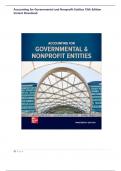
GOVERNMENT AND NOT-FOR-PROFIT
ACCOUNTING CONCEPTS AND PRACTICES
8TH EDITION MICHAEL GRANOF SALEHA
KHUMAWALA THAD CALABRESE DANIEL
SOLUTION MANUAL COMPREHENSIVE
TEST PAPER 2026 COMPLETE ANSWERS
ACCURATE
⫸ If businesses are "governed by the marketplace," governments are
governed by:
A: Legislative bodies
B: Taxes
C: Budgets
D: State constitutions Answer: C: Budgets
⫸ The primary objective of a not-for-profit organization or a
government is to:
A: Maximize revenues
B: Minimize expenditures
C: Provide services to constituents
D: All of the above Answer: C: Provide services to consituents
,⫸ In governments, in contrast to businesses,:
A: Expenditures are driven mainly by the ability of the entity to raise
revenues
B: The amount of revenues collected is a signal of the demand for
services
C: There may not be a direct relationship between revenues raised and
the demand for the entity's services
D: The amount of expenditures is independent of the amount of revenues
collected Answer: C: There may not be a direct relationship between
revenues raised and the demand for the entity's services
⫸ The organization responsible for setting accounting standards for
state and local governments is the:
A: FASB
B: GASB
C: FASAB
D: AICPA Answer: B: GASB
⫸ Governments differ from businesses in that they:
A: Do not raise capital in the financial markets
B: Do not engage in transactions in which they "sell" goods or services
C: Are not required to prepared annual financial reports
D: Do not issue common stock Answer: D: Do not issue common stock
,⫸ Interperiod equity refers to a condition whereby:
A: Total tax revenues are approximately the same from year to year
B: Taxes are distributed fairly among all taxpayers regardless of income
level
C: Current-year revenues are sufficient to pay for current-year services
D: Current-year revenues cover both operating and capital expenditures
Answer: C: Current-year revenue are sufficient to pay for current-year
services
⫸ Which of the following is NOT one of the GASB's financial reporting
objectives?
A: Providing information on the extent to which interperiod equity is
achieved
B: Ensuring that budgeted revenues are equal to or exceed budgeted
expenses
C: Reporting on budgetary compliance
D: Providing information on service efforts and accomplishments
Answer: B: Ensuring that budgeted revenues are equal to or exceed
budgeted expenses
⫸ Which of the following is NOT one of the FASB's financial reporting
objectives?
A: Providing information about economic resources, obligations, and net
resources
B: Providing information to help resource providers make rational
decisions
, C: Reporting on budgetary compliance
D: Providing information on service efforts and accomplishments
Answer: C: Reporting on budgetary compliance
⫸ Which of the following rule-making authorities would establish
accounting standards for Stanford University (a private university)?
A: The AICPA
B: The FASB
C: The FASAB
D: The GASB Answer: B. The FASB
⫸ Which of the following rule-making authorities would establish
accounting standards for the University of Wisconsin (a public
university)?
A: The AICPA
B: The FASB
C: The FASAB
D: The GASB Answer: D. The GASB
⫸ If the GASB has not issued a pronouncement on a specific issue,
which of the following is true with respect to FASB pronouncements?
A: They would automatically govern
B: They could be taken into account but would have no higher standing
than other accounting literature
C: They are irrelevant
ACCOUNTING CONCEPTS AND PRACTICES
8TH EDITION MICHAEL GRANOF SALEHA
KHUMAWALA THAD CALABRESE DANIEL
SOLUTION MANUAL COMPREHENSIVE
TEST PAPER 2026 COMPLETE ANSWERS
ACCURATE
⫸ If businesses are "governed by the marketplace," governments are
governed by:
A: Legislative bodies
B: Taxes
C: Budgets
D: State constitutions Answer: C: Budgets
⫸ The primary objective of a not-for-profit organization or a
government is to:
A: Maximize revenues
B: Minimize expenditures
C: Provide services to constituents
D: All of the above Answer: C: Provide services to consituents
,⫸ In governments, in contrast to businesses,:
A: Expenditures are driven mainly by the ability of the entity to raise
revenues
B: The amount of revenues collected is a signal of the demand for
services
C: There may not be a direct relationship between revenues raised and
the demand for the entity's services
D: The amount of expenditures is independent of the amount of revenues
collected Answer: C: There may not be a direct relationship between
revenues raised and the demand for the entity's services
⫸ The organization responsible for setting accounting standards for
state and local governments is the:
A: FASB
B: GASB
C: FASAB
D: AICPA Answer: B: GASB
⫸ Governments differ from businesses in that they:
A: Do not raise capital in the financial markets
B: Do not engage in transactions in which they "sell" goods or services
C: Are not required to prepared annual financial reports
D: Do not issue common stock Answer: D: Do not issue common stock
,⫸ Interperiod equity refers to a condition whereby:
A: Total tax revenues are approximately the same from year to year
B: Taxes are distributed fairly among all taxpayers regardless of income
level
C: Current-year revenues are sufficient to pay for current-year services
D: Current-year revenues cover both operating and capital expenditures
Answer: C: Current-year revenue are sufficient to pay for current-year
services
⫸ Which of the following is NOT one of the GASB's financial reporting
objectives?
A: Providing information on the extent to which interperiod equity is
achieved
B: Ensuring that budgeted revenues are equal to or exceed budgeted
expenses
C: Reporting on budgetary compliance
D: Providing information on service efforts and accomplishments
Answer: B: Ensuring that budgeted revenues are equal to or exceed
budgeted expenses
⫸ Which of the following is NOT one of the FASB's financial reporting
objectives?
A: Providing information about economic resources, obligations, and net
resources
B: Providing information to help resource providers make rational
decisions
, C: Reporting on budgetary compliance
D: Providing information on service efforts and accomplishments
Answer: C: Reporting on budgetary compliance
⫸ Which of the following rule-making authorities would establish
accounting standards for Stanford University (a private university)?
A: The AICPA
B: The FASB
C: The FASAB
D: The GASB Answer: B. The FASB
⫸ Which of the following rule-making authorities would establish
accounting standards for the University of Wisconsin (a public
university)?
A: The AICPA
B: The FASB
C: The FASAB
D: The GASB Answer: D. The GASB
⫸ If the GASB has not issued a pronouncement on a specific issue,
which of the following is true with respect to FASB pronouncements?
A: They would automatically govern
B: They could be taken into account but would have no higher standing
than other accounting literature
C: They are irrelevant