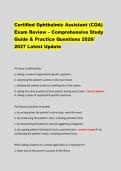
Certified Ophthalmic Assistant (COA)
Exam Review – Comprehensive Study
Guide & Practice Questions 2026/
2027 Latest Update
A history is obtained by:
a. asking a series of organized & specitic questions
b. observing the patient's actions in the exam room
c. allowing the patient to discuss anything he or she wishes
d. asking the same question of each patient during every exam - correct answer-
A. asking a series of organized & specific questions
The history should be recorded:
a. by writing down the patient's entire story, word-for-word
b. by condensing the patient's story, including pertinent facts
c. by interpreting the patient's story & suggesting a diagnosis
d. by copying patient information from a questionnaire - correct answer-B. by
condensing the patient's story, including pertinent facts
When taking a history on a school-aged child, it is important to:
a. listen only to the parent's account of the illness
,b. listen only to the child's account of the illness
c. talk to the parent outside of the child's hearing
d. get an account of the illness from both the parent & child - correct answer-D.
get an account of the illness from both the parent & child
Which of the following statements if false?
a. A thorough history can direct a physician toward a final diagnosis.
b. All information given by the patient can be shred with insurance companies
without patient permission.
c. Statements made by the patient should lead the assistant into additional
questions that can be asked.
d. All patient information is private unless a consent release from is signed. -
correct answer-B. All information given by the patient can be shred with
insurance companies without patient permission.
Which of the following is not a part of a history?
a. presenting complaint
b. medications currently used
c. family eye disease
d. visual acuity - correct answer-D. visual acuity
The "presenting complaint" is:
a. the main reason that the patient has come to the office
b. always the most serious of the patient's many complaints
c. the only item with which the history is really concerned
,d. the main reason the patient should be dilated - correct answer-A. the main
reason that the patient has come to the office
An example of a question relating to onset would be:
a. "Can you still function at work?"
b. "When did you first notice the problem?"
c. "What treatment have you tried?"
d. "Has the problem worsened?" - correct answer-B. "When did you first notice
the problem?"
The question "Does your head hurt so badly that you have to leave school early?"
relates to:
a. onset
b. duration
c. progression
d. severity - correct answer-D. severity
To obtain the most important information about the presenting complaint, you
should ask questions relating to:
a. location, timing, aggravating & alleviating factors, & family history
b. location, quality, severity, timing, & aggravating & alleviating factors
c. location, severity, timing, drug allergies, & past surgical procedures
d. present illness, past ocular history, family history, & description of pain -
correct answer-B. location, quality, severity, timing, & aggravating & alleviating
factors
, A symptom is:
a. something you notice when you look at the patient
b. something that can always be tested & proven
c. a change noticed by the patient
d. any change that results from injury - correct answer-C. a change noticed by the
patient
An example of a sign is:
a. the patient tells you what part of the eye hurts
b. an elevated intraocular pressure reading
c. the patient complains of blurred vision
d. the patient complains of a pressure sensation behind the eyes - correct
answer-B. an elevated intraocular pressure reading
A 56-year-old patient complains of a sudden onset of double vision. It is most
important to ask:
a. "Does the doubling go away if you cover one eye?"
b. "Are the eyes also red?"
c. "Do the eyes ache?"
d. "Does anyone in your family have a lazy eye?" - correct answer-A. "Does the
doubling go away if you cover one eye?"
An old photograph of the patient will be most useful to the physician if the
patient complains of or exhibits:
a. eye protrusion, double vision, or floaters
b. lid droop, pupil abnormality, or head tilt
Exam Review – Comprehensive Study
Guide & Practice Questions 2026/
2027 Latest Update
A history is obtained by:
a. asking a series of organized & specitic questions
b. observing the patient's actions in the exam room
c. allowing the patient to discuss anything he or she wishes
d. asking the same question of each patient during every exam - correct answer-
A. asking a series of organized & specific questions
The history should be recorded:
a. by writing down the patient's entire story, word-for-word
b. by condensing the patient's story, including pertinent facts
c. by interpreting the patient's story & suggesting a diagnosis
d. by copying patient information from a questionnaire - correct answer-B. by
condensing the patient's story, including pertinent facts
When taking a history on a school-aged child, it is important to:
a. listen only to the parent's account of the illness
,b. listen only to the child's account of the illness
c. talk to the parent outside of the child's hearing
d. get an account of the illness from both the parent & child - correct answer-D.
get an account of the illness from both the parent & child
Which of the following statements if false?
a. A thorough history can direct a physician toward a final diagnosis.
b. All information given by the patient can be shred with insurance companies
without patient permission.
c. Statements made by the patient should lead the assistant into additional
questions that can be asked.
d. All patient information is private unless a consent release from is signed. -
correct answer-B. All information given by the patient can be shred with
insurance companies without patient permission.
Which of the following is not a part of a history?
a. presenting complaint
b. medications currently used
c. family eye disease
d. visual acuity - correct answer-D. visual acuity
The "presenting complaint" is:
a. the main reason that the patient has come to the office
b. always the most serious of the patient's many complaints
c. the only item with which the history is really concerned
,d. the main reason the patient should be dilated - correct answer-A. the main
reason that the patient has come to the office
An example of a question relating to onset would be:
a. "Can you still function at work?"
b. "When did you first notice the problem?"
c. "What treatment have you tried?"
d. "Has the problem worsened?" - correct answer-B. "When did you first notice
the problem?"
The question "Does your head hurt so badly that you have to leave school early?"
relates to:
a. onset
b. duration
c. progression
d. severity - correct answer-D. severity
To obtain the most important information about the presenting complaint, you
should ask questions relating to:
a. location, timing, aggravating & alleviating factors, & family history
b. location, quality, severity, timing, & aggravating & alleviating factors
c. location, severity, timing, drug allergies, & past surgical procedures
d. present illness, past ocular history, family history, & description of pain -
correct answer-B. location, quality, severity, timing, & aggravating & alleviating
factors
, A symptom is:
a. something you notice when you look at the patient
b. something that can always be tested & proven
c. a change noticed by the patient
d. any change that results from injury - correct answer-C. a change noticed by the
patient
An example of a sign is:
a. the patient tells you what part of the eye hurts
b. an elevated intraocular pressure reading
c. the patient complains of blurred vision
d. the patient complains of a pressure sensation behind the eyes - correct
answer-B. an elevated intraocular pressure reading
A 56-year-old patient complains of a sudden onset of double vision. It is most
important to ask:
a. "Does the doubling go away if you cover one eye?"
b. "Are the eyes also red?"
c. "Do the eyes ache?"
d. "Does anyone in your family have a lazy eye?" - correct answer-A. "Does the
doubling go away if you cover one eye?"
An old photograph of the patient will be most useful to the physician if the
patient complains of or exhibits:
a. eye protrusion, double vision, or floaters
b. lid droop, pupil abnormality, or head tilt