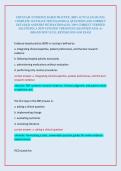
COA EXAM / CERTIFIED OPHTHALMIC ASSISTANT (COA) ACTUAL
EXAM 2026/2027 COMPLETE ACCURATE TEST EXAM APPROVED
QUESTIONS AND CORRECT DETAILED ANSWERS WITH
RATIONALES (100% CORRECT VERIFIED SOLUTIONS) LATEST
UPDATED VERSION |GUARANTEED PASS A+
which structure is primarily responsible for focusing light onto the retina?
a. cornea
b. sclera
c. optic nerve
d. choroid
correct answer: a. cornea
rationale: the cornea provides the majority of the eye’s refractive power, bending
incoming light so it can be focused on the retina.
the transparent structure located behind the iris is the:
a. vitreous
b. lens
c. cornea
d. aqueous
correct answer: b. lens
rationale: the lens fine-tunes focus by changing shape to accommodate for near and
far vision.
which part of the retina is responsible for sharp central vision?
,a. oar serrate
b. optic disc
c. macula
d. peripheral retina
correct answer: c. macula
rationale: the macula contains a high concentration of cones needed for detailed
central vision.
the normal adult intraocular pressure range is approximately:
a. 2–8 mg
b. 10–21 mg
c. 25–35 mg
d. 40–60 mg
correct answer: b. 10–21 mg
rationale: this is the accepted normal range used to screen for glaucoma risk.
which cranial nerve controls most extraocular eye movements?
a. optic nerve (ii)
b. oculomotor nerve (iii)
c. trigeminal nerve (v)
d. facial nerve (vii)
correct answer: b. oculomotor nerve (iii)
,rationale: cranial nerve iii innervates four of the six extraocular muscles and the
elevator muscle.
visual acuity of 20/40 means:
a. the patient sees better than normal
b. the patient sees at 40 feet what a normal person sees at 20 feet
c. the patient sees at 20 feet what a normal person sees at 40 feet
d. the patient is legally blind
correct answer: c. the patient sees at 20 feet what a normal person sees at 40 feet
rationale: larger denominators indicate reduced visual acuity.
the abbreviation “out” refers to:
a. right eye only
b. left eye only
c. both eyes
d. neither eye
correct answer: c. both eyes
rationale: “out” is the Latin abbreviation for oculus uterus, meaning both eyes.
which instrument measures corneal curvature?
a. tonometer
b. keratometer
c. ophthalmoscope
d. retinoscopy
, correct answer: b. keratometer
rationale: keratometry evaluates corneal curvature, often used for contact lens
fitting.
a patient with diabetes is at risk for which eye disease?
a. macular hole
b. retinal detachment
c. diabetic retinopathy
d. keratoconus
correct answer: c. diabetic retinopathy
rationale: prolonged high blood sugar damages retinal blood vessels.
the medical term for nearsightedness is:
a. hyperopia
b. astigmatism
c. myopia
d. presbyopia
correct answer: c. myopia
rationale: myopia causes distant objects to appear blurred.
which test evaluates peripheral vision?
a. Snellen chart
b. ambler grid
EXAM 2026/2027 COMPLETE ACCURATE TEST EXAM APPROVED
QUESTIONS AND CORRECT DETAILED ANSWERS WITH
RATIONALES (100% CORRECT VERIFIED SOLUTIONS) LATEST
UPDATED VERSION |GUARANTEED PASS A+
which structure is primarily responsible for focusing light onto the retina?
a. cornea
b. sclera
c. optic nerve
d. choroid
correct answer: a. cornea
rationale: the cornea provides the majority of the eye’s refractive power, bending
incoming light so it can be focused on the retina.
the transparent structure located behind the iris is the:
a. vitreous
b. lens
c. cornea
d. aqueous
correct answer: b. lens
rationale: the lens fine-tunes focus by changing shape to accommodate for near and
far vision.
which part of the retina is responsible for sharp central vision?
,a. oar serrate
b. optic disc
c. macula
d. peripheral retina
correct answer: c. macula
rationale: the macula contains a high concentration of cones needed for detailed
central vision.
the normal adult intraocular pressure range is approximately:
a. 2–8 mg
b. 10–21 mg
c. 25–35 mg
d. 40–60 mg
correct answer: b. 10–21 mg
rationale: this is the accepted normal range used to screen for glaucoma risk.
which cranial nerve controls most extraocular eye movements?
a. optic nerve (ii)
b. oculomotor nerve (iii)
c. trigeminal nerve (v)
d. facial nerve (vii)
correct answer: b. oculomotor nerve (iii)
,rationale: cranial nerve iii innervates four of the six extraocular muscles and the
elevator muscle.
visual acuity of 20/40 means:
a. the patient sees better than normal
b. the patient sees at 40 feet what a normal person sees at 20 feet
c. the patient sees at 20 feet what a normal person sees at 40 feet
d. the patient is legally blind
correct answer: c. the patient sees at 20 feet what a normal person sees at 40 feet
rationale: larger denominators indicate reduced visual acuity.
the abbreviation “out” refers to:
a. right eye only
b. left eye only
c. both eyes
d. neither eye
correct answer: c. both eyes
rationale: “out” is the Latin abbreviation for oculus uterus, meaning both eyes.
which instrument measures corneal curvature?
a. tonometer
b. keratometer
c. ophthalmoscope
d. retinoscopy
, correct answer: b. keratometer
rationale: keratometry evaluates corneal curvature, often used for contact lens
fitting.
a patient with diabetes is at risk for which eye disease?
a. macular hole
b. retinal detachment
c. diabetic retinopathy
d. keratoconus
correct answer: c. diabetic retinopathy
rationale: prolonged high blood sugar damages retinal blood vessels.
the medical term for nearsightedness is:
a. hyperopia
b. astigmatism
c. myopia
d. presbyopia
correct answer: c. myopia
rationale: myopia causes distant objects to appear blurred.
which test evaluates peripheral vision?
a. Snellen chart
b. ambler grid