EDF 6222 QUESTIONS AND ANSWERS
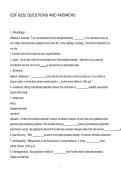
1. Readings;
Weekly Lectures: Try to incorporate all of the assigned weekly in your discussion posts, as
your midterm and final exam questions come from ALL of the readings, including . Points will be deducted if you
only cite
1-2 sources and do not include your own, original reference.
2. exams: You will also notice that some weeks have "recommended readings" - these are for your personal
enrichment and are not on the or required for your discussion posts
3. Science;
lawful relations: " is more than the mere description of events as they occur. It is an attempt to
discover order, to show that certain events stand in to other events (Skinner, 1953, p.6)."
4. evidence: Being scientifically skeptical means that until there is available, assumptions
should not be made.
5. observer
bias;
experimental
control;
replication: In order to be excellent stewards of science, as behavior analysts, we can follow a few guidelines when
gathering and evaluating evidence. This includes reducing by ensuring interobserver agreement,
examining for actual (as opposed to ettects that could have produced changes without the intervention), an
6. parsimony: With we look for the simplest explanation possible, not extensive mentalistic explanations.
7. philosophy: "Behaviorism is not the science of human behavior; it is the of that
science" (Skinner, 1974. p.3).
8. introspection: Structuralism relied on which looked inward to describe sensations,
images, and feelings.
1/
18
,9. Methodological: behaviorism might be thought of as a psychological version of logical
positivism or operationism.
10. psychophysical parallelism: While some methodological behaviorists accept that there are mental
states, they have ruled them completely out of consideration. This is not a new concept and was once referred to as
.
11. mentalistic;
explanatory: In Pavlov's early research, he did not jump to conclusions to suggest that the dog was "thinking" of
food, and therefore salivating. Instead, he carefully controlled conditions that allowed him to show that particular stimuli
can "acquire" the ability to elicit secretion. His careful analysis of the scientific method allowed him to avoid both
and fictions
2/
18
, 12. debilitating: The evolutionary explanation for reflexes indicates that they are for the survival of the organism.
However, we know all too well that sometimes responses can be conditioned that serve no purpose - even add a
purpose - to our complex lives.
13. conditioning;
stimulus control;
novel: Skinner (1953) informed us "Although the process of greatly extends the scope of the eliciting stimulus,
it does not bring all the behavior of the organism within such "(p. 56). Conditioning can add numerous
ditterent eliciting stimuli, but it will never fashion a response.
14. prediction;
control;
accessible: According to Skinner, contingencies of reinforcement have an edge over contingencies of survival
because contingencies of reinforcement "Have the edge with and and the conditions under which a
species acquires behavior are relatively and can often be manipulated".
15. ontogeny: is the learned behaviors of a particular animal during its lifetime.
16. phylogeny: is behaviors that have been passed down over the lifetime of the entire species.
17. chain of events;
learned: It can be diflcult to distinguish between ontogenetic and phylogenic established behaviors. For a person
viewing a complex for the first time, it may seem mysterious. But each step of the chain can be traced back to
the shaping process. Just because the shaping process was not observed, it does not mean that it was not
18. genes;
environment;
cause: Moore (2015) stated " predispose an individual's susceptibility to influence from the (p. 27).
We must be careful not to assert that genes " " behavior; rather, they set up the physical basis for the processes
and structures that participate in behavior. Behavior still occurs in the context of the environment.
19. model: Imitative responses necessarily require the learner to orient toward the rather than the topo-
graphical correspondence of their behavior with respect to the model.
3/
18
1. Readings;
Weekly Lectures: Try to incorporate all of the assigned weekly in your discussion posts, as
your midterm and final exam questions come from ALL of the readings, including . Points will be deducted if you
only cite
1-2 sources and do not include your own, original reference.
2. exams: You will also notice that some weeks have "recommended readings" - these are for your personal
enrichment and are not on the or required for your discussion posts
3. Science;
lawful relations: " is more than the mere description of events as they occur. It is an attempt to
discover order, to show that certain events stand in to other events (Skinner, 1953, p.6)."
4. evidence: Being scientifically skeptical means that until there is available, assumptions
should not be made.
5. observer
bias;
experimental
control;
replication: In order to be excellent stewards of science, as behavior analysts, we can follow a few guidelines when
gathering and evaluating evidence. This includes reducing by ensuring interobserver agreement,
examining for actual (as opposed to ettects that could have produced changes without the intervention), an
6. parsimony: With we look for the simplest explanation possible, not extensive mentalistic explanations.
7. philosophy: "Behaviorism is not the science of human behavior; it is the of that
science" (Skinner, 1974. p.3).
8. introspection: Structuralism relied on which looked inward to describe sensations,
images, and feelings.
1/
18
,9. Methodological: behaviorism might be thought of as a psychological version of logical
positivism or operationism.
10. psychophysical parallelism: While some methodological behaviorists accept that there are mental
states, they have ruled them completely out of consideration. This is not a new concept and was once referred to as
.
11. mentalistic;
explanatory: In Pavlov's early research, he did not jump to conclusions to suggest that the dog was "thinking" of
food, and therefore salivating. Instead, he carefully controlled conditions that allowed him to show that particular stimuli
can "acquire" the ability to elicit secretion. His careful analysis of the scientific method allowed him to avoid both
and fictions
2/
18
, 12. debilitating: The evolutionary explanation for reflexes indicates that they are for the survival of the organism.
However, we know all too well that sometimes responses can be conditioned that serve no purpose - even add a
purpose - to our complex lives.
13. conditioning;
stimulus control;
novel: Skinner (1953) informed us "Although the process of greatly extends the scope of the eliciting stimulus,
it does not bring all the behavior of the organism within such "(p. 56). Conditioning can add numerous
ditterent eliciting stimuli, but it will never fashion a response.
14. prediction;
control;
accessible: According to Skinner, contingencies of reinforcement have an edge over contingencies of survival
because contingencies of reinforcement "Have the edge with and and the conditions under which a
species acquires behavior are relatively and can often be manipulated".
15. ontogeny: is the learned behaviors of a particular animal during its lifetime.
16. phylogeny: is behaviors that have been passed down over the lifetime of the entire species.
17. chain of events;
learned: It can be diflcult to distinguish between ontogenetic and phylogenic established behaviors. For a person
viewing a complex for the first time, it may seem mysterious. But each step of the chain can be traced back to
the shaping process. Just because the shaping process was not observed, it does not mean that it was not
18. genes;
environment;
cause: Moore (2015) stated " predispose an individual's susceptibility to influence from the (p. 27).
We must be careful not to assert that genes " " behavior; rather, they set up the physical basis for the processes
and structures that participate in behavior. Behavior still occurs in the context of the environment.
19. model: Imitative responses necessarily require the learner to orient toward the rather than the topo-
graphical correspondence of their behavior with respect to the model.
3/
18