ECS1500 ASSIGNMENT 01: 2021: WITH EXPLANATIONS AND WORKINGS
CALL 0618441387 FOR ASSISTANCE
1.1 Prices bring about involuntary responses from buyers and sellers so that market
equilibrium can be achieved.
[1] True
[2] False
The prices that are established on these markets that provide the essential
signals or impulses to which the various economic participants react voluntarily
(and in their own interest) to bring about a seemingly organised economic order.
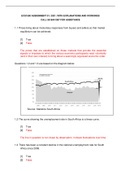
Questions 1.2 and 1.3 are based on the diagram below:
Source: Statistics South Africa
1.2 The curve showing the unemployment rate in South Africa is a linear curve.
[1] True
[2] False
The line in question is non-linear by observation, it shows fluctuations over time.
1.3 There has been a constant decline in the national unemployment rate for South
Africa since 2008.
[1] True
[2] False
, Though there are fluctuations in the rate of unemployment there seems to be an
upward trend showing that unemployment seemed to increase rather than fall.
1.4 Tastes and preferences are not determinants of demand.
[1] True
[2] False
Demand theory postulates tastes and preferences, income, population size,
price of other goods and services to be among determinants of demand.
1.5 An improvement in technologies used to produce pasta can decrease the
equilibrium price.
[1] True
[2] False
Cost-reducing improvement in technology shifts the supply curve to the right and
hence lead to a decrease in the price level.
Questions 1.6 to 1.30 are multiple-choice questions. Only one of the options [1], [2],
[3], [4] or [5] is correct. You have to choose the option that you think is correct.
Remember that Questions 1.21 to 1.30 will not count for marks, and will therefore not
be marked.
1.6 The following term refers to the basic economic problem.
[1] scarcity
[2] wealth
[3] income
[4] consumption
The basic economic problem is that of scarcity, (Unlimited wants given limited
resources).
1.7 Which of the following statements explains what the subject of Economics covers?
[1] It studies how to increase income for households.
[2] It studies how to reduce the total production of the economy.
[3] It studies how people use limited resources to gain the greatest possible
satisfaction of their unlimited wants.
CALL 0618441387 FOR ASSISTANCE
1.1 Prices bring about involuntary responses from buyers and sellers so that market
equilibrium can be achieved.
[1] True
[2] False
The prices that are established on these markets that provide the essential
signals or impulses to which the various economic participants react voluntarily
(and in their own interest) to bring about a seemingly organised economic order.
Questions 1.2 and 1.3 are based on the diagram below:
Source: Statistics South Africa
1.2 The curve showing the unemployment rate in South Africa is a linear curve.
[1] True
[2] False
The line in question is non-linear by observation, it shows fluctuations over time.
1.3 There has been a constant decline in the national unemployment rate for South
Africa since 2008.
[1] True
[2] False
, Though there are fluctuations in the rate of unemployment there seems to be an
upward trend showing that unemployment seemed to increase rather than fall.
1.4 Tastes and preferences are not determinants of demand.
[1] True
[2] False
Demand theory postulates tastes and preferences, income, population size,
price of other goods and services to be among determinants of demand.
1.5 An improvement in technologies used to produce pasta can decrease the
equilibrium price.
[1] True
[2] False
Cost-reducing improvement in technology shifts the supply curve to the right and
hence lead to a decrease in the price level.
Questions 1.6 to 1.30 are multiple-choice questions. Only one of the options [1], [2],
[3], [4] or [5] is correct. You have to choose the option that you think is correct.
Remember that Questions 1.21 to 1.30 will not count for marks, and will therefore not
be marked.
1.6 The following term refers to the basic economic problem.
[1] scarcity
[2] wealth
[3] income
[4] consumption
The basic economic problem is that of scarcity, (Unlimited wants given limited
resources).
1.7 Which of the following statements explains what the subject of Economics covers?
[1] It studies how to increase income for households.
[2] It studies how to reduce the total production of the economy.
[3] It studies how people use limited resources to gain the greatest possible
satisfaction of their unlimited wants.