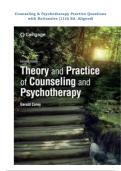
Counseling & Psychotherapy Practice Questions
with Rationales (11th Ed. Aligned)
,This resource provides original, exam-style practice questions with detailed
rationales designed to support students studying Counseling and Psychotherapy
theories and practice, aligned with the 11th Edition course framework
commonly used in counseling, psychology, and related behavioral science
programs.
The questions are structured to reinforce conceptual understanding, theory
differentiation, and applied reasoning, rather than rote memorization. Each item
is accompanied by a clear, academic rationale explaining the correct answer and
addressing common misconceptions across counseling approaches.
Key Features:
• ✔ Original counseling and psychotherapy practice questions
• ✔ Detailed rationales grounded in theory and professional practice
• ✔ Coverage of major counseling approaches, including psychodynamic,
humanistic, cognitive-behavioral, behavioral, existential, Adlerian, and
integrative perspectives
• ✔ Questions focused on theory comparison, application, and ethical
considerations
• ✔ Designed to reflect university-level counseling and psychotherapy
assessments
How This Resource Supports Learning:
Students often struggle not with remembering theories, but with understanding
how and when to apply them. This guide helps learners:
• Distinguish between counseling approaches with similar concepts
• Apply theoretical principles to practical and ethical scenarios
• Strengthen analytical thinking for exams and written assessments
• Build confidence in counseling theory comprehension
Intended Audience:
• Undergraduate and postgraduate students in Counseling, Psychology,
Social Work, and Human Services
• Learners preparing for course exams, quizzes, or comprehensive reviews
• Students seeking practice questions with clear academic explanations
This document is an independently created educational study aid. It is not an
official publisher test bank and is not affiliated with or endorsed by any textbook
publisher.
,Chapters 01 Introduction and Overview
MULTIPLE-CHOICE TEST ITEMS
Note: Below are test items for chapter 1 of Theory and Practice of Counseling
and Psychotherapy.
1. Synthesizing the approaches covered in the text:
a. can easily be accomplished after taking an introductory course.
b. is usually mastered by the end of the first year of one’s graduate program.
c. often requires many years of study, training, and practical counseling
experience.
d. rarely, if ever, happens and is a completely unrealistic goal.
ANS: C PG: 5
2. Which one of the following is not considered an experiential and relationship-
oriented therapy? a.
Gestalt therapy
b. family systems therapy
c. existential approach
d. person-centered
approach ANS: B PG: 10
3. Which one of the following is not associated with the cognitive-behavioral action-
oriented therapies?
a. existential therapy
b. cognitive therapy
c. reality therapy
d. behavior therapy
e. rational emotive behavior
therapy ANS: A PG: 10
4. Which humanistic approach emphasizes the basic attitudes of the
therapist as the core of the therapeutic process? a. psychoanalytic therapy
b. Adlerian therapy
c. person-centered therapy
d. cognitive-behavioral therapy
e. family
therapy ANS: C
PG: 12
5. Presenting one model to which all trainees subscribe
a. is what the counseling profession endorses at present.
b. is likely to be a reality by the year 2020 when the CACREP standards are
revisited.
, c. is dangerous in that it can limit their effectiveness in working with a diverse
range of future clients.
d. is illegal in the Northeastern region of the U.S., but not in other parts of the
country.
ANS: C PG: 5
with Rationales (11th Ed. Aligned)
,This resource provides original, exam-style practice questions with detailed
rationales designed to support students studying Counseling and Psychotherapy
theories and practice, aligned with the 11th Edition course framework
commonly used in counseling, psychology, and related behavioral science
programs.
The questions are structured to reinforce conceptual understanding, theory
differentiation, and applied reasoning, rather than rote memorization. Each item
is accompanied by a clear, academic rationale explaining the correct answer and
addressing common misconceptions across counseling approaches.
Key Features:
• ✔ Original counseling and psychotherapy practice questions
• ✔ Detailed rationales grounded in theory and professional practice
• ✔ Coverage of major counseling approaches, including psychodynamic,
humanistic, cognitive-behavioral, behavioral, existential, Adlerian, and
integrative perspectives
• ✔ Questions focused on theory comparison, application, and ethical
considerations
• ✔ Designed to reflect university-level counseling and psychotherapy
assessments
How This Resource Supports Learning:
Students often struggle not with remembering theories, but with understanding
how and when to apply them. This guide helps learners:
• Distinguish between counseling approaches with similar concepts
• Apply theoretical principles to practical and ethical scenarios
• Strengthen analytical thinking for exams and written assessments
• Build confidence in counseling theory comprehension
Intended Audience:
• Undergraduate and postgraduate students in Counseling, Psychology,
Social Work, and Human Services
• Learners preparing for course exams, quizzes, or comprehensive reviews
• Students seeking practice questions with clear academic explanations
This document is an independently created educational study aid. It is not an
official publisher test bank and is not affiliated with or endorsed by any textbook
publisher.
,Chapters 01 Introduction and Overview
MULTIPLE-CHOICE TEST ITEMS
Note: Below are test items for chapter 1 of Theory and Practice of Counseling
and Psychotherapy.
1. Synthesizing the approaches covered in the text:
a. can easily be accomplished after taking an introductory course.
b. is usually mastered by the end of the first year of one’s graduate program.
c. often requires many years of study, training, and practical counseling
experience.
d. rarely, if ever, happens and is a completely unrealistic goal.
ANS: C PG: 5
2. Which one of the following is not considered an experiential and relationship-
oriented therapy? a.
Gestalt therapy
b. family systems therapy
c. existential approach
d. person-centered
approach ANS: B PG: 10
3. Which one of the following is not associated with the cognitive-behavioral action-
oriented therapies?
a. existential therapy
b. cognitive therapy
c. reality therapy
d. behavior therapy
e. rational emotive behavior
therapy ANS: A PG: 10
4. Which humanistic approach emphasizes the basic attitudes of the
therapist as the core of the therapeutic process? a. psychoanalytic therapy
b. Adlerian therapy
c. person-centered therapy
d. cognitive-behavioral therapy
e. family
therapy ANS: C
PG: 12
5. Presenting one model to which all trainees subscribe
a. is what the counseling profession endorses at present.
b. is likely to be a reality by the year 2020 when the CACREP standards are
revisited.
, c. is dangerous in that it can limit their effectiveness in working with a diverse
range of future clients.
d. is illegal in the Northeastern region of the U.S., but not in other parts of the
country.
ANS: C PG: 5