Please write clearly in block capitals.
Centre number Candidate number
Surname
Forename(s)
Candidate
signature
I declare this is my own work.
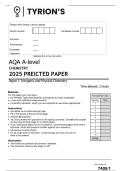
AQA A-level
CHEMISTRY 2025 PREDICTED PAPERS
Paper 3
Time allowed: 2 hours
Materials
For this paper you must have: For Examiner’s Use
• the Periodic Table/Data Booklet, provided as an insert (enclosed)
• a ruler with millimetre measurements Question Mark
• a scientific calculator, which you are expected to use where appropriate. 1
2
Instructions
3
• Use black ink or black ball-point pen.
• Fill in the boxes at the top of this page. 4
• Answer all questions. 5
• You must answer the questions in the spaces provided. Do not write outside 6
the box around each page or on blank pages.
Section B
• If you need extra space for your answer(s), use the lined pages at the end of
this book. Write the question number against your answer(s). TOTAL
• All working must be shown.
• Do all rough work in this book. Cross through any work you do not
want to be marked.
Information
• The marks for questions are shown in brackets.
• The maximum mark for this paper is 90.
Advice
• You are advised to spend 70 minutes on Section A and 50 minutes on Section B.
www.tyrions.com
7405/3
, 2
Do not write
outside the
Section A box
Answer all questions in this section.
0 1
Hexanedioic acid (HOOC–(CH₂)₄–COOH) reacts with ethane-1,2-diol
(HO–CH₂–CH₂–OH) to form a polyester.
0 1 . 1
Draw the repeating unit of this polyester.
[2 marks]
0 1 . 2
Name the small molecule released during condensation polymerisation.
[1 marks]
www.tyrions.com
, 3
Do not write
outside the
0 1 . 3 A student is given a sample of impure citric acid, C₆H₈O₇, which may be mixed with an box
inert substance. The student wants to find out how much pure citric acid is in the
sample.
The student dissolves 1.20 g of the impure sample in water and makes the solution up to
100.0 cm³ in a volumetric flask.
They take 25.0 cm³ of this solution and titrate it with 0.100 mol/dm³ sodium hydroxide
(NaOH) solution. The average volume of NaOH used is 22.50 cm³.
Citric acid reacts with sodium hydroxide according to this balanced equation:
C6H8O7+3NaOH→Na3C6H5O7+3H2O
Relative molar mass of citric acid = 192.0 g/mol
[5 marks]
Percentage purity ________________________
Turn over ►
www.tyrions.com
, 4
Do not write
outside the
0 1 . 4 A student fills a burette with hydrochloric acid. Before the titration, they notice an air box
bubble in the tip of the burette.
Explain why it is important to remove this air bubble before starting the titration.
Describe how the student should remove the air bubble.
[2 marks]
0 1 . 5 Explain why titrations should be repeated until concordant results are obtained.
[2 marks]
0 1 . 6 What colour change would you expect to see when methyl orange is used as
an indicator in a titration of hydrochloric acid with sodium hydroxide?
[1 mark]
www.tyrions.com
Centre number Candidate number
Surname
Forename(s)
Candidate
signature
I declare this is my own work.
AQA A-level
CHEMISTRY 2025 PREDICTED PAPERS
Paper 3
Time allowed: 2 hours
Materials
For this paper you must have: For Examiner’s Use
• the Periodic Table/Data Booklet, provided as an insert (enclosed)
• a ruler with millimetre measurements Question Mark
• a scientific calculator, which you are expected to use where appropriate. 1
2
Instructions
3
• Use black ink or black ball-point pen.
• Fill in the boxes at the top of this page. 4
• Answer all questions. 5
• You must answer the questions in the spaces provided. Do not write outside 6
the box around each page or on blank pages.
Section B
• If you need extra space for your answer(s), use the lined pages at the end of
this book. Write the question number against your answer(s). TOTAL
• All working must be shown.
• Do all rough work in this book. Cross through any work you do not
want to be marked.
Information
• The marks for questions are shown in brackets.
• The maximum mark for this paper is 90.
Advice
• You are advised to spend 70 minutes on Section A and 50 minutes on Section B.
www.tyrions.com
7405/3
, 2
Do not write
outside the
Section A box
Answer all questions in this section.
0 1
Hexanedioic acid (HOOC–(CH₂)₄–COOH) reacts with ethane-1,2-diol
(HO–CH₂–CH₂–OH) to form a polyester.
0 1 . 1
Draw the repeating unit of this polyester.
[2 marks]
0 1 . 2
Name the small molecule released during condensation polymerisation.
[1 marks]
www.tyrions.com
, 3
Do not write
outside the
0 1 . 3 A student is given a sample of impure citric acid, C₆H₈O₇, which may be mixed with an box
inert substance. The student wants to find out how much pure citric acid is in the
sample.
The student dissolves 1.20 g of the impure sample in water and makes the solution up to
100.0 cm³ in a volumetric flask.
They take 25.0 cm³ of this solution and titrate it with 0.100 mol/dm³ sodium hydroxide
(NaOH) solution. The average volume of NaOH used is 22.50 cm³.
Citric acid reacts with sodium hydroxide according to this balanced equation:
C6H8O7+3NaOH→Na3C6H5O7+3H2O
Relative molar mass of citric acid = 192.0 g/mol
[5 marks]
Percentage purity ________________________
Turn over ►
www.tyrions.com
, 4
Do not write
outside the
0 1 . 4 A student fills a burette with hydrochloric acid. Before the titration, they notice an air box
bubble in the tip of the burette.
Explain why it is important to remove this air bubble before starting the titration.
Describe how the student should remove the air bubble.
[2 marks]
0 1 . 5 Explain why titrations should be repeated until concordant results are obtained.
[2 marks]
0 1 . 6 What colour change would you expect to see when methyl orange is used as
an indicator in a titration of hydrochloric acid with sodium hydroxide?
[1 mark]
www.tyrions.com