
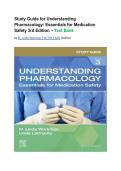
Study Guide for Understanding
Pharmacology: Essentials for Medication
Safety 3rd Edition – Test Bank
by M. Linda Workman PhD RN FAAN (Author)
,TABLE OF CONTENTS
1. Drug Therapy: Roles, Regulations, Actions, and Responses
2. Safely Preparing and Giving Drugs
3. Mathematics Review and Introduction to Dosage Calculations
4. Medical Systems of Weights and Measures
5. Dosage Calculation of Intravenous Solutions and Drugs
6. Anti-Infectives: Antibacterial Drugs
7. Anti-Infectives: Antiviral Drugs
8. Anti-Infectives: Antitubercular and Antifungal Drugs
9. Drugs for Pain Control, Migraines, and Skeletal Muscle Spasms
10. General Anti-Inflammatory Drugs
11. Immunizations and Immunosuppressant Drugs
12. Drugs That Affect Urine Output
13. Drug Therapy for Hypertension
14. Drug Therapy for Heart Failure
15. Drug Therapy for Dysrhythmias
16. Drug Therapy for High Blood Lipids
17. Drugs That Affect Blood Clotting
18. Drug Therapy for Asthma and Other Respiratory Problems
19. Drug Therapy for Gastrointestinal Problems
20. Drug Therapy for Gastric Ulcers, Reflux, and Inflammatory Bowel
Disease
21. Drug Therapy for Diabetes
22. Drug Therapy for Thyroid and Adrenal Gland Problems
23. Drug Therapy for Seizures
24. Drug Therapy for Alzheimer’s and Parkinson’s Diseases
25. Drug Therapy for Psychiatric Problems
26. Drug Therapy for Insomnia
27. Drug Therapy for Eye Problems
28. Drug Therapy for Male Reproductive Problems
29. Drug Therapy for Female Reproductive Problems
,Chapter 01: Drug Regulation, Actions, and Responses
Workman & LaCharity: Understanding Pharmacology:
Essentials for Medication Safety, 3rd Edition
MULTIPLE CHOICE BASIC CONCEPTS
1. Which health care professional has the major responsibility for dispensing prescribed drugs
under the direction of a pharmacist?
a. Physician
b. Nurse practitioner
c. Licensed nurse
d. Pharmacy technician
CORRECT ANSWER: D
The physician and nurse practitioner have the major responsibility for prescribing drugs, not dispensing
them. The licensed nurse has the primary responsibility for administering drugs, although under some
circumstances a licensed nurse may dispense prescribed drugs but this is not his or her major
responsibility in drug therapy. The pharmacy technician has the major responsibility of dispensing
prescribed drugs under the direction of a licensed pharmacist.
DIFFERENCE: Cognitive Level: Remembering REFFERENCE: p. 3
2. Which term describes the effect of a drug that improves body function?
a. Side effect
b. Intended action
c. Adverse reaction
d. Idiosyncratic response
CORRECT ANSWER: B
, NICHOLPRO
The purpose of drug therapy is to take a drug to prevent, reduce, or correct a health problem. This
response is any drug’s intended action also known as a therapeutic response.
DIFFERENCE: Cognitive Level: Remembering REFFERENCE: p. 3
3. Which type of drug name is “owned” by the company that manufactures it?
a. Generic name
b. Chemical name
c. Category name
d. Trade name
CORRECT ANSWER: D
The chemical name is a drug’s exact chemical composition. The generic name is the name assigned to
the drug by the U.S. Adopted Names Council and is not owned by anyone. The category name
REFFERENCEers to the type of drug (what it does or what it is used for) and is not an actual drug name.
The trade name (brand name) is the name provided and owned by a specific drug’s manufacturer.
DIFFERENCE: Cognitive Level: Remembering REFFERENCE: p. 4
4. Which drug or drug class is a “high alert” drug?
a. Penicillin
b. Insulin
c. NSAIDs
d. Calcium
CORRECT ANSWER: B
A high alert drug is one in which harm is likely to result if given at the wrong dose, to the wrong patient,
or not given to the correct patient. Drugs classified as high alert drugs include potassium, narcotics
(opioids), insulin, cancer chemotherapy drugs, and heparin (or any drug that strongly affects blood
clotting). Penicillin, NSAIDs, and calcium are not considered high alert drugs.
DIFFERENCE: Cognitive Level: Remembering REFFERENCE: p. 4
Pharmacology: Essentials for Medication
Safety 3rd Edition – Test Bank
by M. Linda Workman PhD RN FAAN (Author)
,TABLE OF CONTENTS
1. Drug Therapy: Roles, Regulations, Actions, and Responses
2. Safely Preparing and Giving Drugs
3. Mathematics Review and Introduction to Dosage Calculations
4. Medical Systems of Weights and Measures
5. Dosage Calculation of Intravenous Solutions and Drugs
6. Anti-Infectives: Antibacterial Drugs
7. Anti-Infectives: Antiviral Drugs
8. Anti-Infectives: Antitubercular and Antifungal Drugs
9. Drugs for Pain Control, Migraines, and Skeletal Muscle Spasms
10. General Anti-Inflammatory Drugs
11. Immunizations and Immunosuppressant Drugs
12. Drugs That Affect Urine Output
13. Drug Therapy for Hypertension
14. Drug Therapy for Heart Failure
15. Drug Therapy for Dysrhythmias
16. Drug Therapy for High Blood Lipids
17. Drugs That Affect Blood Clotting
18. Drug Therapy for Asthma and Other Respiratory Problems
19. Drug Therapy for Gastrointestinal Problems
20. Drug Therapy for Gastric Ulcers, Reflux, and Inflammatory Bowel
Disease
21. Drug Therapy for Diabetes
22. Drug Therapy for Thyroid and Adrenal Gland Problems
23. Drug Therapy for Seizures
24. Drug Therapy for Alzheimer’s and Parkinson’s Diseases
25. Drug Therapy for Psychiatric Problems
26. Drug Therapy for Insomnia
27. Drug Therapy for Eye Problems
28. Drug Therapy for Male Reproductive Problems
29. Drug Therapy for Female Reproductive Problems
,Chapter 01: Drug Regulation, Actions, and Responses
Workman & LaCharity: Understanding Pharmacology:
Essentials for Medication Safety, 3rd Edition
MULTIPLE CHOICE BASIC CONCEPTS
1. Which health care professional has the major responsibility for dispensing prescribed drugs
under the direction of a pharmacist?
a. Physician
b. Nurse practitioner
c. Licensed nurse
d. Pharmacy technician
CORRECT ANSWER: D
The physician and nurse practitioner have the major responsibility for prescribing drugs, not dispensing
them. The licensed nurse has the primary responsibility for administering drugs, although under some
circumstances a licensed nurse may dispense prescribed drugs but this is not his or her major
responsibility in drug therapy. The pharmacy technician has the major responsibility of dispensing
prescribed drugs under the direction of a licensed pharmacist.
DIFFERENCE: Cognitive Level: Remembering REFFERENCE: p. 3
2. Which term describes the effect of a drug that improves body function?
a. Side effect
b. Intended action
c. Adverse reaction
d. Idiosyncratic response
CORRECT ANSWER: B
, NICHOLPRO
The purpose of drug therapy is to take a drug to prevent, reduce, or correct a health problem. This
response is any drug’s intended action also known as a therapeutic response.
DIFFERENCE: Cognitive Level: Remembering REFFERENCE: p. 3
3. Which type of drug name is “owned” by the company that manufactures it?
a. Generic name
b. Chemical name
c. Category name
d. Trade name
CORRECT ANSWER: D
The chemical name is a drug’s exact chemical composition. The generic name is the name assigned to
the drug by the U.S. Adopted Names Council and is not owned by anyone. The category name
REFFERENCEers to the type of drug (what it does or what it is used for) and is not an actual drug name.
The trade name (brand name) is the name provided and owned by a specific drug’s manufacturer.
DIFFERENCE: Cognitive Level: Remembering REFFERENCE: p. 4
4. Which drug or drug class is a “high alert” drug?
a. Penicillin
b. Insulin
c. NSAIDs
d. Calcium
CORRECT ANSWER: B
A high alert drug is one in which harm is likely to result if given at the wrong dose, to the wrong patient,
or not given to the correct patient. Drugs classified as high alert drugs include potassium, narcotics
(opioids), insulin, cancer chemotherapy drugs, and heparin (or any drug that strongly affects blood
clotting). Penicillin, NSAIDs, and calcium are not considered high alert drugs.
DIFFERENCE: Cognitive Level: Remembering REFFERENCE: p. 4


