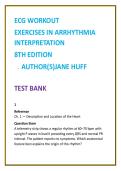
ECG WORKOUT
EXERCISES IN ARRHYTHMIA
INTERPRETATION
8TH EDITION
• AUTHOR(S)JANE HUFF
TEST BANK
1
Reference
Ch. 1 — Cardiac Innervation / SA node function
Question Stem
A telemetry strip shows a regular rhythm at 48 bpm with
upright P waves preceding every narrow QRS; PR intervals are
constant at 0.18 s. The patient is post-op after carotid sinus
manipulation and reports dizziness. Which physiologic
mechanism best explains this ECG finding?
,Options
A. Increased sympathetic outflow causing sinus bradycardia.
B. Enhanced vagal (parasympathetic) tone suppressing SA node
automaticity.
C. Ischemia of the AV node reducing conduction and causing
bradycardia.
D. Bundle branch conduction delay producing apparent slow
ventricular rate.
Correct Answer
B
Rationales
Correct (B): The strip shows sinus bradycardia (rate <60, P
before each QRS, normal PR). Manipulation near the carotid
sinus increases vagal output, slowing SA node automaticity.
Clinically, carotid stimulation commonly triggers vagal-mediated
sinus bradycardia.
Incorrect (A): Sympathetic outflow produces tachycardia, not
bradycardia.
Incorrect (C): AV node ischemia typically causes PR changes or
AV block patterns, not an isolated sinus slowing with preserved
PR.
Incorrect (D): Bundle branch delay widens QRS; rate remains
governed by SA node — narrow QRS here argues against bundle
branch cause.
,Teaching Point
Carotid sinus stimulation increases vagal tone → true sinus
bradycardia with preserved P–QRS relationships.
Citation
Huff, J. (2022). ECG Workout: Exercises in Arrhythmia
Interpretation (8th ed.). Ch. 1.
2
Reference
Ch. 1 — AV node function / PR interval physiology
Question Stem
A monitored patient’s rhythm is regular at 72 bpm. P waves are
present before each QRS but the PR interval measures 0.28 s on
multiple complexes. The patient is asymptomatic. Which
anatomic/physiologic explanation best matches this ECG?
Options
A. First-degree AV block due to delayed conduction in the AV
node (increased PR).
B. Sinus rhythm with accelerated junctional escape causing
prolonged PR.
C. Intraventricular conduction delay lengthening PR interval.
D. Atrial enlargement producing longer PR intervals.
Correct Answer
A
, Rationales
Correct (A): A consistent PR >0.20 s with a P before every QRS
indicates first-degree AV block; anatomically this reflects slowed
conduction through the AV node or proximal conduction tissue.
Incorrect (B): Junctional escape rhythms often have absent or
retrograde P waves and usually a shorter PR relationship, not a
prolonged PR with normal P–QRS sequence.
Incorrect (C): Intraventricular conduction delays widen the QRS,
not the PR interval which reflects AV conduction time.
Incorrect (D): Atrial enlargement alters P-wave morphology, not
PR duration.
Teaching Point
PR interval prolongation reflects AV nodal (or proximal His)
conduction delay, not ventricular conduction delay.
Citation
Huff, J. (2022). ECG Workout: Exercises in Arrhythmia
Interpretation (8th ed.). Ch. 1.
3
Reference
Ch. 1 — Heart Chambers / Atrial enlargement
Question Stem
A telemetry rhythm is regular at 82 bpm. P waves are tall and
peaked in lead II description; QRS complexes are narrow with
normal PR. The patient has chronic pulmonary disease and
EXERCISES IN ARRHYTHMIA
INTERPRETATION
8TH EDITION
• AUTHOR(S)JANE HUFF
TEST BANK
1
Reference
Ch. 1 — Cardiac Innervation / SA node function
Question Stem
A telemetry strip shows a regular rhythm at 48 bpm with
upright P waves preceding every narrow QRS; PR intervals are
constant at 0.18 s. The patient is post-op after carotid sinus
manipulation and reports dizziness. Which physiologic
mechanism best explains this ECG finding?
,Options
A. Increased sympathetic outflow causing sinus bradycardia.
B. Enhanced vagal (parasympathetic) tone suppressing SA node
automaticity.
C. Ischemia of the AV node reducing conduction and causing
bradycardia.
D. Bundle branch conduction delay producing apparent slow
ventricular rate.
Correct Answer
B
Rationales
Correct (B): The strip shows sinus bradycardia (rate <60, P
before each QRS, normal PR). Manipulation near the carotid
sinus increases vagal output, slowing SA node automaticity.
Clinically, carotid stimulation commonly triggers vagal-mediated
sinus bradycardia.
Incorrect (A): Sympathetic outflow produces tachycardia, not
bradycardia.
Incorrect (C): AV node ischemia typically causes PR changes or
AV block patterns, not an isolated sinus slowing with preserved
PR.
Incorrect (D): Bundle branch delay widens QRS; rate remains
governed by SA node — narrow QRS here argues against bundle
branch cause.
,Teaching Point
Carotid sinus stimulation increases vagal tone → true sinus
bradycardia with preserved P–QRS relationships.
Citation
Huff, J. (2022). ECG Workout: Exercises in Arrhythmia
Interpretation (8th ed.). Ch. 1.
2
Reference
Ch. 1 — AV node function / PR interval physiology
Question Stem
A monitored patient’s rhythm is regular at 72 bpm. P waves are
present before each QRS but the PR interval measures 0.28 s on
multiple complexes. The patient is asymptomatic. Which
anatomic/physiologic explanation best matches this ECG?
Options
A. First-degree AV block due to delayed conduction in the AV
node (increased PR).
B. Sinus rhythm with accelerated junctional escape causing
prolonged PR.
C. Intraventricular conduction delay lengthening PR interval.
D. Atrial enlargement producing longer PR intervals.
Correct Answer
A
, Rationales
Correct (A): A consistent PR >0.20 s with a P before every QRS
indicates first-degree AV block; anatomically this reflects slowed
conduction through the AV node or proximal conduction tissue.
Incorrect (B): Junctional escape rhythms often have absent or
retrograde P waves and usually a shorter PR relationship, not a
prolonged PR with normal P–QRS sequence.
Incorrect (C): Intraventricular conduction delays widen the QRS,
not the PR interval which reflects AV conduction time.
Incorrect (D): Atrial enlargement alters P-wave morphology, not
PR duration.
Teaching Point
PR interval prolongation reflects AV nodal (or proximal His)
conduction delay, not ventricular conduction delay.
Citation
Huff, J. (2022). ECG Workout: Exercises in Arrhythmia
Interpretation (8th ed.). Ch. 1.
3
Reference
Ch. 1 — Heart Chambers / Atrial enlargement
Question Stem
A telemetry rhythm is regular at 82 bpm. P waves are tall and
peaked in lead II description; QRS complexes are narrow with
normal PR. The patient has chronic pulmonary disease and