OpenStax Organic Chemistry: A Tenth Edition Student Solutions Manual
Chapter 30 – Orbitals and Organic Chemistry: Pericyclic Reactions
Solutions to Problems
30.1 For ethylene:
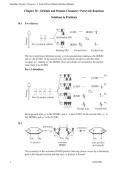
The two π electrons of ethylene occupy ψ1 in the ground state, making ψ1 the HOMO
and ψ2* the LUMO. In the excited state, one electron occupies ψ1 and the other
occupies ψ2*, making ψ2* the HOMO. Since all orbitals are occupied in the excited
state, there is no LUMO.
For 1,3-butadiene:
In the ground state, ψ2 is the HOMO, and ψ3* is the LUMO. In the excited state, ψ3* is
the HOMO, and ψ4* is the LUMO.
30.2
The symmetry of the octatriene HOMO predicts that ring closure occurs by a disrotatory
path in the thermal reaction and that only cis product is formed.
1 10/26/2023
, OpenStax Organic Chemistry: A Tenth Edition Student Solutions Manual
30.3 Note: Trans-3,4-dimethylcyclobutene is chiral; the S,S enantiomer will be used for
this argument.
Conrotatory ring opening of trans-3,4-dimethylcyclobutene can occur in either a
clockwise or a counterclockwise manner. Clockwise opening (path A) yields the E,E
isomer; counterclockwise opening (path B) yields the Z,Z isomer. Production of (2Z,4Z)-
2,4-hexadiene is disfavored because of steric strain between the methyl groups in the
transition state leading to ring-opened product.
30.4
Photochemical electrocyclic reactions of 6 π electron systems always occur in a
conrotatory manner.
11/3/2023 2
, OpenStax Organic Chemistry: A Tenth Edition Student Solutions Manual
30.5
The Diels–Alder reaction is a thermal [4 + 2] cycloaddition, which occurs with
suprafacial geometry. The stereochemistry of the diene is maintained in the product.
30.6
The reaction of cyclopentadiene and cycloheptatrienone is a [6 + 4] cycloaddition. This
thermal cycloaddition proceeds with suprafacial geometry since five electron pairs are
involved in the concerted process. The π electrons of the carbonyl group do not take part
in the reaction.
3 11/3/2023
Chapter 30 – Orbitals and Organic Chemistry: Pericyclic Reactions
Solutions to Problems
30.1 For ethylene:
The two π electrons of ethylene occupy ψ1 in the ground state, making ψ1 the HOMO
and ψ2* the LUMO. In the excited state, one electron occupies ψ1 and the other
occupies ψ2*, making ψ2* the HOMO. Since all orbitals are occupied in the excited
state, there is no LUMO.
For 1,3-butadiene:
In the ground state, ψ2 is the HOMO, and ψ3* is the LUMO. In the excited state, ψ3* is
the HOMO, and ψ4* is the LUMO.
30.2
The symmetry of the octatriene HOMO predicts that ring closure occurs by a disrotatory
path in the thermal reaction and that only cis product is formed.
1 10/26/2023
, OpenStax Organic Chemistry: A Tenth Edition Student Solutions Manual
30.3 Note: Trans-3,4-dimethylcyclobutene is chiral; the S,S enantiomer will be used for
this argument.
Conrotatory ring opening of trans-3,4-dimethylcyclobutene can occur in either a
clockwise or a counterclockwise manner. Clockwise opening (path A) yields the E,E
isomer; counterclockwise opening (path B) yields the Z,Z isomer. Production of (2Z,4Z)-
2,4-hexadiene is disfavored because of steric strain between the methyl groups in the
transition state leading to ring-opened product.
30.4
Photochemical electrocyclic reactions of 6 π electron systems always occur in a
conrotatory manner.
11/3/2023 2
, OpenStax Organic Chemistry: A Tenth Edition Student Solutions Manual
30.5
The Diels–Alder reaction is a thermal [4 + 2] cycloaddition, which occurs with
suprafacial geometry. The stereochemistry of the diene is maintained in the product.
30.6
The reaction of cyclopentadiene and cycloheptatrienone is a [6 + 4] cycloaddition. This
thermal cycloaddition proceeds with suprafacial geometry since five electron pairs are
involved in the concerted process. The π electrons of the carbonyl group do not take part
in the reaction.
3 11/3/2023