OpenStax Organic Chemistry: A Tenth Edition Student Solutions Manual
Chapter 21 – Carboxylic Acid Derivatives: Nucleophilic Acyl Substitution Reactions
Solutions to Problems
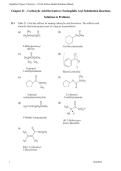
21.1 Table 21.1 lists the suffixes for naming carboxylic acid derivatives. The suffixes used
when the functional group is part of a ring are in parentheses.
(a) (b)
(c) (d)
(e) (f)
(g) (h)
(i)
1 10/4/2023
, OpenStax Organic Chemistry: A Tenth Edition Student Solutions Manual
21.2
(a) (b)
(c) (d)
(e) (f)
(g) (h)
21.3
10/4/2023 2
,OpenStax Organic Chemistry: A Tenth Edition Student Solutions Manual
21.4 Use Figure 21.3 if you need help.
Most reactive Least reactive
(a)
(b)
The most reactive acyl derivatives contain strongly electron-withdrawing groups in the
part of the structure that is to be the leaving group.
21.5 Identify the nucleophile (boxed) and the leaving group (circled), and replace the leaving
group by the nucleophile in the product.
(a)
(b)
(c)
(d)
21.6 The structure represents the tetrahedral intermediate in the reaction of methyl
cyclopentylacetate with hydroxide, a nucleophile. The products are cyclopentylacetate
anion and methanol.
3 10/4/2023
, OpenStax Organic Chemistry: A Tenth Edition Student Solutions Manual
21.7 In Fischer esterification, an alcohol undergoes a nucleophilic acyl substitution with a
carboxylic acid to yield an ester. The mineral acid catalyst makes the carboxyl group of
the acid more electrophilic. Predicting the products is easier if the two reagents are
positioned so that the reacting functional groups point towards each other.
(a)
(b)
(c)
21.8 Under Fischer esterification conditions, many hydroxycarboxylic acids can form
intramolecular esters (lactones).
21.9 Pyridine neutralizes the HCl byproduct by forming pyridinium chloride. This
neutralization removes from the product mixture acid that might cause side reactions. As
mentioned previously, positioning the reacting groups so that they face each other makes
it easier to predict the products.
(a)
(b)
10/4/2023 4
Chapter 21 – Carboxylic Acid Derivatives: Nucleophilic Acyl Substitution Reactions
Solutions to Problems
21.1 Table 21.1 lists the suffixes for naming carboxylic acid derivatives. The suffixes used
when the functional group is part of a ring are in parentheses.
(a) (b)
(c) (d)
(e) (f)
(g) (h)
(i)
1 10/4/2023
, OpenStax Organic Chemistry: A Tenth Edition Student Solutions Manual
21.2
(a) (b)
(c) (d)
(e) (f)
(g) (h)
21.3
10/4/2023 2
,OpenStax Organic Chemistry: A Tenth Edition Student Solutions Manual
21.4 Use Figure 21.3 if you need help.
Most reactive Least reactive
(a)
(b)
The most reactive acyl derivatives contain strongly electron-withdrawing groups in the
part of the structure that is to be the leaving group.
21.5 Identify the nucleophile (boxed) and the leaving group (circled), and replace the leaving
group by the nucleophile in the product.
(a)
(b)
(c)
(d)
21.6 The structure represents the tetrahedral intermediate in the reaction of methyl
cyclopentylacetate with hydroxide, a nucleophile. The products are cyclopentylacetate
anion and methanol.
3 10/4/2023
, OpenStax Organic Chemistry: A Tenth Edition Student Solutions Manual
21.7 In Fischer esterification, an alcohol undergoes a nucleophilic acyl substitution with a
carboxylic acid to yield an ester. The mineral acid catalyst makes the carboxyl group of
the acid more electrophilic. Predicting the products is easier if the two reagents are
positioned so that the reacting functional groups point towards each other.
(a)
(b)
(c)
21.8 Under Fischer esterification conditions, many hydroxycarboxylic acids can form
intramolecular esters (lactones).
21.9 Pyridine neutralizes the HCl byproduct by forming pyridinium chloride. This
neutralization removes from the product mixture acid that might cause side reactions. As
mentioned previously, positioning the reacting groups so that they face each other makes
it easier to predict the products.
(a)
(b)
10/4/2023 4