NURS 6512 Week 6 Midterm Exam / NURS6512 Week 6 Midterm Exam (Recent): Advanced Health Assessment(Version 2)
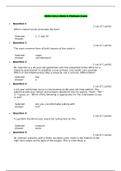
NURS 6512 Week 6 Midterm Exam / NURS6512 Week 6 Midterm Exam (Latest): Advanced Health Assessment: Walden University(Version 2) • Question 1 Which cranial nerves innervate the face? • Question 2 The most common form of birth trauma of the scalp is: • Question 3 Mr. Sanchez is a 45-year-old gentleman who has presented to the office for a physical examination to establish a new primary care health care provider. Which of the following describes a physical, not a cultural, differentiator? • Question 4 A 22-year-old female nurse is interviewing an 86-year-old male patient. The patient avoids eye contact and answers questions only by saying, "Yeah," "No," or "I guess so." Which of the following is appropriate for the interviewer to say or ask? • • Question 5 To perform the Rinne test, place the tuning fork on the: • Question 6 Mr. Johnson presents with a freely movable cystic mass in the midline of the high neck region at the base of the tongue. This is most likely a: • Question 7 Nuchal rigidity is most commonly associated with: • Question 8 Mrs. Leonard brings her newborn infant into the pediatrician's office for a first well-baby visit. As the health care provider, you teach her that newborns are more vulnerable to hypothermia due to: • Question 9 Bulging of an amber tympanic membrane without mobility is most often associated with: • Question 10 You are examining a pregnant patient and have noted a vascular lesion. When you blanche over the vascular lesion, the site blanches and refills evenly from the center outward. The nurse documents this lesion as a: • Question 11 Tuning forks with a frequency of 500 to 1000 Hz are most commonly used to measure: • Question 12 Spasmodic muscular contractions of the head, face, or neck are called: • Question 13 When examining the skull of a 4-month-old baby, you should normally find: • Question 14 Which of the following occurs when firm pressure is used to apply the stethoscope's bell end-piece to the skin? • Question 15 Peritonitis produces bowel sounds that are: • Question 16 Sweat glands, hair, and nails are all formed from: • Question 17 Mr. Donalds is a 45-year-old roofer. Your inspection to determine color variations of the skin is best conducted: • Question 18 Cherry angiomas are a common finding in: • Question 19 Mrs. Hartzell is a 34-year-old patient who has presented for nutritional counseling because she is a vegetarian. Deficiency of which of the following is a concern in the vegetarian diet? • Question 20 Unusual white areas on the skin may be due to: • Question 21 Knowledge of the culture or cultures represented by the patient should be used to: • Question 22 Mr. D. complains of a headache. During the history, he mentions his use of alcohol and illicit drugs. This information would most likely belong in the: • Question 23 Tangential lighting is best used for inspecting skin: • Question 24 When taking a history, you should: • Question 25 Your patient returns for a blood pressure check 2 weeks after a visit during which you performed a complete history and physical. This visit would be documented by creating a(n): • Question 26 A 5-year-old child presents with nasal congestion and a headache. To assess for sinus tenderness you should palpate over the: • Question 27 Mrs. Tuber is a 36-year-old patient who comes into the health center with complaints that her fingernails are not growing. Which structure is the site of new nail growth? • Question 28 In counseling a client regarding nutrition education, you explain that linoleic acid, a major fatty acid, is thought to be essential for: • Question 29 You are completing a general physical examination on Mr. Rock, a 39-year-old man with complaints of constipation. When examining a patient with tense abdominal musculature, a helpful technique is to have the patient: • Question 30 Expected hair distribution changes in older adults include: • Question 31 Peritonitis produces bowel sounds that are: • Question 32 White, rounded, or oval ulcerations surrounded by a red halo and found on the oral mucosa are: • Question 33 Which of the following is the most accurate reflection of an individual's food intake? • Question 34 Which part of the information contained in the patient's record may be used in court? • Question 35 You are using an ophthalmoscope to examine a patient's inner eye. You rotate the lens selector clockwise, then counterclockwise to compensate for: • Question 36 Mr. Jones is a 45-year-old patient who presents for a physical examination. On examination, you note costochondral beading, enlarged skull, and bowed legs and diagnose him with rickets. A deficiency of which fat-soluble micronutrient can result in rickets? • Question 37 A guideline for history taking is for caregivers to: • Question 38 When communicating with older children and teenagers, you should be sensitive to their: • Question 39 A 17-year-old girl presents to the clinic for a sports physical. Physical examination findings reveal bradycardia, multiple erosions of tooth enamel, and scars on her knuckles. She appears healthy otherwise. You should ask her if she: • Question 40 Ms. Jones is a 31-year-old female patient who presents for a routine physical examination. Which examination technique will be used first? • Question 41 Nasal symptoms that imply an allergic response include: • Question 42 Coarse, dry, and brittle hair is associated with which metabolic disorder? • Question 43 What finding is unique to the documentation of a physical examination of an infant? • Question 44 Your patient presents with symptoms that lead you to suspect acute appendicitis. Which assessment finding is least likely to be associated with this condition early in its course? • Question 45 A brief statement of the reason the patient is seeking health care is called the: • Question 46 Mrs. Britton is a 34-year-old patient who presents to the office with complaints of skin rashes. You have noted a 4' 3-cm, rough, elevated area of psoriasis. This is an example of a: • Question 47 Mr. L. presents to the clinic with severe groin pain and a history of kidney stones. Mr. L.'s son tells you that, for religious reasons, his father wishes to keep any stone that is passed into the urine filter that he has been using. What is your most appropriate response? • Question 48 Mrs. G. reports an increase in her alcohol intake over the past 5 years. To screen her for problem drinking, you would use the: • Question 49 Mr. Akins is a 78-year-old patient who presents to the clinic with complaints of hearing loss. Which of the following are changes in hearing that occur in the elderly? Select all that apply. • Question 50 As part of your health promotion education for a new patient, you explain that the risk factors for skin cancer include: • Question 51 Ms. Davis is a 27-year-old patient with a BMI of 33. Based on her BMI, your diagnosis would be: • Question 52 The infant should be placed in which position to have his or her height or length measured? • Question 53 Which of the following formats would be used for visits that address problems not yet identified in the problem-oriented medical record (POMR)? • Question 54 Which of the following is an expected change in the assessment of the thyroid during pregnancy? • Question 55 A serous membrane that lines the abdominal cavity and forms a protective cover for many abdominal structures is the: • Question 56 Pigmented, raised, warty lesions over the face and trunk should be assessed by an experienced practitioner who can distinguish: • Question 57 Penicillin is considered a • Question 58 Which question would be considered a leading question? • Question 59 Which of the following organs is part of the alimentary tract? • Question 60 Small, minute bruises are called: • Question 61 When recording physical findings, which data are recorded first for all systems? • Question 62 When hearing is evaluated, which cranial nerve is being tested? • Question 63 You are palpating a patient's thyroid and find that its broadest dimension measures 4 cm. The right lobe is 25% larger than the left. These data would indicate: • Question 64 Auscultation should be carried out last, except when examining the: • Question 65 You are collecting a history from an 11-year-old girl. Her mother is sitting next to her in the examination room. When collecting history from older children or adolescents, they should be: • Question 66 Mr. Mathews is a 47-year-old patient who presents for a routine physical examination. On examination, you have noted a bruit heard over the thyroid. This is suggestive of: • Question 67 A detailed description of the symptoms related to the chief complaint is presented in the: • Question 68 Mr. and Mrs. Johnson have presented to the office with their infant son with complaints of ear drainage. When examining an infant's middle ear, the nurse should use one hand to stabilize the otoscope against the head while using the other hand to: • Question 69 In examining the neck of a 34-year-old female patient, you note that the uppermost ridge of the tracheal cartilage is at the: • Question 70 A flat, nonpalpable lesion is described as a macule if the diameter is: • Question 71 During physical examination of a 30-year-old Chinese man, you notice slight asymmetry of his face. The cranial nerve examination is normal. Your best action is to: • Question 72 Placing the base of a vibrating tuning fork on the midline vertex of the patient's head is a test for: • Question 73 Expected normal percussion tones include: • Question 74 Fluorescing lesions are best distinguished using a(n): • Question 75 A college student comes to the student health center complaining of difficulty in concentrating during class and while studying. The diet that would contribute to this problem is one that consumes mostly: • Question 76 Mr. Abdul is a 40-year-old Middle Eastern man who presents to the office for a first visit with the complaint of new abdominal pain. You are concerned about violating a cultural prohibition when you prepare to do his rectal examination. The best tactic would be to: • Question 77 Mr. Williams, age 25, has recovered recently from an upper and lower respiratory infection. He describes a long-standing nasal dripping. He is seeking treatment for a mild hearing loss that has not gone away. Information concerning his chronic postnasal drip should be documented within which section of his history? • Question 78 The term denoting the caregiver's need to do no harm to the patient is: • Question 79 When palpating the abdomen, you should note whether the liver is enlarged in the: • Question 80 To correctly document absent bowel sounds, one must listen continuously for: • Question 81 The adult recommended dietary fat intake should be _____ gday. • Question 82 Mr. Marks is a 66-year-old patient who presents for a physical examination to the clinic. Which question has the most potential for exploring a patient's cultural beliefs related to a health problem? • Question 83 The most superior part of the stomach is the: • Question 84 Mrs. Webb is a 38-year-old patient who has been changing her lifestyle to eat in a healthy way and lose weight. During your health promotion education regarding her nutritional status, you explain the function of dietary protein as: • Question 85 Percussing at the right midclavicular line, below the umbilicus, and continuing upward is the correct technique for locating the: • Question 86 When you are questioning a patient regarding alcohol intake, she tells you that she is only a social drinker. Which initial response is appropriate? • Question 87 Regardless of the origin, discharge is described by noting: • Question 88 Ms. Otten is a 45-year-old patient who presents with a complaint of weight gain. Which medication is frequently associated with weight gain? • Question 89 George Michaels, a 22-year-old patient, tells the nurse that he is here today to "check his allergies." He has been having "green nasal discharge" for the last 72 hours. How would the nurse document his reason for seeking care? • Question 90 To approximate vocal frequencies, which tuning fork should be used to assess hearing? • Question 91 Your patient is complaining of acute, intense sharp epigastric pain that radiates to the back and left scapula with nausea and vomiting. Based on this history, your prioritized physical examination should be to: • Question 92 You have just completed a skin assessment on Mr. Baker. During your assessment, you have transilluminated a skin lesion. During the physical examination, you know that skin lesions are transilluminated to distinguish: • Question 93 Mrs. Raymonds is a 24-year-old patient who has presented for a routine concern over her current weight. In your patient teaching with her, you explain the importance of macronutrients. Which of the following is a macronutrient? • Question 94 In issues surrounding ethical decision making, beneficence refers to the: • Question 95 Which statement is true regarding the relationship of physical characteristics and culture? • Question 96 The review of systems is a component of the: • Question 97 The recommended minimum daily protein requirement for the normal adult is ______. • Question 98 Subjective and symptomatic data are: • Question 99 When are open-ended questions generally most useful? • Question 100 Mrs. Grace is a 58-year-old patient who has a diagnosis of pernicious anemia. Which B vitamin is deficient in patients with pernicious anemia?
Written for
- Institution
- Nursing course
- Course
- Nursing course
Document information
- Uploaded on
- March 22, 2021
- Number of pages
- 17
- Written in
- 2020/2021
- Type
- Other
- Person
- Unknown
Subjects
- walden university
- nurs 6512n midterm exam
- nurs6512n midterm exam
-
nurs 6512 week 6 midterm exam
-
nurs6512 week 6 midterm exam
-
advanced health assessment

Also available in package deal