PROBLEM 2. 1
EXPERIMENTAL APPROACHES TO UNDERSTAND ANXIETY
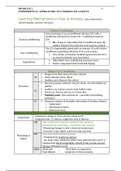
Learning Mechanisms in Fear & Anxiety (Sara Scheveneels,
Yannick Boddez, and Dirk Hermans)
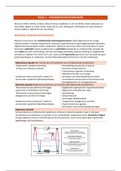
Classical conditioning
Several pairings of an unconditional stimulus (UC) with a
conditional stimulus(CS) results into > conditional response
Classical conditioning (CR)
CR: change in responding that is conditional upon the
relation between the presence of at least two stimuli
The CS is (repeatedly) paired with an aversive US until it elicits
conditional responding indicative of fear and anxiety.
Fear conditioning
Very similar to classical conditioning but here the UC is
an aversive stimulus (e.g. loud noise)
Little Albert- fear conditioning (rat-loud noise)
Experiments
Pavlov’s dog experiment (food-bell ringing)
Human Fear Conditioning
Ranges from fairly neutral to fear-relevant
CS Visual stimulus (more often)
Auditory and olfactory (less often)
Electrocutaneous stimulus/ electric shock- uncomfortable/not
Processes painful
Auditory e.g. human scream, loud (white) noise
US
Visual e.g. aversive pictures or movie clips
Modeling panic: CO2 enriched air > sensation of breathing
restriction
CR Response systems of focus(Bio-information & Emotion theory)
1. Verbal level
2. Physiological indices
3. Behavioral levels
- Expectancy ratings of US occurrence (most used)
Verbal level
- Subjective fear, CS valence, subjective units of distress
SCR Skin conductance response/ galvanic skin response/
electrodermal responding/ sympathetic skin response
-Measuring changes in skin’s electrical conductance
-Increases in any salient event (not only aversive)
FPS Fear-potentiated startle response
Physiological
- Modulated by emotional valence
indices
- Eye-blink reflex: elicited by white noise administration and it is
measured by electromyographic activity of the muscles around
the eye (orbicularis oculi)
Other Heart-rate All of them correspond to
Pupil dilation symptoms of clinical anxiety
, PROBLEM 2. 2
EXPERIMENTAL APPROACHES TO UNDERSTAND ANXIETY
Avoidance behavior measured by:
Option of avoiding the CS or the US (presented w/ CS)
Vary in cost
Visual avoidance- eye tracking method
Behavioral level
Approach avoidance tasks: presentation of manikin on bottom/top of
screen and CS on the other half.
If participants move the manikin faster away from the CS than
toward it > avoidance tendency
Low correlation between the three indices are either due to measurement error or because they
represent different dimensions of anxiety.
External validity of human fear conditioning model
The similarity between the (fear conditioning) model and the
anxiety disorder.
SCR, startling, heart rate
Face validity Difference between simple lab stimuli and complex real-
life
→ Use of multisensory stimulus configurations for a
better analogue of real-life experience (investigation)
Assessment of whether the same processed are at play in the
Construct Validity
model and the clinical disorder (underlying mechanisms)
Neuroimaging studies (similar neurocircuity, role of
Evidence amygdaloid nuclei)
Other brain areas e.g. hippocampus, insula etc.
Many anxiety patients are not able to report a CS-US event that
1st Criticism
can account for current anxiety symptoms.
1. Not accurate memory
2. Generalization and higher-order conditioning hide learning
Observational conditioning/ learning
Fear learning via instruction (verbal)
Olsson & Phelps (2004) > similar SCR in all pathways-verbal, direct &
observational- high correlation of amygdala activation.
3. US subtle e.g. fatigue > overlook learning
4. US interoceptive (in panic)
Not everyone undergoing a traumatic experience will eventually
2nd Criticism
develop an anxiety disorder.
Moderators of learning process:
Biological/ Temperamental predisposition
o 5-HTTLPR : polymorphic region of serotonin transporter gene (mainly s-allele)
o Assoc with: anxiety related p.traits and facilitated fear conditioning, Severe panic
& social anxiety symptoms, Diathesis stress model of psychopathology.
o Highly active neural fear network in response to CS only when history of stressful
events
EXPERIMENTAL APPROACHES TO UNDERSTAND ANXIETY
Learning Mechanisms in Fear & Anxiety (Sara Scheveneels,
Yannick Boddez, and Dirk Hermans)
Classical conditioning
Several pairings of an unconditional stimulus (UC) with a
conditional stimulus(CS) results into > conditional response
Classical conditioning (CR)
CR: change in responding that is conditional upon the
relation between the presence of at least two stimuli
The CS is (repeatedly) paired with an aversive US until it elicits
conditional responding indicative of fear and anxiety.
Fear conditioning
Very similar to classical conditioning but here the UC is
an aversive stimulus (e.g. loud noise)
Little Albert- fear conditioning (rat-loud noise)
Experiments
Pavlov’s dog experiment (food-bell ringing)
Human Fear Conditioning
Ranges from fairly neutral to fear-relevant
CS Visual stimulus (more often)
Auditory and olfactory (less often)
Electrocutaneous stimulus/ electric shock- uncomfortable/not
Processes painful
Auditory e.g. human scream, loud (white) noise
US
Visual e.g. aversive pictures or movie clips
Modeling panic: CO2 enriched air > sensation of breathing
restriction
CR Response systems of focus(Bio-information & Emotion theory)
1. Verbal level
2. Physiological indices
3. Behavioral levels
- Expectancy ratings of US occurrence (most used)
Verbal level
- Subjective fear, CS valence, subjective units of distress
SCR Skin conductance response/ galvanic skin response/
electrodermal responding/ sympathetic skin response
-Measuring changes in skin’s electrical conductance
-Increases in any salient event (not only aversive)
FPS Fear-potentiated startle response
Physiological
- Modulated by emotional valence
indices
- Eye-blink reflex: elicited by white noise administration and it is
measured by electromyographic activity of the muscles around
the eye (orbicularis oculi)
Other Heart-rate All of them correspond to
Pupil dilation symptoms of clinical anxiety
, PROBLEM 2. 2
EXPERIMENTAL APPROACHES TO UNDERSTAND ANXIETY
Avoidance behavior measured by:
Option of avoiding the CS or the US (presented w/ CS)
Vary in cost
Visual avoidance- eye tracking method
Behavioral level
Approach avoidance tasks: presentation of manikin on bottom/top of
screen and CS on the other half.
If participants move the manikin faster away from the CS than
toward it > avoidance tendency
Low correlation between the three indices are either due to measurement error or because they
represent different dimensions of anxiety.
External validity of human fear conditioning model
The similarity between the (fear conditioning) model and the
anxiety disorder.
SCR, startling, heart rate
Face validity Difference between simple lab stimuli and complex real-
life
→ Use of multisensory stimulus configurations for a
better analogue of real-life experience (investigation)
Assessment of whether the same processed are at play in the
Construct Validity
model and the clinical disorder (underlying mechanisms)
Neuroimaging studies (similar neurocircuity, role of
Evidence amygdaloid nuclei)
Other brain areas e.g. hippocampus, insula etc.
Many anxiety patients are not able to report a CS-US event that
1st Criticism
can account for current anxiety symptoms.
1. Not accurate memory
2. Generalization and higher-order conditioning hide learning
Observational conditioning/ learning
Fear learning via instruction (verbal)
Olsson & Phelps (2004) > similar SCR in all pathways-verbal, direct &
observational- high correlation of amygdala activation.
3. US subtle e.g. fatigue > overlook learning
4. US interoceptive (in panic)
Not everyone undergoing a traumatic experience will eventually
2nd Criticism
develop an anxiety disorder.
Moderators of learning process:
Biological/ Temperamental predisposition
o 5-HTTLPR : polymorphic region of serotonin transporter gene (mainly s-allele)
o Assoc with: anxiety related p.traits and facilitated fear conditioning, Severe panic
& social anxiety symptoms, Diathesis stress model of psychopathology.
o Highly active neural fear network in response to CS only when history of stressful
events