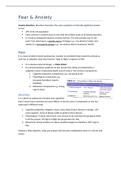
Fear & Anxiety
Anxiety disorders: Disorders that share the same symptoms of clinically significant anxiety
or fear.
29% of the US population
Most common in women than in men with the earliest onset of all mental disorders.
It is hard to distinguish between anxiety and fear. The only possible way (in the
past): Fear referring to a specific source of danger e.g. I am afraid of snakes and
anxiety to a non-specific danger e.g. I am anxious about my parents’ health.
Fear
It is a basic emotion-instant spontaneous reaction to potential threat shared by animals as
well, has an adaptive value that involves “fight or flight” response of ANS.
If no obvious external danger → Panic attack
Has almost identical symptoms to fear except from being accompanied by a
subjective sense of upcoming death, loss of control. The common components:
1. Cognitive/subjective components e.g. I am going to die
2. Physiological components e.g.
increased heartbeat, heavily
breathing
3. Behavioral components e.g. strong
urge to leave
Anxiety
It is a blend of unpleasant emotions and cognitions
that is more future oriented and more diffuse. It has the same 3 components as fear but
expressed in different ways.
1. Cognitive/subjective: Negative mood, worry about future threats or danger, self-
preoccupation, sense of being unable to predict future threats.
2. Physiological: Tension and chronic over-arousal to be activated and prepared when
it will be present. NO fight or flight but preparation for that.
3. Behavioral: Strong tendency to above possibly dangerous situations. NOT urge to
flee.
Anxiety is often adaptive, helps you prepare but becomes maladaptive when it is chronic and
severe.
, Conditioning fear & anxiety
Many sources of anxiety are learned. Many people and animals establish fear and anxiety
responses through conditioning.
NS paired with US (frightening, unpleasant events e.g. physical or psychological
trauma) →CR (elicit fear or anxiety)
This process can often lead to clinically significant fears and anxieties.
Anxiety Disorders
They are characterized by unrealistic, irrational fears or anxieties that cause significant
distress or impairment in functioning.
Specific phobia: Fear and panic response not only during facing the object or
situation but also in possibility of it.
Social anxiety disorder (social phobia)
Panic disorder: Frequent panic attacks and intense anxiety in the possibility of having
another one.
Agoraphobia: People go to great lengths to avoid a variety of situations e.g. open
streets to crowded places.
Generalized anxiety disorder: General sense of diffuse anxiety and worry about
many potentially bad things. They also experience occasional panic attacks but it’s
not the source of their anxiety. They experience one more anxiety disorder and/or
depression.
Specific phobias
Phobia: A persistent disproportionate fear of some specific object or situation that presents
little or no actual danger and yet leads to great deal of avoidance of these feared situations.
As we will see, three main categories of phobias are 1. Specific phobias, 2. Social phobia, 3.
Agoraphobia.
Specific phobias:
Strong and persistent fear triggered by the presence or expectance of a specific object or
situation and leads to significant distress or/and impairment in person’s ability to function.
They show a fear response similar to panic attack. They try to avoid the situations as much as
possible.
Avoidance happens because of the phobic response itself that is very unpleasant
and because of the irrational appraisal of the likelihood that sth bad will happen
Anxiety disorders: Disorders that share the same symptoms of clinically significant anxiety
or fear.
29% of the US population
Most common in women than in men with the earliest onset of all mental disorders.
It is hard to distinguish between anxiety and fear. The only possible way (in the
past): Fear referring to a specific source of danger e.g. I am afraid of snakes and
anxiety to a non-specific danger e.g. I am anxious about my parents’ health.
Fear
It is a basic emotion-instant spontaneous reaction to potential threat shared by animals as
well, has an adaptive value that involves “fight or flight” response of ANS.
If no obvious external danger → Panic attack
Has almost identical symptoms to fear except from being accompanied by a
subjective sense of upcoming death, loss of control. The common components:
1. Cognitive/subjective components e.g. I am going to die
2. Physiological components e.g.
increased heartbeat, heavily
breathing
3. Behavioral components e.g. strong
urge to leave
Anxiety
It is a blend of unpleasant emotions and cognitions
that is more future oriented and more diffuse. It has the same 3 components as fear but
expressed in different ways.
1. Cognitive/subjective: Negative mood, worry about future threats or danger, self-
preoccupation, sense of being unable to predict future threats.
2. Physiological: Tension and chronic over-arousal to be activated and prepared when
it will be present. NO fight or flight but preparation for that.
3. Behavioral: Strong tendency to above possibly dangerous situations. NOT urge to
flee.
Anxiety is often adaptive, helps you prepare but becomes maladaptive when it is chronic and
severe.
, Conditioning fear & anxiety
Many sources of anxiety are learned. Many people and animals establish fear and anxiety
responses through conditioning.
NS paired with US (frightening, unpleasant events e.g. physical or psychological
trauma) →CR (elicit fear or anxiety)
This process can often lead to clinically significant fears and anxieties.
Anxiety Disorders
They are characterized by unrealistic, irrational fears or anxieties that cause significant
distress or impairment in functioning.
Specific phobia: Fear and panic response not only during facing the object or
situation but also in possibility of it.
Social anxiety disorder (social phobia)
Panic disorder: Frequent panic attacks and intense anxiety in the possibility of having
another one.
Agoraphobia: People go to great lengths to avoid a variety of situations e.g. open
streets to crowded places.
Generalized anxiety disorder: General sense of diffuse anxiety and worry about
many potentially bad things. They also experience occasional panic attacks but it’s
not the source of their anxiety. They experience one more anxiety disorder and/or
depression.
Specific phobias
Phobia: A persistent disproportionate fear of some specific object or situation that presents
little or no actual danger and yet leads to great deal of avoidance of these feared situations.
As we will see, three main categories of phobias are 1. Specific phobias, 2. Social phobia, 3.
Agoraphobia.
Specific phobias:
Strong and persistent fear triggered by the presence or expectance of a specific object or
situation and leads to significant distress or/and impairment in person’s ability to function.
They show a fear response similar to panic attack. They try to avoid the situations as much as
possible.
Avoidance happens because of the phobic response itself that is very unpleasant
and because of the irrational appraisal of the likelihood that sth bad will happen