OpenStax Chemistry: Atoms First 2e
2.4: Chemical Formulas
Chemistry: Atoms First 2e
2: Atoms, Molecules, and Ions
2.4: Chemical Formulas
27. Explain why the symbol for an atom of the element oxygen and the formula for a molecule of
oxygen differ.
Solution
The symbol for the element oxygen, O, represents both the element and one atom of oxygen. A
molecule of oxygen, O2, contains two oxygen atoms; the subscript 2 in the formula must be used
to distinguish the diatomic molecule from two single oxygen atoms.
28. Explain why the symbol for the element sulfur and the formula for a molecule of sulfur
differ.
Solution
The symbol for the sulfur atom, S, represents the element and one atom of the element. The
sulfur molecule (S8) consists of eight sulfur atoms linked in a ring. Thus, S without a subscript
would be an inadequate representation of the molecule.
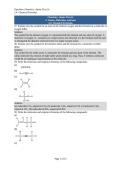
29. Write the molecular and empirical formulas of the following compounds:
(a)
(b)
(c)
(d)
Solution
(a) molecular CO2, empirical CO2; (b) molecular C2H2, empirical CH; (c) molecular C2H4,
empirical CH2; (d) molecular H2SO4, empirical H2SO4
30. Write the molecular and empirical formulas of the following compounds:
(a)
(b)
(c)
Page 1 of 15
, OpenStax Chemistry: Atoms First 2e
2.4: Chemical Formulas
(d)
Solution
(a) molecular C4H8, empirical CH2; (b) molecular C4H6, empirical C2H3; (c) molecular Si2H2Cl4,
empirical SiHCl2; (d) molecular H3PO4, empirical H3PO4
31. Determine the empirical formulas for the following compounds:
(a) caffeine, C8H10N4O2
(b) sucrose, C12H22O11
(c) hydrogen peroxide, H2O2
(d) glucose, C6H12O6
(e) ascorbic acid (vitamin C), C6H8O6
Solution
(a) C4H5N2O; (b) C12H22O11; (c) HO; (d) CH2O; (e) C3H4O3
32. Determine the empirical formulas for the following compounds:
(a) acetic acid, C2H4O2
(b) citric acid, C6H8O7
(c) hydrazine, N2H4
(d) nicotine, C10H14N2
(e) butane, C4H10
Solution
(a) CH2O; (b) C6H8O7; (c) NH2; (d) C5H7N; (e) C2H5
33. Write the empirical formulas for the following compounds:
(a)
(b)
Solution
(a) CH2O; (b) C2H4O
34. Open the URL: http://phet.colorado.edu/en/simulation/build-a-molecule and select the
“Larger Molecules” tab. Select an appropriate atom’s “Kit” to build a molecule with two carbon
and six hydrogen atoms. Drag atoms into the space above the “Kit” to make a molecule. A name
will appear when you have made an actual molecule that exists (even if it is not the one you
want). You can use the scissors tool to separate atoms if you would like to change the
connections. Click on “3D” to see the molecule, and look at both the space-filling and ball-and-
stick possibilities.
Page 2 of 15
2.4: Chemical Formulas
Chemistry: Atoms First 2e
2: Atoms, Molecules, and Ions
2.4: Chemical Formulas
27. Explain why the symbol for an atom of the element oxygen and the formula for a molecule of
oxygen differ.
Solution
The symbol for the element oxygen, O, represents both the element and one atom of oxygen. A
molecule of oxygen, O2, contains two oxygen atoms; the subscript 2 in the formula must be used
to distinguish the diatomic molecule from two single oxygen atoms.
28. Explain why the symbol for the element sulfur and the formula for a molecule of sulfur
differ.
Solution
The symbol for the sulfur atom, S, represents the element and one atom of the element. The
sulfur molecule (S8) consists of eight sulfur atoms linked in a ring. Thus, S without a subscript
would be an inadequate representation of the molecule.
29. Write the molecular and empirical formulas of the following compounds:
(a)
(b)
(c)
(d)
Solution
(a) molecular CO2, empirical CO2; (b) molecular C2H2, empirical CH; (c) molecular C2H4,
empirical CH2; (d) molecular H2SO4, empirical H2SO4
30. Write the molecular and empirical formulas of the following compounds:
(a)
(b)
(c)
Page 1 of 15
, OpenStax Chemistry: Atoms First 2e
2.4: Chemical Formulas
(d)
Solution
(a) molecular C4H8, empirical CH2; (b) molecular C4H6, empirical C2H3; (c) molecular Si2H2Cl4,
empirical SiHCl2; (d) molecular H3PO4, empirical H3PO4
31. Determine the empirical formulas for the following compounds:
(a) caffeine, C8H10N4O2
(b) sucrose, C12H22O11
(c) hydrogen peroxide, H2O2
(d) glucose, C6H12O6
(e) ascorbic acid (vitamin C), C6H8O6
Solution
(a) C4H5N2O; (b) C12H22O11; (c) HO; (d) CH2O; (e) C3H4O3
32. Determine the empirical formulas for the following compounds:
(a) acetic acid, C2H4O2
(b) citric acid, C6H8O7
(c) hydrazine, N2H4
(d) nicotine, C10H14N2
(e) butane, C4H10
Solution
(a) CH2O; (b) C6H8O7; (c) NH2; (d) C5H7N; (e) C2H5
33. Write the empirical formulas for the following compounds:
(a)
(b)
Solution
(a) CH2O; (b) C2H4O
34. Open the URL: http://phet.colorado.edu/en/simulation/build-a-molecule and select the
“Larger Molecules” tab. Select an appropriate atom’s “Kit” to build a molecule with two carbon
and six hydrogen atoms. Drag atoms into the space above the “Kit” to make a molecule. A name
will appear when you have made an actual molecule that exists (even if it is not the one you
want). You can use the scissors tool to separate atoms if you would like to change the
connections. Click on “3D” to see the molecule, and look at both the space-filling and ball-and-
stick possibilities.
Page 2 of 15