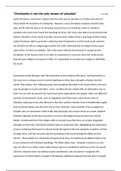
‘Christianity is not the only means of salvation’ 11.2.18
Some Christians, exclusivists, believe that the only way to salvation is to follow the word of
Jesus within the doctrines of Christianity. However, many Christians recognise that this idea
does not fit with the idea of an all loving and just God as it would be unfair to condemn
someone who had never heard the teachings of Jesus; this is the view taken by inclusivists who
believe salvation can be found if people ‘anonymously’ follow Christ’s teachings without being
called Christians. Others go further, believing that Christianity is not the truth at all, and that
we should treat life as a pilgrimage towards the truth, believing that all religions have equal
value when it comes to salvation. This is the most rational view because it recognises the
limitations of the human mind to be able to comprehend a supreme deity and understands
that because religions are based on faith, it is impossible to say that your religion is definitely
the truth.
Exclusivists would disagree with this statement as they believe that Jesus’ sacrificial death on
the cross was a unique event of cosmic significance when Jesus brought salvation into the
world. They believe that following Jesus and accepting the belief in his resurrection is the only
way for people to receive salvation - Jesus’ sacrifice did not simply offer an alternative way to
God. You can only be saved if you have heard and responded to the gospel. There are different
versions of exclusivism, some, such as Augustine and Calvin had a very narrow view of
salvation, believing it was only offered to the elect and the Catholic Church traditionally taught
that its denomination was the only way to God. However, more recently it has recognised a
broader view of exclusivism which holds that all people who accept Christ are saved. Hendrik
Kraemer objected to the idea that there is truth in all religions because they have similar
beliefs, he believed that if the religion did not accept Jesus then they are simply misguided
attempts to find truth. Karl Barth similarly took an exclusivist view, highlighting the importance
of Jesus, believing that God can only be found through the full and complete revelation of God
through Jesus, and the accounts and the spreading of his word through the Bible and the
Church. These beliefs are somewhat strong because they are backed up by biblical claims and
so are coherent with Christian teachings. The Bible claims that: ‘salvation is found in no one
else, for there is no other name under heaven given to mankind by which we much be saved’
and that ‘whoever does not believe stands condemned’ and exclusivism recognises this
importance of Christ which is taught in Christianity. Balthasar believed that the Church should
Some Christians, exclusivists, believe that the only way to salvation is to follow the word of
Jesus within the doctrines of Christianity. However, many Christians recognise that this idea
does not fit with the idea of an all loving and just God as it would be unfair to condemn
someone who had never heard the teachings of Jesus; this is the view taken by inclusivists who
believe salvation can be found if people ‘anonymously’ follow Christ’s teachings without being
called Christians. Others go further, believing that Christianity is not the truth at all, and that
we should treat life as a pilgrimage towards the truth, believing that all religions have equal
value when it comes to salvation. This is the most rational view because it recognises the
limitations of the human mind to be able to comprehend a supreme deity and understands
that because religions are based on faith, it is impossible to say that your religion is definitely
the truth.
Exclusivists would disagree with this statement as they believe that Jesus’ sacrificial death on
the cross was a unique event of cosmic significance when Jesus brought salvation into the
world. They believe that following Jesus and accepting the belief in his resurrection is the only
way for people to receive salvation - Jesus’ sacrifice did not simply offer an alternative way to
God. You can only be saved if you have heard and responded to the gospel. There are different
versions of exclusivism, some, such as Augustine and Calvin had a very narrow view of
salvation, believing it was only offered to the elect and the Catholic Church traditionally taught
that its denomination was the only way to God. However, more recently it has recognised a
broader view of exclusivism which holds that all people who accept Christ are saved. Hendrik
Kraemer objected to the idea that there is truth in all religions because they have similar
beliefs, he believed that if the religion did not accept Jesus then they are simply misguided
attempts to find truth. Karl Barth similarly took an exclusivist view, highlighting the importance
of Jesus, believing that God can only be found through the full and complete revelation of God
through Jesus, and the accounts and the spreading of his word through the Bible and the
Church. These beliefs are somewhat strong because they are backed up by biblical claims and
so are coherent with Christian teachings. The Bible claims that: ‘salvation is found in no one
else, for there is no other name under heaven given to mankind by which we much be saved’
and that ‘whoever does not believe stands condemned’ and exclusivism recognises this
importance of Christ which is taught in Christianity. Balthasar believed that the Church should