6 Biopsychology
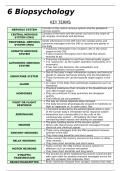
KEY TERMS
Consists of the central nervous system and the peripheral
NERVOUS SYSTEM nervous system
CENTRAL NERVOUS Consists of the brain and the spinal cord and is the origin of
all complex commands and decisions
SYSTEM (CNS)
Sends information to the CNS from the outside world, and
PERIPHERAL NERVOUS
transmits messages from the CNS to muscles and glands in
SYSTEM (PNS) the body
Transmits information from receptor cells in the sense
SOMATIC NERVOUS organs to the CNS
SYSTEM It also receives information from the CNS that directs
muscles to act
Transmits information to and from internal bodily organs
It is ‘autonomic’ as the system operates involuntarily (it is
AUTONOMIC NERVOUS
automatic)
SYSTME It has two main divisions: the sympathetic and
parasympathetic nervous systems
One of the body’s major information systems and instructs
glands to release hormones directly into the bloodstream
ENDOCRINE SYSTEM
These hormones are carried towards target organs in the
body
An organ in the body that synthesises substances such as
GLAND
hormones
Chemical substances that circulate in the bloodstream and
only affect target organs
HORMONES They are produced in large quantities but disappear
quickly
Their effects are very powerful
The way an animal responds when stressed
FIGHT OR FLIGHT
The body becomes physiologically aroused in readiness to
RESPONSE fight an aggressor or, in some cases, flee
A hormone produced by the adrenal glands which is part
of the human body’s immediate stress response system
ADRENALINE Adrenaline has a strong effect on the cells of the
cardiovascular system – stimulating the heart rate,
contracting blood vessels and dilating air passages
The basic building blocks of the nervous system
NEURON Nerve cells that process and transmit messages through
electrical and chemical signals
These carry messages from the PNS (peripheral nervous
SENSORY NEURONS system) to the CNS
They have long dendrites and short axons
These connect the sensory neurons to the motor or other
RELAY NEURONS relay neurons
They have short dendrites and short axons
These connect the CNS (central nervous system) to
MOTOR NEURONS effectors such as muscles and glands
They have short dendrites and long axons
The process by which neighbouring neurons communicate
SYNAPTIC
with each other by sending chemical messages across the
TRANSMISSION gap (the synapse) that separates them
NEUROTRANSMITTER Brain chemicals released from synaptic vesicles that relay
, signals across the synapse from one neuron to another
Neurotransmitters can be broadly divided into those that
perform an excitatory function that those that perform an
inhibitory function
When a neurotransmitter, such as adrenaline, increases
the positive charge of the postsynaptic neuron
EXCITATION This increases the likelihood that the neuron will fire and
pass on the electrical impulse
When a neurotransmitter, such as serotonin, increases the
negative charge of the postsynaptic neuron
INHIBITION This decreases the likelihood that the neuron will fire and
pass on the electrical impulse
LOCALISATION OF The theory that different areas of the brain are responsible
FUNCTION for different behaviours, processes or activities
A region of the frontal lobe involved in regulating
MOTOR AREA movement
SOMATOSENSORY An area of the parietal lobe that processes sensory
AREA information such as touch
A part of the occipital lobe that receives and processes
VISUAL AREA visual information
Located in the temporal lobe and concerned with the
AUDITORY AREA analysis of speech-based information
An area of the frontal lobe of the brain in the left
BROCA’S AREA hemisphere (in most people) responsible for speech
production
An area of the temporal lobe (encircling the auditory
WERNICKE’S AREA cortex) in the left hemisphere (in most people) responsible
for language comprehension
(also referred to as neuroplasticity or cortical remapping)
This describes the brain’s tendency to change and adapt
PLASTICITY (functionally and physically) as a result of experience and
new learning
A form of plasticity
FUNCTIONAL Following damage through trauma, the brain’s ability to
RECOVERY redistribute or transfer functions usually performed by a
damaged area(s) to other, undamaged area(s)
The idea that the 2 halves (hemispheres) of the brain are
functionally different and that certain mental processes
HEMISPHERIC
and behaviours are mainly controlled by one hemisphere
LATERALISATION rather than the other, as in the example of language
(which is localised as well as lateralised)
A series of studies which began in the 1960s (and are still
ongoing) involving epileptic patients who had experienced
SPLIT-BRAIN
a surgical separation of the hemispheres of the brain
RESEARCH This allowed researchers to investigate the extent to which
brain function is lateralised
FUNCTIONAL A method used to measure brain activity while a person is
performing a task that uses MRI technology (detecting
MAGNETIC
radio waves from changing magnetic fields)
RESONANCE IMAGIN This enables researchers to detect which regions of the
(FMRI) brain are rich in oxygen and thus are active
A record of the tiny electrical impulses produced by the
ELECTROENCEPHALOG brain’s activity
RAM By measuring characteristic wave patterns, the EEF can
help diagnose certain conditions of the brain
The brain’s electrophysical response to a specific sensory,
EVENT-RELATED
cognitive or motor event can be isolated through
POTENTIALS (ERPS) statistical analysis of EEG data
KEY TERMS
Consists of the central nervous system and the peripheral
NERVOUS SYSTEM nervous system
CENTRAL NERVOUS Consists of the brain and the spinal cord and is the origin of
all complex commands and decisions
SYSTEM (CNS)
Sends information to the CNS from the outside world, and
PERIPHERAL NERVOUS
transmits messages from the CNS to muscles and glands in
SYSTEM (PNS) the body
Transmits information from receptor cells in the sense
SOMATIC NERVOUS organs to the CNS
SYSTEM It also receives information from the CNS that directs
muscles to act
Transmits information to and from internal bodily organs
It is ‘autonomic’ as the system operates involuntarily (it is
AUTONOMIC NERVOUS
automatic)
SYSTME It has two main divisions: the sympathetic and
parasympathetic nervous systems
One of the body’s major information systems and instructs
glands to release hormones directly into the bloodstream
ENDOCRINE SYSTEM
These hormones are carried towards target organs in the
body
An organ in the body that synthesises substances such as
GLAND
hormones
Chemical substances that circulate in the bloodstream and
only affect target organs
HORMONES They are produced in large quantities but disappear
quickly
Their effects are very powerful
The way an animal responds when stressed
FIGHT OR FLIGHT
The body becomes physiologically aroused in readiness to
RESPONSE fight an aggressor or, in some cases, flee
A hormone produced by the adrenal glands which is part
of the human body’s immediate stress response system
ADRENALINE Adrenaline has a strong effect on the cells of the
cardiovascular system – stimulating the heart rate,
contracting blood vessels and dilating air passages
The basic building blocks of the nervous system
NEURON Nerve cells that process and transmit messages through
electrical and chemical signals
These carry messages from the PNS (peripheral nervous
SENSORY NEURONS system) to the CNS
They have long dendrites and short axons
These connect the sensory neurons to the motor or other
RELAY NEURONS relay neurons
They have short dendrites and short axons
These connect the CNS (central nervous system) to
MOTOR NEURONS effectors such as muscles and glands
They have short dendrites and long axons
The process by which neighbouring neurons communicate
SYNAPTIC
with each other by sending chemical messages across the
TRANSMISSION gap (the synapse) that separates them
NEUROTRANSMITTER Brain chemicals released from synaptic vesicles that relay
, signals across the synapse from one neuron to another
Neurotransmitters can be broadly divided into those that
perform an excitatory function that those that perform an
inhibitory function
When a neurotransmitter, such as adrenaline, increases
the positive charge of the postsynaptic neuron
EXCITATION This increases the likelihood that the neuron will fire and
pass on the electrical impulse
When a neurotransmitter, such as serotonin, increases the
negative charge of the postsynaptic neuron
INHIBITION This decreases the likelihood that the neuron will fire and
pass on the electrical impulse
LOCALISATION OF The theory that different areas of the brain are responsible
FUNCTION for different behaviours, processes or activities
A region of the frontal lobe involved in regulating
MOTOR AREA movement
SOMATOSENSORY An area of the parietal lobe that processes sensory
AREA information such as touch
A part of the occipital lobe that receives and processes
VISUAL AREA visual information
Located in the temporal lobe and concerned with the
AUDITORY AREA analysis of speech-based information
An area of the frontal lobe of the brain in the left
BROCA’S AREA hemisphere (in most people) responsible for speech
production
An area of the temporal lobe (encircling the auditory
WERNICKE’S AREA cortex) in the left hemisphere (in most people) responsible
for language comprehension
(also referred to as neuroplasticity or cortical remapping)
This describes the brain’s tendency to change and adapt
PLASTICITY (functionally and physically) as a result of experience and
new learning
A form of plasticity
FUNCTIONAL Following damage through trauma, the brain’s ability to
RECOVERY redistribute or transfer functions usually performed by a
damaged area(s) to other, undamaged area(s)
The idea that the 2 halves (hemispheres) of the brain are
functionally different and that certain mental processes
HEMISPHERIC
and behaviours are mainly controlled by one hemisphere
LATERALISATION rather than the other, as in the example of language
(which is localised as well as lateralised)
A series of studies which began in the 1960s (and are still
ongoing) involving epileptic patients who had experienced
SPLIT-BRAIN
a surgical separation of the hemispheres of the brain
RESEARCH This allowed researchers to investigate the extent to which
brain function is lateralised
FUNCTIONAL A method used to measure brain activity while a person is
performing a task that uses MRI technology (detecting
MAGNETIC
radio waves from changing magnetic fields)
RESONANCE IMAGIN This enables researchers to detect which regions of the
(FMRI) brain are rich in oxygen and thus are active
A record of the tiny electrical impulses produced by the
ELECTROENCEPHALOG brain’s activity
RAM By measuring characteristic wave patterns, the EEF can
help diagnose certain conditions of the brain
The brain’s electrophysical response to a specific sensory,
EVENT-RELATED
cognitive or motor event can be isolated through
POTENTIALS (ERPS) statistical analysis of EEG data