Page |1
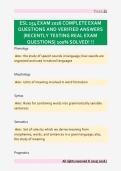
ESL 154 EXAM 2026 COMPLETE EXAM
QUESTIONS AND VERIFIED ANSWERS
|RECENTLY TESTING REAL EXAM
QUESTIONS| 100% SOLVED! !!
Phonology
Ans: the study of speech sounds in language; how sounds are
organized and used in natural languages
Morphology
Ans: Units of meaning involved in word formation
Syntax
Ans: Rules for combining words into grammatically sensible
sentences
Semantics
Ans: Set of rules by which we derive meaning from
morphemes, words, and sentences in a given language; also,
the study of meaning
Pragmatics
All rights reserved © 2025/ 2026 |
, Page |2
Ans: Appropriate use of language in different contexts; social
use of language
What are two examples of critical components for the second language
learner?
Ans: Oral language development and phonological/phonemic
awareness
ELLs need ____________________ of L2 before they can make
connections between letter and sound.
Ans: Phonology
___________________ awareness instruction focuses on the sounds in
spoken language. It is auditory and does not involve print.
Ans: Phonological
Target Sound
Ans: Sound to be transcribed
All rights reserved © 2025/ 2026 |
, Page |3
An English language learner is experiencing difficulty with an aspect of
English phonology. In order to address a difficulty in this area, the
student's teacher should initially focus instruction on what?
Ans: The associated target sound
Phoneme
Ans: The smallest distinctive sound unit
What are some best practices strategies to promote literacy
development for ELLs?
Ans: Teach phonics in context
Use hands on activities to help teach letter -sound relationships
Have students write for sound
Help students make a connection between their L1 and English.
The approach of teachers making students see them writing down
their exact words to reinforce their understanding of the relationship
between written and oral language trains students to...?
Ans: Write for sound - they learn to represent words
phonetically in their writing
Content Based Instruction + 3 Models
All rights reserved © 2025/ 2026 |
, Page |4
Ans: CBI: requires students to practice language skills in a
highly integrated, communicative way while learning content
3 Models:
1) theme-based - language skills are integrated in the study of
themes or broad topics
2) adjunct - language and content courses are taught separately
but closely coordinated
3) sheltered - English is simplified to ELL's level of proficiency
while teaching content
Why is combining sentences to make complex sentences an important
exercise to help ESL students advance in their writing abilities?
Ans: Most of the sentences used in writing or in continuous
speech are complex.
Literal comprehension
Ans: Understanding of the basic facts that the student has
read; grasping and interpreting text
Inferential comprehension
Ans: Understanding of information that isn't explicitly given,
but rather implied in a written passage. (make predictions);
make inferences
All rights reserved © 2025/ 2026 |
ESL 154 EXAM 2026 COMPLETE EXAM
QUESTIONS AND VERIFIED ANSWERS
|RECENTLY TESTING REAL EXAM
QUESTIONS| 100% SOLVED! !!
Phonology
Ans: the study of speech sounds in language; how sounds are
organized and used in natural languages
Morphology
Ans: Units of meaning involved in word formation
Syntax
Ans: Rules for combining words into grammatically sensible
sentences
Semantics
Ans: Set of rules by which we derive meaning from
morphemes, words, and sentences in a given language; also,
the study of meaning
Pragmatics
All rights reserved © 2025/ 2026 |
, Page |2
Ans: Appropriate use of language in different contexts; social
use of language
What are two examples of critical components for the second language
learner?
Ans: Oral language development and phonological/phonemic
awareness
ELLs need ____________________ of L2 before they can make
connections between letter and sound.
Ans: Phonology
___________________ awareness instruction focuses on the sounds in
spoken language. It is auditory and does not involve print.
Ans: Phonological
Target Sound
Ans: Sound to be transcribed
All rights reserved © 2025/ 2026 |
, Page |3
An English language learner is experiencing difficulty with an aspect of
English phonology. In order to address a difficulty in this area, the
student's teacher should initially focus instruction on what?
Ans: The associated target sound
Phoneme
Ans: The smallest distinctive sound unit
What are some best practices strategies to promote literacy
development for ELLs?
Ans: Teach phonics in context
Use hands on activities to help teach letter -sound relationships
Have students write for sound
Help students make a connection between their L1 and English.
The approach of teachers making students see them writing down
their exact words to reinforce their understanding of the relationship
between written and oral language trains students to...?
Ans: Write for sound - they learn to represent words
phonetically in their writing
Content Based Instruction + 3 Models
All rights reserved © 2025/ 2026 |
, Page |4
Ans: CBI: requires students to practice language skills in a
highly integrated, communicative way while learning content
3 Models:
1) theme-based - language skills are integrated in the study of
themes or broad topics
2) adjunct - language and content courses are taught separately
but closely coordinated
3) sheltered - English is simplified to ELL's level of proficiency
while teaching content
Why is combining sentences to make complex sentences an important
exercise to help ESL students advance in their writing abilities?
Ans: Most of the sentences used in writing or in continuous
speech are complex.
Literal comprehension
Ans: Understanding of the basic facts that the student has
read; grasping and interpreting text
Inferential comprehension
Ans: Understanding of information that isn't explicitly given,
but rather implied in a written passage. (make predictions);
make inferences
All rights reserved © 2025/ 2026 |