
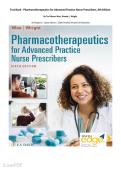
Test Bank - Pharmacotherapeutics for Advanced Practice Nurse Prescribers, 6th Edition.
By Teri Moser Woo, Wendy L. Wright.
All Chapters | Latest Edition | 100% Verified Answers & Rationales
,Chapter 1. The Role of the Advanced Practice Nurse as Prescriber
MULTIPLE CHOICE
1. Nurse practitioner prescriptive authority is regulated by:
A. The National Council of State Boards of Nursing
B. The U.S. Drug Enforcement Administration
C. The State Board of Nursing for each state
D. The State Board of Pharmacy
Answer: C PTS: 1
2. The benefits to the patient of having an advanced practice registered nurse (APRN) prescriber
include:
A. Nurses know more about pharmacology than other prescribers because they take it both in
their basic nursing program and in their APRN program.
B. Nurses care for the patient from a holistic approach and include the patient in decision-making
regarding their care.
C. APRNs are less likely to prescribe narcotics and other controlled substances.
D. APRNs are able to prescribe independently in all states, whereas a physician’s assistant
needs to have a physician supervising their practice.
Answer: B PTS: 1
3. Clinical judgment in prescribing includes:
A. Factoring in the cost to the patient of the medication prescribed
B. Always prescribing the newest medication available for the disease process
C. Handing out drug samples to poor patients
D. Prescribing all generic medications to cut costs
Answer: A PTS: 1
4. The process for choosing an effective drug for a disorder includes:
A. Asking the patient what drug they think would work best for them
,B. Consulting nationally recognized guidelines for disease management
C. Prescribing medications that are available as samples before writing a prescription
D. Following U.S. Drug Enforcement Administration guidelines for prescribing
Answer: B PTS: 1
5. Nonintentional non adherence of drug therapy may occur due to:
A. Belief that medication does not work
B. Adverse drug reactions
C. Chronic conditions that require daily therapy
D. Forgetfulness or distraction
Answer: D PTS: 1
Chapter 2. Review of Basic Principles of Pharmacology
MULTIPLE CHOICE
1. A patient’s nutritional intake and laboratory results reflect hypoalbuminemia. This is critical to
prescribing because:
A. Distribution of drugs to target tissue may be affected.
B. The solubility of the drug will not match the site of absorption.
C. There will be less free drug available to generate an effect.
D. Drugs bound to albumin are readily excreted by the kidneys.
Answer: A PTS: 1
2. Drugs that have a significant first-pass effect:
A. Must be given by the enteral (oral) route only
B. Bypass the hepatic circulation
, C. Are rapidly metabolized by the liver and may have little, if any, desired action
D. Are converted by the liver to more active and fat-soluble forms
Answer: C PTS: 1
3. The route of excretion of a volatile drug will likely be the:
A. Kidneys
B. Lungs
C. Bile and feces
D. Skin
Answer: B PTS: 1
4. A major disadvantage to IV administration is that:
A. First-pass metabolism is eliminated.
B. Needles and sterility are required.
C. Absorption of the drug cannot be slowed after administration.
D. It is significantly more expensive than other routes.
Answer: C PTS: 1
5. The nurse practitioner (NP) chooses to give cephalexin every 8 hours based on knowledge of
the drug’s:
A. Propensity to go to the target receptor
B. Biological half-life
C. Pharmacodynamics
D. Safety and side effects
Answer: B PTS: 1
6. Deferasirox is a chelating agent used to treat iron overload by binding iron to render it
biologically inactive. This is best characterized as a(n):
By Teri Moser Woo, Wendy L. Wright.
All Chapters | Latest Edition | 100% Verified Answers & Rationales
,Chapter 1. The Role of the Advanced Practice Nurse as Prescriber
MULTIPLE CHOICE
1. Nurse practitioner prescriptive authority is regulated by:
A. The National Council of State Boards of Nursing
B. The U.S. Drug Enforcement Administration
C. The State Board of Nursing for each state
D. The State Board of Pharmacy
Answer: C PTS: 1
2. The benefits to the patient of having an advanced practice registered nurse (APRN) prescriber
include:
A. Nurses know more about pharmacology than other prescribers because they take it both in
their basic nursing program and in their APRN program.
B. Nurses care for the patient from a holistic approach and include the patient in decision-making
regarding their care.
C. APRNs are less likely to prescribe narcotics and other controlled substances.
D. APRNs are able to prescribe independently in all states, whereas a physician’s assistant
needs to have a physician supervising their practice.
Answer: B PTS: 1
3. Clinical judgment in prescribing includes:
A. Factoring in the cost to the patient of the medication prescribed
B. Always prescribing the newest medication available for the disease process
C. Handing out drug samples to poor patients
D. Prescribing all generic medications to cut costs
Answer: A PTS: 1
4. The process for choosing an effective drug for a disorder includes:
A. Asking the patient what drug they think would work best for them
,B. Consulting nationally recognized guidelines for disease management
C. Prescribing medications that are available as samples before writing a prescription
D. Following U.S. Drug Enforcement Administration guidelines for prescribing
Answer: B PTS: 1
5. Nonintentional non adherence of drug therapy may occur due to:
A. Belief that medication does not work
B. Adverse drug reactions
C. Chronic conditions that require daily therapy
D. Forgetfulness or distraction
Answer: D PTS: 1
Chapter 2. Review of Basic Principles of Pharmacology
MULTIPLE CHOICE
1. A patient’s nutritional intake and laboratory results reflect hypoalbuminemia. This is critical to
prescribing because:
A. Distribution of drugs to target tissue may be affected.
B. The solubility of the drug will not match the site of absorption.
C. There will be less free drug available to generate an effect.
D. Drugs bound to albumin are readily excreted by the kidneys.
Answer: A PTS: 1
2. Drugs that have a significant first-pass effect:
A. Must be given by the enteral (oral) route only
B. Bypass the hepatic circulation
, C. Are rapidly metabolized by the liver and may have little, if any, desired action
D. Are converted by the liver to more active and fat-soluble forms
Answer: C PTS: 1
3. The route of excretion of a volatile drug will likely be the:
A. Kidneys
B. Lungs
C. Bile and feces
D. Skin
Answer: B PTS: 1
4. A major disadvantage to IV administration is that:
A. First-pass metabolism is eliminated.
B. Needles and sterility are required.
C. Absorption of the drug cannot be slowed after administration.
D. It is significantly more expensive than other routes.
Answer: C PTS: 1
5. The nurse practitioner (NP) chooses to give cephalexin every 8 hours based on knowledge of
the drug’s:
A. Propensity to go to the target receptor
B. Biological half-life
C. Pharmacodynamics
D. Safety and side effects
Answer: B PTS: 1
6. Deferasirox is a chelating agent used to treat iron overload by binding iron to render it
biologically inactive. This is best characterized as a(n):


