Final Exam Study Guide NURSING 599
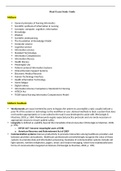
Midterm • General principles of Nursing Informatics • Scientific synthesis of information in nursing • Concepts: computer, cognitive, information • Knowledge • Wisdom • Scientific Underpinning • The Foundation of Knowledge Model • Computer science • Cognitive science • Information science • Standard Terminology • Informatics Competencies • Information literacy • Health literacy • Meaningful Use • Patient-centered Information Systems • Clinical Decision Support Systems • Electronic Medical Records • Human-Technology Interface • Health Information Technology • Alarm fatigue • Digital natives • Information Literacy Competency Standards for Nursing • HITECH Act • TIGER-based Nursing Informatics Competencies Model Midterm Feedback • Workarounds are ways invented by users to bypass the system to accomplish a task; usually indicate a poor fit of the system or technology to the workflow or user; devised methods to beat a system that does not function appropriately or is not suited to the task it was developed to assist with (McGonigle & Mastrian, 2018, p. 584). Workarounds negate expected practice protocols and are rarely necessary or appropriate means to ensure patient safety. • Longevity is defined as usability beyond the immediate clinical encounter (McGonigle & Mastrian, 2018, p. 570). o HITCH ACT- become meaningful users of EHR. o American Recovery and Reinvestment Act of 2009 • Communication systems improve productivity to promote interaction among healthcare providers and between providers and patients. Healthcare professionals overwhelmingly recognize the value of these systems to promote data and information processing. Examples of communication systems include call light systems, wireless telephones, pagers, email, and instant messaging, which have traditionally been forms of communication targeted at clinicians (McGonigle & Mastrian, 2018, p. 190). • A major barrier to widespread adoption of educational opportunities for patients among American healthcare providers is the fact that reimbursement mechanisms for electronic health care interventions are inadequate or nonexistent. The goal of the interactive behavior change technology is to improve communication between patients and healthcare providers and to provide educational interventions that promote better disease management between office visits (McGonigle & Mastrian, 2018, p. 335). • Once the technology is integrated into the organization, biomedical engineers can become valuable partners in promoting patient safety through appropriate use of these technologies. For example, in one organization, the biomedical engineers helped to revamp processes associated with the new technology alarm systems after they discovered several key issues: slow response times to legitimate alarms and multiple false alarms (promoting alarm fatigue) created by alarm parameters that were too sensitive. Strategies for addressing these issues included improving the nurse call system by adding Voice over Internet Protocol telephones that wirelessly receive alarms directly from technology equipment carried by all nurses, thus reducing response times to alarms; feeding alarm data into a reporting database for further analysis; and encouraging nurses to roun ........................................CONTINUED............................................
Document information
- Uploaded on
- March 20, 2021
- Number of pages
- 12
- Written in
- 2020/2021
- Type
- Other
- Person
- Unknown