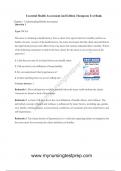
NUR 201 MEDICAL-SURGICAL NURSING EXAM 3 (2026/2027) | NURSING PROGRAM
COMPLETE VERIFIED Q&A
NUR 201: Medical-Surgical Nursing - Examination 3 | Core Domains: Neurological Disorders,
Musculoskeletal Disorders, Sensory Disorders (Eye & Ear), Integumentary Disorders, Multisystem
Trauma & Emergencies, Oncology & Cancer Care, Immunologic Disorders, and Complex Care
Coordination | Nursing Program Focus | Systems-Based Medical-Surgical Exam Format
Exam Structure
The NUR 201 Medical-Surgical Nursing Exam 3 for the 2026/2027 academic cycle is an 85-question,
multiple-choice question (MCQ) examination.
Introduction
This NUR 201 Medical-Surgical Nursing Exam 3 guide for the 2026/2027 cycle prepares nursing students
for the third systems-focused assessment in the medical-surgical sequence. The content emphasizes the
nursing management of neurological, musculoskeletal, sensory, integumentary, and oncologic disorders,
as well as the principles of caring for patients with multisystem trauma and complex immunologic
conditions.
Answer Format
All correct answers and nursing interventions must be presented in bold and green, followed by
detailed rationales that explain disorder-specific pathophysiology, justify pharmacologic and
non-pharmacologic management, apply priority-setting frameworks in trauma and multisystem illness,
and incorporate patient safety and rehabilitation principles.
Questions (85 Total)
1. A patient with a traumatic brain injury has a Glasgow Coma Scale (GCS) score of 6. What is the nurse’s
priority action?
A. Administer PRN pain medication
B. Prepare for intubation and maintain airway patency
C. Apply ice packs to the head
D. Encourage family visitation
Rationale: A GCS ≤8 indicates severe brain injury and inability to protect the airway. Airway
management is the top priority per the ABCs (Airway, Breathing, Circulation). Intubation prevents
hypoxia, which worsens secondary brain injury. Pain meds may depress respiration further. Ice packs
and visitation are secondary to physiological stabilization.
2. A patient with multiple myeloma reports bone pain and fatigue. Which laboratory finding is expected?
A. Hypocalcemia
B. Hypercalcemia
,C. Elevated platelets
D. Low BUN
Rationale: Multiple myeloma causes osteoclast activation, leading to bone destruction and
hypercalcemia. Other findings include anemia, renal failure (elevated BUN/creatinine), and monoclonal
protein in serum/urine. Hypercalcemia can cause fatigue, confusion, and polyuria. Monitor calcium
levels and hydrate aggressively.
3. After a total hip arthroplasty, the nurse should instruct the patient to avoid:
A. Using a walker
B. Internal rotation and adduction of the affected leg
C. Performing ankle pumps
D. Sitting in a high chair
Rationale: Hip precautions after posterior approach THA include avoiding hip flexion >90°, internal
rotation, and adduction (crossing legs). These positions increase dislocation risk. Ankle pumps prevent
DVT. High chairs keep hips below 90°. Adherence to precautions is critical for 6–12 weeks post-op.
4. A patient with systemic lupus erythematosus (SLE) is prescribed prednisone. Which statement by the
patient indicates understanding?
A. “I’ll stop taking it when I feel better.”
B. “I should not abruptly stop this medication.”
C. “I can take ibuprofen for joint pain without concern.”
D. “Sun exposure will help my rash.”
Rationale: Glucocorticoids like prednisone must be tapered to avoid adrenal insufficiency. NSAIDs can
be used but increase GI/renal risk—especially with SLE nephritis. Sun exposure exacerbates malar rash;
sunscreen and hats are essential. Patient education on medication adherence and side effects is vital in
chronic autoimmune disease.
5. A patient presents with sudden right-sided facial droop, slurred speech, and left arm weakness. What is
the priority diagnostic test?
A. CT abdomen
B. Non-contrast CT head
C. Lumbar puncture
D. EEG
, Rationale: This presentation suggests acute ischemic stroke. A non-contrast CT head is performed
immediately to rule out hemorrhage before considering thrombolytics (e.g., tPA within 4.5 hours). MRI
is more sensitive but takes longer. LP and EEG are not first-line for stroke evaluation.
6. A patient with a stage 3 pressure injury over the sacrum has black eschar. What is the appropriate
intervention?
A. Assess for signs of infection before debridement
B. Remove eschar immediately with scissors
C. Apply dry gauze dressings
D. Massage the area to improve circulation
Rationale: Stable, dry eschar on heels or ischemic areas may be left intact. However, on the sacrum,
eschar often masks infection. Assess for warmth, purulence, odor, or fever. If no infection, autolytic
debridement may be used; if infected, surgical debridement is needed. Never massage bony
prominences—this increases tissue damage.
7. A patient with Ménière’s disease is at risk for falls due to:
A. Visual impairment
B. Vertigo and imbalance
C. Peripheral neuropathy
D. Orthostatic hypotension
Rationale: Ménière’s disease involves endolymphatic fluid buildup, causing vertigo, tinnitus, hearing
loss, and nausea. Vertigo leads to severe imbalance and fall risk. Safety measures include bed rest
during attacks, assistive devices, and low-sodium diet. It is not related to vision, neuropathy, or BP
changes.
8. In a patient with suspected compartment syndrome, which finding is most concerning?
A. Swelling and bruising
B. Pain out of proportion to injury and pain with passive stretch
C. Mild edema
D. Capillary refill of 3 seconds
Rationale: The 6 P’s of compartment syndrome: Pain (disproportionate, worse with passive stretch),
Paresthesia, Pallor, Paralysis, Pulselessness (late sign), and Poikilothermia. Pain with passive stretch is
an early, sensitive indicator. Compartment syndrome is a surgical emergency requiring fasciotomy to
prevent necrosis.
COMPLETE VERIFIED Q&A
NUR 201: Medical-Surgical Nursing - Examination 3 | Core Domains: Neurological Disorders,
Musculoskeletal Disorders, Sensory Disorders (Eye & Ear), Integumentary Disorders, Multisystem
Trauma & Emergencies, Oncology & Cancer Care, Immunologic Disorders, and Complex Care
Coordination | Nursing Program Focus | Systems-Based Medical-Surgical Exam Format
Exam Structure
The NUR 201 Medical-Surgical Nursing Exam 3 for the 2026/2027 academic cycle is an 85-question,
multiple-choice question (MCQ) examination.
Introduction
This NUR 201 Medical-Surgical Nursing Exam 3 guide for the 2026/2027 cycle prepares nursing students
for the third systems-focused assessment in the medical-surgical sequence. The content emphasizes the
nursing management of neurological, musculoskeletal, sensory, integumentary, and oncologic disorders,
as well as the principles of caring for patients with multisystem trauma and complex immunologic
conditions.
Answer Format
All correct answers and nursing interventions must be presented in bold and green, followed by
detailed rationales that explain disorder-specific pathophysiology, justify pharmacologic and
non-pharmacologic management, apply priority-setting frameworks in trauma and multisystem illness,
and incorporate patient safety and rehabilitation principles.
Questions (85 Total)
1. A patient with a traumatic brain injury has a Glasgow Coma Scale (GCS) score of 6. What is the nurse’s
priority action?
A. Administer PRN pain medication
B. Prepare for intubation and maintain airway patency
C. Apply ice packs to the head
D. Encourage family visitation
Rationale: A GCS ≤8 indicates severe brain injury and inability to protect the airway. Airway
management is the top priority per the ABCs (Airway, Breathing, Circulation). Intubation prevents
hypoxia, which worsens secondary brain injury. Pain meds may depress respiration further. Ice packs
and visitation are secondary to physiological stabilization.
2. A patient with multiple myeloma reports bone pain and fatigue. Which laboratory finding is expected?
A. Hypocalcemia
B. Hypercalcemia
,C. Elevated platelets
D. Low BUN
Rationale: Multiple myeloma causes osteoclast activation, leading to bone destruction and
hypercalcemia. Other findings include anemia, renal failure (elevated BUN/creatinine), and monoclonal
protein in serum/urine. Hypercalcemia can cause fatigue, confusion, and polyuria. Monitor calcium
levels and hydrate aggressively.
3. After a total hip arthroplasty, the nurse should instruct the patient to avoid:
A. Using a walker
B. Internal rotation and adduction of the affected leg
C. Performing ankle pumps
D. Sitting in a high chair
Rationale: Hip precautions after posterior approach THA include avoiding hip flexion >90°, internal
rotation, and adduction (crossing legs). These positions increase dislocation risk. Ankle pumps prevent
DVT. High chairs keep hips below 90°. Adherence to precautions is critical for 6–12 weeks post-op.
4. A patient with systemic lupus erythematosus (SLE) is prescribed prednisone. Which statement by the
patient indicates understanding?
A. “I’ll stop taking it when I feel better.”
B. “I should not abruptly stop this medication.”
C. “I can take ibuprofen for joint pain without concern.”
D. “Sun exposure will help my rash.”
Rationale: Glucocorticoids like prednisone must be tapered to avoid adrenal insufficiency. NSAIDs can
be used but increase GI/renal risk—especially with SLE nephritis. Sun exposure exacerbates malar rash;
sunscreen and hats are essential. Patient education on medication adherence and side effects is vital in
chronic autoimmune disease.
5. A patient presents with sudden right-sided facial droop, slurred speech, and left arm weakness. What is
the priority diagnostic test?
A. CT abdomen
B. Non-contrast CT head
C. Lumbar puncture
D. EEG
, Rationale: This presentation suggests acute ischemic stroke. A non-contrast CT head is performed
immediately to rule out hemorrhage before considering thrombolytics (e.g., tPA within 4.5 hours). MRI
is more sensitive but takes longer. LP and EEG are not first-line for stroke evaluation.
6. A patient with a stage 3 pressure injury over the sacrum has black eschar. What is the appropriate
intervention?
A. Assess for signs of infection before debridement
B. Remove eschar immediately with scissors
C. Apply dry gauze dressings
D. Massage the area to improve circulation
Rationale: Stable, dry eschar on heels or ischemic areas may be left intact. However, on the sacrum,
eschar often masks infection. Assess for warmth, purulence, odor, or fever. If no infection, autolytic
debridement may be used; if infected, surgical debridement is needed. Never massage bony
prominences—this increases tissue damage.
7. A patient with Ménière’s disease is at risk for falls due to:
A. Visual impairment
B. Vertigo and imbalance
C. Peripheral neuropathy
D. Orthostatic hypotension
Rationale: Ménière’s disease involves endolymphatic fluid buildup, causing vertigo, tinnitus, hearing
loss, and nausea. Vertigo leads to severe imbalance and fall risk. Safety measures include bed rest
during attacks, assistive devices, and low-sodium diet. It is not related to vision, neuropathy, or BP
changes.
8. In a patient with suspected compartment syndrome, which finding is most concerning?
A. Swelling and bruising
B. Pain out of proportion to injury and pain with passive stretch
C. Mild edema
D. Capillary refill of 3 seconds
Rationale: The 6 P’s of compartment syndrome: Pain (disproportionate, worse with passive stretch),
Paresthesia, Pallor, Paralysis, Pulselessness (late sign), and Poikilothermia. Pain with passive stretch is
an early, sensitive indicator. Compartment syndrome is a surgical emergency requiring fasciotomy to
prevent necrosis.