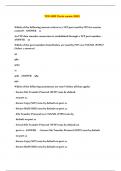
SPCE 630 FINAL EXAM SCRIPT 2026 FULL
QUESTION SET WITH VERIFIED SOLUTIONS
⫸ the primary ethical concern associated with withdrawal designs is
Answer: removing a successful intervention
⫸ external validity of an ABAB design can be improved by Answer:
having at least 3 participants
⫸ unlike withdrawal designs, reversal designs involve Answer: a second
intervention phase
⫸ which is the most powerful within-subject design? Answer: ABAB
⫸ in withdrawal designs, when is procedural infidelity most likely to
occur? Answer: immediately after condition changes
⫸ when using "ABC Notation," the B stands for Answer: intervention 1
⫸ which of the following is NOT a limitation of an AB design
(intervention is not withdrawn, lack of control for internal validity, lack
of control for external validity, cannot determine functional
relationships) Answer: intervention is not withdrawn
, ⫸ what can researchers do to help avoid attrition in withdrawal designs?
Answer: disclose and describe the withdrawal condition during the
consent process
⫸ the withdrawal design is not particularly sensitive to which threats to
internal validity?
a) history, maturation, data instability
b) procedural infidelity, attrition, maturation
c) carryover effects, hawthorne effect, irreversibility of behaviors
d) testing, procedural infidelity, data instability Answer: d
⫸ history Answer: refers to events that occur during an experiment, but
are not related to planned procedural changes that may influence the
outcome
⫸ maturation Answer: changes in behavior due to passage of time
⫸ testing Answer: threat in any study that requires participants to
respond to the same test repeatedly
⫸ facilitative effect Answer: an improvement in performance over
successive baseline or probe testing or observation sessions
QUESTION SET WITH VERIFIED SOLUTIONS
⫸ the primary ethical concern associated with withdrawal designs is
Answer: removing a successful intervention
⫸ external validity of an ABAB design can be improved by Answer:
having at least 3 participants
⫸ unlike withdrawal designs, reversal designs involve Answer: a second
intervention phase
⫸ which is the most powerful within-subject design? Answer: ABAB
⫸ in withdrawal designs, when is procedural infidelity most likely to
occur? Answer: immediately after condition changes
⫸ when using "ABC Notation," the B stands for Answer: intervention 1
⫸ which of the following is NOT a limitation of an AB design
(intervention is not withdrawn, lack of control for internal validity, lack
of control for external validity, cannot determine functional
relationships) Answer: intervention is not withdrawn
, ⫸ what can researchers do to help avoid attrition in withdrawal designs?
Answer: disclose and describe the withdrawal condition during the
consent process
⫸ the withdrawal design is not particularly sensitive to which threats to
internal validity?
a) history, maturation, data instability
b) procedural infidelity, attrition, maturation
c) carryover effects, hawthorne effect, irreversibility of behaviors
d) testing, procedural infidelity, data instability Answer: d
⫸ history Answer: refers to events that occur during an experiment, but
are not related to planned procedural changes that may influence the
outcome
⫸ maturation Answer: changes in behavior due to passage of time
⫸ testing Answer: threat in any study that requires participants to
respond to the same test repeatedly
⫸ facilitative effect Answer: an improvement in performance over
successive baseline or probe testing or observation sessions