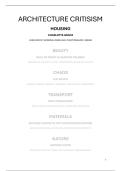
ARCHITECTURE CRITISISM
HOUSING
CHARLOTTE GRACE
LIVING ROOM, WORKING, DWELLING, FUNCTIONALISM, DESING
BEAUTY
NELE DE RAEDT & MAARTEN DELBEKE
AESTHETICS, POLITICS, TASTE, COMPOSITION, POPULAR CULTURE
CHAOS
LUC DELEU
URBAN PLANNING, SPRAWL, HARMONY, PUBLIC SPACE, DEMOCRATY
TRANSPORT
NELO MAGALHAES
CARS, TRAINS, INFRASTRUCTURE, EMISSIONS, NETWORKS
MATERIALS
MICHAEL GHYOOT & TOM SCHOONJANS (ROTOR)
RE-USE, RECYCLING, UPCYCLING, CONSTRUCTION INDUSTRY
NATURE
ANTOINE PICON
IMITATION, ECOLOGY, TREES, NON-HUMANS, GREENWASHING
1
,HOUSING
Lecture 1 – The Living Room as a Critical Architectural Problem
Introduction
Housing is one of architecture’s most persistent and politically charged tasks. As the course
introduction states, housing does not merely shelter life but organises how life is lived
together, thereby materialising social hierarchies, norms, and power relations .
This first lecture deliberately starts with what appears to be the most banal domestic space—
the living room—in order to show how architectural criticism can emerge from everyday
interiors. The session is anchored in Charlotte Grace’s 2025 essay “The Lost Living Room”,
which frames the living room as a spatial, social, and political apparatus rather than a neutral
room.
1. Defining the Living Room (Charlotte Grace, 2025)
1.1 Definition and function
Grace defines the living room as a “non-productive space”, a room not dedicated to survival
(sleeping, cooking, hygiene) nor to wage labour, but to free time, social reproduction, and
self-expression (pp. 35–36).
Unlike the kitchen or bedroom, the living room is programmatically loose: it hosts hospitality,
leisure, imagination, and identity formation. Grace stresses that it is precisely this looseness
that makes the living room politically vulnerable.
“The fight for the living room is a fight for non-productive space and free time.” (p. 35)
1.2 The “everything-room”
Under contemporary housing pressure, especially in overheated rental markets, the living room
is increasingly absorbed into an “everything-room”: bedroom, office, storage, circulation
space, and social space collapse into one overloaded interior (pp. 35–36).
Grace shows how this spatial compression produces psychological stress, loss of privacy,
and infantilisation of adult inhabitants, revealing that architectural layout directly shapes
subjectivity.
2. Contextualising the Living Room Historically
2.1 Bourgeois origins
Grace situates the living room within the bourgeois European home of the 18th–20th
centuries, where domestic space was divided according to gendered and economic roles:
parlour, boudoir, nursery, study, bedroom (p. 36).
2
,The modern living room emerges when these specialised rooms are collapsed into a single
multifunctional space during the mass production of housing in the 20th century.
2.2 Housing as social reproduction
This reading resonates strongly with Dolores Hayden’s feminist critique of domestic space,
included in the course reader, which exposes housing as a mechanism for organising unpaid
labour and care work .
Housing is thus revealed as an active political instrument, not a passive container.
3. Problematizing the Living Room Today
3.1 Precarity and spatial injustice
Grace argues that in conditions of precarity, the loss of the living room becomes a material
indicator of shrinking social rights. The disappearance of non-productive space forces
inhabitants to externalise social life into commodified spaces (cafés, co-working spaces),
eroding privacy and autonomy (pp. 36–37).
3.2 Architecture’s responsibility
The text explicitly warns architects against normalising injustice by merely “designing better
everything-rooms.” Instead, Grace calls on architects to defend the living room as an
essential spatial right, aligned with broader struggles over labour, time, and freedom (p. 37).
“The living room should not be regarded as a luxury, but as an essential apparatus of freedom.”
4. Architectural Counterpositions (from the course reader)
4.1 The “right to host” – Sandi Hilal
Projects such as Al-Madhafah (Living Room) by Sandi Hilal demonstrate how the living room
can be reimagined as a collective and political space, restoring hospitality, dignity, and
agency—especially for displaced communities (pp. 16–18).
4.2 Habiter – Lacaton & Vassal
Lacaton & Vassal’s concept of habiter reinforces Grace’s argument by defining housing quality
in terms of generosity, freedom of use, and spatial surplus, rather than minimum standards
(pp. 154–163).
Here, the living room becomes a spatial condition for emancipation rather than efficiency.
Conclusion – Why this lecture is central to the course
3
, This lecture is featured because it demonstrates how architectural criticism begins at the
scale of everyday life. By focusing on the living room, the course shows that housing is not only
a technical or typological issue, but a political battlefield where time, labour, care, and
freedom are negotiated spatially.
The living room becomes a lens through which broader themes of the course—power, social
reproduction, inequality, and architectural responsibility—are made tangible.
In short, this lecture establishes housing as a critical discipline, not merely a design problem,
and sets the tone for the entire second part of Architecture and Criticism.
A DEEPER ANALYSIS OF THE LOST LIVING ROOM
Charlotte Grace, The Architectural Review, January 2025
Introduction: Why the Living Room Matters Critically
At first glance, The Lost Living Room appears to address a modest architectural issue: the
disappearance of a room. Yet Charlotte Grace’s text operates on a much deeper level. It uses
the living room as a diagnostic tool to expose how contemporary housing regimes reorganise
time, labour, subjectivity, and political agency through space.
The living room is not treated as a typological given, but as a historically contingent and
politically contested spatial construct. Its disappearance is not accidental but symptomatic
of broader transformations in capitalism, housing markets, and the governance of everyday life.
This is precisely why the text is chosen as the entry point for the Housing lecture in
Architecture and Criticism .
1. The Living Room as Non-Productive Space
1.1 Beyond function: social reproduction
Grace defines the living room as a non-productive space, meaning a space not directly
oriented toward wage labour, biological survival, or measurable output (pp. 35–36).
Instead, it is a space of social reproduction: rest, hospitality, play, imagination, care, and
identity formation.
Crucially, this makes the living room politically fragile. In a system that increasingly values
space only in terms of economic productivity, rooms that cannot be directly monetised are the
first to disappear.
“The fight for the living room is a fight for non-productive space and free time.” (p. 35)
1.2 Architecture and time
The text implicitly reframes housing as an organisation of time, not only of space. The living
room historically protected time outside work. Its erosion corresponds to the erosion of
4
HOUSING
CHARLOTTE GRACE
LIVING ROOM, WORKING, DWELLING, FUNCTIONALISM, DESING
BEAUTY
NELE DE RAEDT & MAARTEN DELBEKE
AESTHETICS, POLITICS, TASTE, COMPOSITION, POPULAR CULTURE
CHAOS
LUC DELEU
URBAN PLANNING, SPRAWL, HARMONY, PUBLIC SPACE, DEMOCRATY
TRANSPORT
NELO MAGALHAES
CARS, TRAINS, INFRASTRUCTURE, EMISSIONS, NETWORKS
MATERIALS
MICHAEL GHYOOT & TOM SCHOONJANS (ROTOR)
RE-USE, RECYCLING, UPCYCLING, CONSTRUCTION INDUSTRY
NATURE
ANTOINE PICON
IMITATION, ECOLOGY, TREES, NON-HUMANS, GREENWASHING
1
,HOUSING
Lecture 1 – The Living Room as a Critical Architectural Problem
Introduction
Housing is one of architecture’s most persistent and politically charged tasks. As the course
introduction states, housing does not merely shelter life but organises how life is lived
together, thereby materialising social hierarchies, norms, and power relations .
This first lecture deliberately starts with what appears to be the most banal domestic space—
the living room—in order to show how architectural criticism can emerge from everyday
interiors. The session is anchored in Charlotte Grace’s 2025 essay “The Lost Living Room”,
which frames the living room as a spatial, social, and political apparatus rather than a neutral
room.
1. Defining the Living Room (Charlotte Grace, 2025)
1.1 Definition and function
Grace defines the living room as a “non-productive space”, a room not dedicated to survival
(sleeping, cooking, hygiene) nor to wage labour, but to free time, social reproduction, and
self-expression (pp. 35–36).
Unlike the kitchen or bedroom, the living room is programmatically loose: it hosts hospitality,
leisure, imagination, and identity formation. Grace stresses that it is precisely this looseness
that makes the living room politically vulnerable.
“The fight for the living room is a fight for non-productive space and free time.” (p. 35)
1.2 The “everything-room”
Under contemporary housing pressure, especially in overheated rental markets, the living room
is increasingly absorbed into an “everything-room”: bedroom, office, storage, circulation
space, and social space collapse into one overloaded interior (pp. 35–36).
Grace shows how this spatial compression produces psychological stress, loss of privacy,
and infantilisation of adult inhabitants, revealing that architectural layout directly shapes
subjectivity.
2. Contextualising the Living Room Historically
2.1 Bourgeois origins
Grace situates the living room within the bourgeois European home of the 18th–20th
centuries, where domestic space was divided according to gendered and economic roles:
parlour, boudoir, nursery, study, bedroom (p. 36).
2
,The modern living room emerges when these specialised rooms are collapsed into a single
multifunctional space during the mass production of housing in the 20th century.
2.2 Housing as social reproduction
This reading resonates strongly with Dolores Hayden’s feminist critique of domestic space,
included in the course reader, which exposes housing as a mechanism for organising unpaid
labour and care work .
Housing is thus revealed as an active political instrument, not a passive container.
3. Problematizing the Living Room Today
3.1 Precarity and spatial injustice
Grace argues that in conditions of precarity, the loss of the living room becomes a material
indicator of shrinking social rights. The disappearance of non-productive space forces
inhabitants to externalise social life into commodified spaces (cafés, co-working spaces),
eroding privacy and autonomy (pp. 36–37).
3.2 Architecture’s responsibility
The text explicitly warns architects against normalising injustice by merely “designing better
everything-rooms.” Instead, Grace calls on architects to defend the living room as an
essential spatial right, aligned with broader struggles over labour, time, and freedom (p. 37).
“The living room should not be regarded as a luxury, but as an essential apparatus of freedom.”
4. Architectural Counterpositions (from the course reader)
4.1 The “right to host” – Sandi Hilal
Projects such as Al-Madhafah (Living Room) by Sandi Hilal demonstrate how the living room
can be reimagined as a collective and political space, restoring hospitality, dignity, and
agency—especially for displaced communities (pp. 16–18).
4.2 Habiter – Lacaton & Vassal
Lacaton & Vassal’s concept of habiter reinforces Grace’s argument by defining housing quality
in terms of generosity, freedom of use, and spatial surplus, rather than minimum standards
(pp. 154–163).
Here, the living room becomes a spatial condition for emancipation rather than efficiency.
Conclusion – Why this lecture is central to the course
3
, This lecture is featured because it demonstrates how architectural criticism begins at the
scale of everyday life. By focusing on the living room, the course shows that housing is not only
a technical or typological issue, but a political battlefield where time, labour, care, and
freedom are negotiated spatially.
The living room becomes a lens through which broader themes of the course—power, social
reproduction, inequality, and architectural responsibility—are made tangible.
In short, this lecture establishes housing as a critical discipline, not merely a design problem,
and sets the tone for the entire second part of Architecture and Criticism.
A DEEPER ANALYSIS OF THE LOST LIVING ROOM
Charlotte Grace, The Architectural Review, January 2025
Introduction: Why the Living Room Matters Critically
At first glance, The Lost Living Room appears to address a modest architectural issue: the
disappearance of a room. Yet Charlotte Grace’s text operates on a much deeper level. It uses
the living room as a diagnostic tool to expose how contemporary housing regimes reorganise
time, labour, subjectivity, and political agency through space.
The living room is not treated as a typological given, but as a historically contingent and
politically contested spatial construct. Its disappearance is not accidental but symptomatic
of broader transformations in capitalism, housing markets, and the governance of everyday life.
This is precisely why the text is chosen as the entry point for the Housing lecture in
Architecture and Criticism .
1. The Living Room as Non-Productive Space
1.1 Beyond function: social reproduction
Grace defines the living room as a non-productive space, meaning a space not directly
oriented toward wage labour, biological survival, or measurable output (pp. 35–36).
Instead, it is a space of social reproduction: rest, hospitality, play, imagination, care, and
identity formation.
Crucially, this makes the living room politically fragile. In a system that increasingly values
space only in terms of economic productivity, rooms that cannot be directly monetised are the
first to disappear.
“The fight for the living room is a fight for non-productive space and free time.” (p. 35)
1.2 Architecture and time
The text implicitly reframes housing as an organisation of time, not only of space. The living
room historically protected time outside work. Its erosion corresponds to the erosion of
4