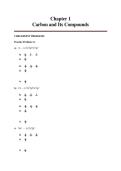
Chapter 1
Carbon and Its Compounds
CHECKPOINT PROBLEMS
Practice Problem 1.1
a) S — 1s22s22p63s23p4
b) Cl — 1s22s22p63s23p5
c) Na+ — 1s22s22p6
,Practice Problem 1.2
a) Count valence electrons.
Build a basic bonding framework and account for electrons used.
Add remaining electrons and check for formal charges.
The molecule has a lone pair on the nitrogen. All other electrons are bonding electrons.
b) Count valence electrons.
Build a basic bonding framework and account for electrons used.
1-2 Copyright © 2018 Nelson Education Limited
, Add remaining electrons and check for formal charges.
There are formal charges on the S and O atoms. They can be removed by making an
additional bond between O and S.
The molecule has a lone pair on the sulfur and two lone pairs on oxygen. All other electrons
are bonding electrons.
c) Count valence electrons.
CH3CH2CN (nitrogen is connected to one carbon only)
3 carbons (group 4) 3 X 4 = 12
5 hydrogens (group 1) 5X1= 5
1 nitrogen (group 5) 1X5= 5
22 valence e-
Build a basic bonding framework and account for electrons used.
H H 8 bonds = 16 bonding e -
H C C C N
22 valence e - – 16 bonding e - = 6 non-bonded e -
H H
Copyright © 2018 Nelson Education Limited 1-3
, Add remaining electrons and check for formal charges.
The formal charges on C and N show the carbon needs more electrons and the N has too
many. Forming two more bonds between C and N alleviates this problem.
The molecule has a lone pair on the nitrogen. All other electrons are bonding electrons.
d) Count valence electrons.
Build a basic bonding framework and account for electrons used.
Add remaining electrons and check for formal charges.
The oxygen atom has three lone pairs and a positive charge. All other electrons are bonding
electrons.
1-4 Copyright © 2018 Nelson Education Limited
Carbon and Its Compounds
CHECKPOINT PROBLEMS
Practice Problem 1.1
a) S — 1s22s22p63s23p4
b) Cl — 1s22s22p63s23p5
c) Na+ — 1s22s22p6
,Practice Problem 1.2
a) Count valence electrons.
Build a basic bonding framework and account for electrons used.
Add remaining electrons and check for formal charges.
The molecule has a lone pair on the nitrogen. All other electrons are bonding electrons.
b) Count valence electrons.
Build a basic bonding framework and account for electrons used.
1-2 Copyright © 2018 Nelson Education Limited
, Add remaining electrons and check for formal charges.
There are formal charges on the S and O atoms. They can be removed by making an
additional bond between O and S.
The molecule has a lone pair on the sulfur and two lone pairs on oxygen. All other electrons
are bonding electrons.
c) Count valence electrons.
CH3CH2CN (nitrogen is connected to one carbon only)
3 carbons (group 4) 3 X 4 = 12
5 hydrogens (group 1) 5X1= 5
1 nitrogen (group 5) 1X5= 5
22 valence e-
Build a basic bonding framework and account for electrons used.
H H 8 bonds = 16 bonding e -
H C C C N
22 valence e - – 16 bonding e - = 6 non-bonded e -
H H
Copyright © 2018 Nelson Education Limited 1-3
, Add remaining electrons and check for formal charges.
The formal charges on C and N show the carbon needs more electrons and the N has too
many. Forming two more bonds between C and N alleviates this problem.
The molecule has a lone pair on the nitrogen. All other electrons are bonding electrons.
d) Count valence electrons.
Build a basic bonding framework and account for electrons used.
Add remaining electrons and check for formal charges.
The oxygen atom has three lone pairs and a positive charge. All other electrons are bonding
electrons.
1-4 Copyright © 2018 Nelson Education Limited