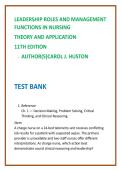
LEADERSHIP ROLES AND MANAGEMENT
FUNCTIONS IN NURSING
THEORY AND APPLICATION
11TH EDITION
• AUTHOR(S)CAROL J. HUSTON
TEST BANK
Reference: Ch. 1 — Decision Making, Problem Solving, Critical
Thinking, and Clinical Reasoning — Defining Objectives
Stem: A nurse manager must decide whether to change the
unit’s hourly rounding process to reduce falls. Before choosing a
solution, which step best reflects effective problem solving?
A. Immediately implement hourly rounding on all shifts.
B. Define clear, measurable objectives for the change initiative.
C. Ask staff to vote for their preferred approach.
D. Pilot the change only on day shift when staffing is strongest.
Correct answer: B
,Rationale — Correct: Defining clear, measurable objectives
focuses the team, allows evaluation, and aligns actions with
desired outcomes. It follows Huston’s emphasis on clarifying
objectives before action.
Rationale — A: Acting immediately risks addressing the wrong
problem and bypasses data collection.
Rationale — C: Staff input is useful but voting may not align
with evidence or objectives.
Rationale — D: Piloting is wise later, but without defined
objectives the pilot lacks evaluation criteria.
Teaching point: Start with clear, measurable objectives before
selecting solutions.
Citation: Huston, C. J. (2024). Leadership Roles and
Management Functions in Nursing (11th ed.). Ch. 1.
2.
Reference: Ch. 1 — Decision Making — Gathering Data Carefully
Stem: A charge nurse notices a cluster of medication delays
overnight. Which first action best demonstrates gathering data
carefully?
A. Immediately reprimand night staff for lateness in medication
administration.
B. Review medication administration records, staffing levels,
and incident reports from the past month.
C. Ask the day-shift nurse manager to solve the problem.
D. Switch all high-risk meds to scheduled administration times.
,Correct answer: B
Rationale — Correct: Systematic review of records and staffing
data gathers relevant evidence to identify patterns and root
causes. Huston emphasizes data collection before decisions.
Rationale — A: Reprimand assumes cause and may harm staff
morale without evidence.
Rationale — C: Defers responsibility and delays local problem
solving.
Rationale — D: Changing practice without data may create
unintended consequences.
Teaching point: Collect objective data from multiple sources
before action.
Citation: Huston, C. J. (2024). Leadership Roles and
Management Functions in Nursing (11th ed.). Ch. 1.
3.
Reference: Ch. 1 — Decision Making — Taking the Time
Necessary
Stem: During a staffing crisis, a nurse manager must choose a
temporary staffing model. Which approach best reflects “taking
the time necessary” in urgent but important decisions?
A. Pause all decisions until a full committee meets in two
weeks.
B. Use a rapid evidence review and a short trial with built-in
review points.
C. Implement a permanent staffing algorithm without
, evaluation.
D. Choose the option that requires the least discussion.
Correct answer: B
Rationale — Correct: A rapid review plus time-limited trial
balances urgency with evidence and allows iterative
evaluation—aligned with Huston’s guidance to take appropriate
time.
Rationale — A: Waiting two weeks may be unsafe in a crisis.
Rationale — C: Permanent changes without evaluation risk
harm.
Rationale — D: Choosing minimal-discussion options ignores
quality and stakeholder input.
Teaching point: Use rapid trials and review cycles for urgent
decisions.
Citation: Huston, C. J. (2024). Leadership Roles and
Management Functions in Nursing (11th ed.). Ch. 1.
4.
Reference: Ch. 1 — Decision Making — Use an Evidence-Based
Approach
Stem: A unit is trialing bedside shift report to improve
communication. Which decision best follows an evidence-based
approach?
A. Implement bedside report because it is trendy.
B. Review literature, benchmark similar units, and measure
handoff errors before and after.
FUNCTIONS IN NURSING
THEORY AND APPLICATION
11TH EDITION
• AUTHOR(S)CAROL J. HUSTON
TEST BANK
Reference: Ch. 1 — Decision Making, Problem Solving, Critical
Thinking, and Clinical Reasoning — Defining Objectives
Stem: A nurse manager must decide whether to change the
unit’s hourly rounding process to reduce falls. Before choosing a
solution, which step best reflects effective problem solving?
A. Immediately implement hourly rounding on all shifts.
B. Define clear, measurable objectives for the change initiative.
C. Ask staff to vote for their preferred approach.
D. Pilot the change only on day shift when staffing is strongest.
Correct answer: B
,Rationale — Correct: Defining clear, measurable objectives
focuses the team, allows evaluation, and aligns actions with
desired outcomes. It follows Huston’s emphasis on clarifying
objectives before action.
Rationale — A: Acting immediately risks addressing the wrong
problem and bypasses data collection.
Rationale — C: Staff input is useful but voting may not align
with evidence or objectives.
Rationale — D: Piloting is wise later, but without defined
objectives the pilot lacks evaluation criteria.
Teaching point: Start with clear, measurable objectives before
selecting solutions.
Citation: Huston, C. J. (2024). Leadership Roles and
Management Functions in Nursing (11th ed.). Ch. 1.
2.
Reference: Ch. 1 — Decision Making — Gathering Data Carefully
Stem: A charge nurse notices a cluster of medication delays
overnight. Which first action best demonstrates gathering data
carefully?
A. Immediately reprimand night staff for lateness in medication
administration.
B. Review medication administration records, staffing levels,
and incident reports from the past month.
C. Ask the day-shift nurse manager to solve the problem.
D. Switch all high-risk meds to scheduled administration times.
,Correct answer: B
Rationale — Correct: Systematic review of records and staffing
data gathers relevant evidence to identify patterns and root
causes. Huston emphasizes data collection before decisions.
Rationale — A: Reprimand assumes cause and may harm staff
morale without evidence.
Rationale — C: Defers responsibility and delays local problem
solving.
Rationale — D: Changing practice without data may create
unintended consequences.
Teaching point: Collect objective data from multiple sources
before action.
Citation: Huston, C. J. (2024). Leadership Roles and
Management Functions in Nursing (11th ed.). Ch. 1.
3.
Reference: Ch. 1 — Decision Making — Taking the Time
Necessary
Stem: During a staffing crisis, a nurse manager must choose a
temporary staffing model. Which approach best reflects “taking
the time necessary” in urgent but important decisions?
A. Pause all decisions until a full committee meets in two
weeks.
B. Use a rapid evidence review and a short trial with built-in
review points.
C. Implement a permanent staffing algorithm without
, evaluation.
D. Choose the option that requires the least discussion.
Correct answer: B
Rationale — Correct: A rapid review plus time-limited trial
balances urgency with evidence and allows iterative
evaluation—aligned with Huston’s guidance to take appropriate
time.
Rationale — A: Waiting two weeks may be unsafe in a crisis.
Rationale — C: Permanent changes without evaluation risk
harm.
Rationale — D: Choosing minimal-discussion options ignores
quality and stakeholder input.
Teaching point: Use rapid trials and review cycles for urgent
decisions.
Citation: Huston, C. J. (2024). Leadership Roles and
Management Functions in Nursing (11th ed.). Ch. 1.
4.
Reference: Ch. 1 — Decision Making — Use an Evidence-Based
Approach
Stem: A unit is trialing bedside shift report to improve
communication. Which decision best follows an evidence-based
approach?
A. Implement bedside report because it is trendy.
B. Review literature, benchmark similar units, and measure
handoff errors before and after.