NRSG 1640: Piya Jordan Bowel Obstruction VCE. Questions & Answers.
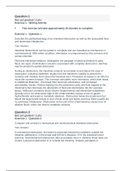
Question 1 Not yet graded / 1 pts Exercise 1 - Writing Activity This exercise will take approximately 20 minutes to complete. Exercise 1 - Question 1 Describe the pathophysiology of an intestinal obstruction as well as the associated fluid and electrolyte imbalances. Your Answer: Intestinal obstructions can be partial or complete and are classified as mechanical or nonmechanical. With either condition, elimination is compromised by this common and serious disorder. Fluid and electrolyte balance. Obstipation (no passage of stool) and failure to pass flatus are signs of elimination concerns associated with complete obstruction; diarrhea may be present in partial obstruction During an obstruction, the intestinal contents accumulate at and above the area of obstruction. Intestinal distention results from the intestine’s inability to absorb the contents and mobilize them down the intestinal tract. Peristalsis increases in an effort to move the contents forward. This increase stimulates more secretions, which then leads to additional distention. The bowel then becomes edematous, and increased permeability results. Plasma leaking into the peritoneal cavity and fluid trapped in the intestinal lumen decrease the absorption of fluid and electrolytes into the vascular space. Reduced circulatory blood volume (hypovolemia) and electrolyte imbalances typically occur. An obstruction high in the small intestine causes a loss of gastric hydrochloride and leads to metabolic alkalosis. Obstruction below the duodenum but above the large bowel results in loss of both acids and bases and thus there usually are no acid-base imbalances. Obstruction at the end of the small intestine causes loss of alkaline fluids, which can lead to metabolic acidosis. Question 2 Not yet graded / 1 pts Exercise 1 - Question 2 Compare and contrast a mechanical and nonmechanical intestinal obstruction. Your Answer: In mechanical obstruction, the bowel is physically blocked by problems outside the intestine (adhesions), in the bowel wall (Chron's disease), or in the intestinal lumen (tumors). Nonmechanical obstruction (aka as paralytic ileus or dynamic ileus) does not involve a physical obstruction in or outside the intestine. Instead, peristalsis is
Written for
- Institution
-
Concorde Career Colleges
- Course
-
NRSG 1640
Document information
- Uploaded on
- March 18, 2021
- Number of pages
- 18
- Written in
- 2020/2021
- Type
- Exam (elaborations)
- Contains
- Questions & answers
Subjects
-
nrsg 1640 nrsg1640
-
nrsg 1640 piya jordan bowel obstruction vce
-
exercise 1 question 1 describe the pathophysiology of an intestinal obstruction as well as the associated fluid and electrolyte imba

Also available in package deal